Category: Ahl al-Bayt

The Family of the Prophet (s)

  • Sayyida Zaynab Bint Fāṭimah’s (ع) Courageous Stand

    Sayyida Zaynab Bint Fāṭimah’s (ع) Courageous Stand

    Excerpt from The Sands of Karbala, by Imam al-Tabari

    When he entered with the head of Ḥusayn, his children, his sisters, and his women to ʿUbayd Allāh ibn Ziyād, Zaynab, the daughter of Fāṭimah (ع), wore her worst clothes and disguised herself, surrounded by her maidservants. When she entered, she sat down. ʿUbayd Allāh ibn Ziyād said: “Who is the woman that is sitting?” She did not speak to him. He said that three times, and each time she did not speak to him. One of her maidservants said: “This is Zaynab, the daughter of Fāṭimah.” ʿUbayd Allāh said to her: “Praise be to Allah who exposed you, killed you, and proved your story false!” She said: “Praise be to Allah who honored us with Muḥammad, peace be upon him, and purified us with a thorough purification, not as you say. Only the wicked are exposed, and the liar is proven false.” He said: “How did you find Allah’s treatment of your family?” She said: “He decreed death for them, and they went out to their resting places, and Allah will gather you and them, and you will argue with Him, and dispute before Him.” Ibn Ziyād became angry and furious. ʿAmr ibn Ḥurayth said to him: “May Allah rectify the governor! She is only a woman, and is a woman held accountable for her words? She is not held accountable for her speech, nor blamed for her mistakes.”

    Sayyida Zaynab bint Fāṭimah’ saves ʿAlī ibn al-Ḥusayn

    Abū Mikhnaf, from al-Mujālid ibn Saʿīd, said: When ʿUbayd Allāh ibn Ziyād looked at ʿAlī ibn al-Ḥusayn, he said to a guard: “See if he has reached the age of men.” He uncovered his garment and said: “Yes.” He said: “Take him and strike his neck.” ʿAlī said to him: “If there is kinship between you and these women, send a man with them to protect them.” Ibn Ziyād said to him: “Go!,” and he sent ʿAlī ibn al-Ḥusayn with them.

    Abū Mikhnaf related: As for Sulaymān ibn Abī Rāshid, he told me from Ḥumayd ibn Muslim who said:

    I was standing by Ibn Ziyād when ʿAlī ibn al-Ḥusayn was presented to him.  He said to him: “What is your name?” He said: “I am ʿAlī ibn al-Ḥusayn.” He said: “Did Allah not kill ʿAlī ibn al-Ḥusayn?” He remained silent. Ibn Ziyād said to him: “Why do you not speak?” He said: “I had a brother also named ʿAlī, and the people killed him.” He said: “Allah has killed him.”
    He remained silent. Ibn Ziyād said to him: “Why do you not speak?”
    He said: “Allah takes the souls at the time of their death, and no soul can die except by Allah’s permission.” He said: “By Allah, you are one of them. Woe to you! See if he has reached maturity. By Allah, I think he is a man.”
    Marī ibn Muʿādh al-Aḥmarī uncovered him and said: “Yes, he has reached maturity.” He said: “Kill him.”

    ʿAlī ibn al-Ḥusayn said: “Who will take care of these women?” Zaynab, his aunt, clung to him and said: “O son of Ziyād, enough of us! Have you not had enough of our blood? Have you left anyone of us?”
    She embraced him and said: “I ask you by Allah, if you are a believer, if you kill him, then kill me with him!”

    ʿAlī called out to him and said: “O son of Ziyād, if there is kinship between you and them, send a pious man with them to accompany them with the companionship of Islam.”

    He looked at her for a while, then looked at the people and said: “How amazing is kinship! By Allah, I think she wishes that if I killed him, I would kill her with him. Leave the boy, go with your women.”

    Yazīd ibn Muʿāwiyah’s Treatment of the Captive Womenfolk of al-Ḥusayn

    Then Yazīd ibn Muʿāwiyah called for the women and children and seated them before him. He saw their poor condition and said: “May Allah curse Ibn Marjānah! If there had been any kinship or relationship between him and you, he would not have done this to you, nor sent you like this.”

    Abū Mikhnaf related, from al-Ḥārith ibn Kaʿb, from Fāṭimah bint ʿAlī who said: When we were seated before Yazīd ibn Muʿāwiyah, he showed us compassion, ordered something for us, and treated us kindly. Then a red-faced man from al-Shām stood up and said to Yazīd: “O Commander of the Faithful, give me this one” – meaning me, and I was a beautiful girl. I trembled and was frightened, thinking that it was permissible for them. I took hold of my sister Zaynab’s clothes. She said: “My sister Zaynab was older and wiser than me, and she knew that it was not permissible.” She said: “You have lied, by Allah, and you have been disgraceful! That is not for you or him.”

    Yazīd became angry and said: “You have lied, by Allah, that is for me, and if I wanted to do it, I would have done it.” She said: “No, by Allah, Allah has not made that permissible for you unless you leave our religion and follow a different religion.” Yazīd became even angrier and said: “Do you address me like this! It was your father and your brother who left the religion.” Zaynab said: “By the religion of Allah, the religion of my father, the religion of my brother, and the religion of my grandfather, you and your father and your grandfather were guided.” He said: “You have lied, O enemy of Allah.” She said: “You are a tyrant ruler, you insult unjustly, and you oppress with your authority.” By Allah, it was as if he was ashamed and fell silent.

    Then the man from al-Shām returned and said: “O Commander of the Faithful, give me this girl.” Yazīd said: “Go away, may Allah grant you a decisive death!” Then Yazīd ibn Muʿāwiyah said: “O Nuʿmān ibn Bashīr, prepare them with what they need, and send with them a trustworthy and righteous man from the people of al-Shām, and send with him horses and helpers to take them to al-Madīnah.”

    Then he ordered the women to be housed in a separate house, with what they needed, and their brother ʿAlī ibn al-Ḥusayn with them in the house they were in. They left until they entered the house of Yazīd, and no woman from the family of Muʿāwiyah remained except that she met them, crying and mourning for al-Ḥusayn. They mourned for him for three days. 

    BIO OF SAYYIDA ZAYNAB BIN FATIMAH

  • Ahl al-Bayt’s Status Before Allah (ﷻ)

    Ahl al-Bayt’s Status Before Allah (ﷻ)

    Allāh said in regard to the family of the Prophet ﷺ:

    قُل لا أَسْأَلُكُمْ عَلَيْهِ أَجْراً إِلا الْمَوَدَّةَ فِي الْقُرْبَى

    Say: I do not ask of you any reward for it but love for my near relatives;
    (ash-Shūrā 42:23)

    This shows the two sides of love of the Prophet ﷺ―on the one hand love for his family, and on the other hand love for the Ummah, in particular the sincere, guided and perfected ones who hold fast to the Sunnah.
    In respect of the first love, the the Prophet ﷺ said, “I have left among you two matters by holding fast to which, you shall never be misguided: Allāh’s Book and the Sunnah of His Prophet.” Another version adds: “And these two shall never part ways until they show up at the Pond.”

    ‏حدثنا ‏ابن نمير ‏حدثنا ‏عبد الملك بن أبي سليمان ‏عن ‏عطية العوفي ‏عن ‏أبي سعيد الخدري ‏قال
    ‏قال رسول الله ‏صلى الله عليه وسلم ‏إني قد تركت فيكم ما إن أخذتم به لن تضلوا بعدي ‏الثقلين ‏أحدهما أكبر من الآخر كتاب الله حبل ممدود من السماء إلى الأرض ‏وعترتي ‏أهل بيتي ألا وإنهما لن يفترقا حتى يردا علي الحوض

    Other versions state:
    I am leaving among you that which if you hold to it, you shall never go astray, one of them greater than the other: Allāh’s Book―a rope extended down from the heaven to the earth―and my mantle (‘itra), the People of my House. These two shall never part ways until they come to me at the Pond. Look well to how you act with them after me.
    The five mentioned here are known as Ahl al-‘abā’a, for Jibrīl covered them with the cloak (‘abā’a) of the Prophet ﷺ, and they were given importance as Ahl al-Bayt in two incidents mentioned in the Qur’ān:
    It is established that when the verse of mutual invocation of curses (mubāhala) was revealed:

    فَمَنْ حَآجَّكَ فِيهِ مِن بَعْدِ مَا جَاءكَ مِنَ الْعِلْمِ فَقُلْ تَعَالَوْاْ نَدْعُ أَبْنَاءنَا وَأَبْنَاءكُمْ وَنِسَاءنَا وَنِسَاءكُمْ وَأَنفُسَنَا وأَنفُسَكُمْ ثُمَّ نَبْتَهِلْ فَنَجْعَل لَّعْنَةَ اللّهِ عَلَى الْكَاذِبِينَ

    And whoso disputeth with thee concerning him, after the knowledge which hath come unto thee, say (unto him): Come! We will summon our sons and your sons, and our women and your women, and ourselves and yourselves, then we will pray humbly (to our Lord) and (solemnly) invoke the curse of Allah upon those who lie. (Āl-‘Imrān 3:61),
    the Prophet ﷺ summoned ‘Alī, Fātima, al-Hasan, and al-Husayn, and said: “O Allāh! These are my Family” (Allāhumā hā’ūlā’i Ahlī).

    ‏حدثنا ‏قتيبة بن سعيد ‏حدثنا ‏حاتم بن إسماعيل ‏عن ‏بكير بن مسمار ‏عن ‏عامر بن سعد ‏عن ‏أبيه ‏قال
    ‏سمعت رسول الله ‏صلى الله عليه وسلم ‏يقول له وخلفه في بعض مغازيه فقال ‏‏ علي ‏أتخلفني مع النساء والصبيان قال يا ‏‏ علي ‏أما ‏ترضى أن تكون مني بمنزلة ‏هارون ‏من ‏موسى ‏إلا أنه لا نبوة بعدي وسمعته يقول يوم ‏خيبر ‏لأعطين ‏الراية ‏رجلا يحب الله ورسوله ويحبه الله ورسوله ‏فتطاولنا ‏لها فقال ادعوا لي ‏‏ عليا ‏فأتي به ‏أرمد ‏فبصق في عينه ودفع الراية إليه ففتح الله عليه ولما نزلت هذه الآية
    نَدْعُ أَبْنَاءنَا وَأَبْنَاءكُمْ ‏‏دعا رسول الله ‏صلى الله عليه وسلم عليا ‏‏ وفاطمة ‏‏ وحسنا ‏‏ وحسينا ‏فقال اللهم هؤلاء أهلي (مسند أحمد)

    ‘Amir bin Sa‘d bin Abī Waqqās reported on the authority of his father that Mu‘awīya bin Abī Sufyān appointed Sa‘d as the governor and said: “What prevents you from abusing Abū Turāb ( ‘Alī)?” At this he said: “It is because of three things which I remember Allah’s Messenger ﷺ having said about him that I would not abuse him and even if I find one of those three things for me, it would be more dear to me than the red camels. …(The third occasion is) when the (following) verse was revealed: Let us summon our children and your children. Allāh’s Messenger ﷺ called ‘Alī, Fātima, Hasan and Husain and said: ‘O Allāh, they are my family.’”

    He repeated this act when the verse of the cleansing of the People of the House was revealed:

    إِنَّمَا يُرِيدُ اللَّهُ لِيُذْهِبَ عَنكُمُ الرِّجْسَ أَهْلَ الْبَيْتِ وَيُطَهِّرَكُمْ تَطْهِيراً

    Allah only desires to keep away the uncleanness from you, O people of the House! and to purify you a (thorough) purifying, (al-Ahzāb 33:33)
    as mentioned in the following hadith:

    قَالَ اِبْن جَرِير حَدَّثَنَا اِبْن الْمُثَنَّى حَدَّثَنَا بَكْر بْن يَحْيَى بْن أَبَانَ الْعَنَزِيّ حَدَّثَنَا مَنْدَل عَنْ الأعْمَش عَنْ عَطِيَّة عَنْ أَبِي سَعِيد رَضِيَ اللَّه عَنْهُ قَالَ قَالَ رَسُول اللَّه صَلَّى اللَّه عَلَيْهِ وَسَلَّمَ نَزَلَتْ هَذِهِ الآيَة فِي خَمْسَة : فِيَّ وَفِي عَلِيّ وَحَسَن وَحُسَيْن وَفَاطِمَة “ إِنَّمَا يُرِيد اللَّه لِيُذْهِب عَنْكُمْ الرِّجْس أَهْل الْبَيْت وَيُطَهِّركُمْ تَطْهِيرًا قَدْ تَقَدَّمَ أَنَّ فُضَيْل بْن مَرْزُوق رَوَاهُ عَنْ عَطِيَّة عَنْ أَبِي سَعِيد عَنْ أُمّ سَلَمَة رَضِيَ اللَّه عَنْهَا كَمَا تَقَدَّمَ وَرَوَى اِبْن أَبِي حَاتِم مِنْ حَدِيث هَارُون بْن سَعْد الْعِجْلِيّ عَنْ عَطِيَّة عَنْ أَبِي سَعِيد رَضِيَ اللَّه عَنْهُ مَوْقُوفًا وَاَللَّه سُبْحَانه وَتَعَالَى أَعْلَم”

    Abī Sa‘īd (ر) related that the Prophet ﷺ said:
    This verse was revealed regarding five: regarding myself; regarding ‘Alī and Hassan and Husayn and Fātima, “Allāh only desires to keep away the uncleanness from you, O people of the House! and to purify you a (thorough) purifying.”
    Lexically, the term ‘itra was defined as “A man’s relatives such as his children, grandchildren, and paternal cousins” while in the context of the present hadiths it was explained to mean “Those of the Prophet’s Family who follow his Religion and cling to his commands.” What emerges from these meanings together with the two wordings of the hadith “I have left among you two matters” is firm evidence that there is an inseparable connection, until the Last Day, between the Qur’ān, the Sunnah, and the Family of the Prophet ﷺ.
    Know that the light of the Prophet ﷺ is in you, for Allāh said:

    وَاعْلَمُوا أَنَّ فِيكُمْ رَسُولَ اللَّهِ

    …And know that Allah’s Messenger is within you; (al-Hujurāt, 49:7)

    Through this verse, and the preceding narrations, we must know that Prophet Muhammad ﷺ was informing us that his light is within every believer; with a particular emphasis on the qualities of perfect character exemplified by Sayyidinā Abū Bakr ر and Sayyidinā ‘Umar ر, while those related to the Prophet ﷺ through blood, have the specialty of being from his family, whom Allāh favored in a tremendous way―particularly the descendants of Ahl al-abā’a, the children of Sayyidinā ‘Alī ر and Sayyida Fātima ر. And all will come together with the Prophet ﷺ on the Day of Judgment, meeting at his Pond.

  • Sayyida Zainab bint Sayyidina `Ali (ر)

    Sayyida Zainab bint Sayyidina `Ali (ر)

    This is the tomb of the sister of the two moons

    The daughter of the imam and honorable parents

    She is the daughter of al-Zahra’, the daughter of Ahmed (ر)

    The light of existence and the Master of the two genus’

    Of honorable lineage is the eloquent Zaynab (ع)

    The morning sun and the daughter of the two worlds

    Sayyida Zaynab (ع) is well known: her maternal grandfather is our master Muhammadﷺ and her maternal grandmother is Lady Khadija bint Khuwailid (ع), the first of the Mothers of the Believers. Her mother is Fatima al-Zahra’ (ع) and her father is Imam Ali ibn Abu Talib (ع). Her brothers are our masters al-Hasan (ع) and al-Husayn (ع), the grandsons of the Messenger of Allah ﷺ.

    Lady Zaynab (ع)  was born in al-Medina al-Munawara, on 5 Jumada al Awwal, 5 AH (October 2) 626 CE. Just like Hassan (ع) and Hussain(ع), she was also named by Prophet Muhammad (ﷺ). The Prophet ﷺ, her grandfather, blessed her and named her Zaynab (ع). Sayyidina `Ali’s (ع) three daughters were named “Zainab” so, she was called “Zainab the Elder”. Her mother, Lady Fatima (ع), passed away six months after the Prophet’s ﷺ death at which time she was just 7 years old. Thus she became a substitute mother to her brothers, al-Hasan and al-Husayn. 

    When she approached the age of marriage, her father chose her paternal cousin, Abdullah ibn Ja’far (ع), as a husband for her. After his father’s death in the battle of Mu’ta the Prophet ﷺ told Abdullah, “Allah has replaced your father’s arms with a pair of wings with which he flies in Paradise however he wishes.”

    All reports are unanimous that Abdullah was highly regarded by his contemporaries from among Banu Hashim and Banu Umayya alike. He was known for his graciousness, generosity, tolerance and nobility of character to the extent that he was nicknamed “the leader of generosity”.

    In spite of all the written material on the life of this exceptional woman, all accounts fail to describe her during that period of her life when she was veiled and married to Ja’far; she was almost never seen except from behind a screen. It was the tragedy of Karbala’ that forced her to emerge in public [without a face cover]. Abdullah ibn Ayub al-Ansari (ر) described her saying, “By Allah! I have never seen such a face which is like a piece of the moon.” In his book al-Bayan wal Tabyeen, al-Jahez wrote, “Her character reflected her mother’s geniality and compassion and her father’s knowledge and piety. She held copious knowledge sessions for women who wished to learn about matters of religion. The community’s leading scholar, Abdullah ibn Abbas (ر), reported hadiths (Prophetic traditions) from her, which she had heard from her father Ali (ر), her mother Fatima, and her brothers al-Hasan and al-Husayn. Abdullah ibn Abbas would predicate the hadiths he heard from her with the words, “Our erudite, Zaynab (ع) the daughter of Ali (ع), told me such-and-such …” And he would then relate the hadiths. She did indeed live up to her nickname, the erudite of Banu Hashim.

    Lady Zaynab (ع) bore her husband Abdullah ibn Ja’far three sons: Ja’far (ع), Ali (ع), and Awn (ع) the senior and two girls, Umm Kulthoum (ع) and Umm Abdullah (ع). Her various nicknames included Jabal As-Sabr (mountain of patience) because her father Ali (ع) was martyred in 40 AH; she buried her brother al-Hasan next to her mother in al-Baqi`ee in 49 AH; and witnessed al-Husayn’s death in Karbala’.

    After the martyrdom of the family in the Battle of Karbala, She (ع) was the one who supported the other family members. She (ع) and her family members have marched all around Syria. Traditions state that at the time she (ع) was suffering from severe mental and physical pain after seeing her brother Hussain (ع) die.

    History books written by Arabs and orientalists all agree that Zaynab (ع) was the first woman in Islam destined to play an important role in politics. In Islamic and human history, her name became associated with the tragedy of Karbala’.

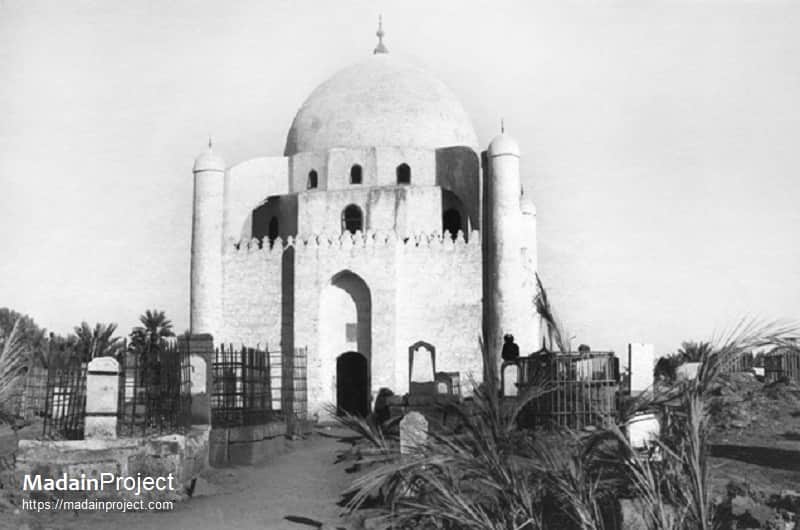
    Sayyida Zainab bint Ali, Cairo

    Sayyida Zainab bint `Ali’s shrine in Cairo.

    Umm Hashem, Lady Zaynab (ع), wished to spend the rest of her life [in Medina] to be near her grandfather, the Messenger of Allah . However, Banu Umayya denied her this wish as her presence in al-Medina was enough to incite the people to avenge her brother, al-Husayn (ع). So the governor of al-Medina asked her to leave the city and reside wherever she wishes and she chose to live in Egypt. Lady Zaynab (ع) was indeed a Divine gift and a flowing stream of the light and abundant good from the Prophet to the people of Egypt.

    Lady Zaynab (ع), may Allah be pleased with her, arrived in Egypt in the month of Sha’ban 61 AH. Maslama ibn Mukhlad al-Ansary, the governor of Egypt, and the Muslims welcomed her at the outskirts of Egypt until they reached Fustat (Cairo). Maslama accompanied her to his house where she stayed for almost a year. All of the members of the governor’s household sought her counsel and advice and it was due to this that she came to be called Sahibat al-Shura (the one from whom counsel is sought). When Lady Zaynab (ع) came to Egypt, the governor and his men would gather in her house for scholarly sessions under her leadership. Consequently, she was called, ‘the best of Banu Hashem’. Her house was a shelter to the weak, the ill, and the needy and so she was called, ‘the mother of the destitute’. She was firm and resolute so much so that she was called by the resolute, ‘the mother of the resolute’. She was greatly devoted to Allah during her lifetime and after her death was sought out for intercession and blessings. For this reason, her names, titles, and nicknames are considered symbols of spiritual and metaphysical significance.

    She was said to have had an eloquent tongue. On the merit of relying on Allah, she said:

    Many have slept and many have awoken,

    Thinking about matters that may or may not come to pass.

    There is a God that has satisfied you yesterday,

    And Who will satisfy you tomorrow.

    So keep worry away from you,

    For carrying worries is madness.

    Sayyida Zainab bint Ali, Cairo

    Sayyida Zainab bint `Ali’s shrine in Cairo.

    On her complete submission to death, she said:

    Matters are not in my hands, nor are the disposal of affairs,

    I do not have control over the things that are I surmise,

    For I have a Creator Who is my provider; He does whatever He wills,

    His knowledge of me preceded my creation.


    Sayyida Zaynab (ع) died on 15th Rajab 62 AH when she was just 57 years old. Today there are two shrines, one in Cairo and the other in Damascus, where she (ع) is said to be buried.

       اللهم صلى و سلّم على النبي الامي و على أله و صحبه


    Source Mazarat Misr.

  • About Marriage to Ahl al-Bayt

    Al-Tabarani and al-Hakim narrated it from `Abd Allah b. Abi Awfa. Al-Shirazi also narrated in al-Alqab from Ibn `Abbas that the Messenger of Allah – upon him blessings and peace – said, “I asked my Lord that I not marry off but to people of Paradise and that I not marry into other than people of Paradise.” Ahmad and al-Hakim narrated from al-Miswar that the Prophet said: “Fatima is a piece of my flesh, whatever distresses her distresses me and whatever delights her delights me. Verily lineages will all be cut off on the Day of Resurrection except my lineage and my line and relationships to me.” This report is fully documented in the chapter on Abu Ya`la’s Musnad.

    Munawi said in Fayd al-Qadir: “It appears that this [privilege] includes whoever marries or gets married off among his descendants; this means great tidings for whoever becomes related through marriage to a Sharif or a Sharifa.”

    The fact that Ahl al-Bayt spouses and in-laws are all bound for bliss is clarified by what Ibn `Asakir narrated in al-Arba`in fi manaqib Ummahat al-mu’minin, Hadith 37, from ‘Sayyidina `Ali (r) that the Prophet – upon him blessings and peace – said: “None that marries into me or that I marry into enters Hellfire.” He added, “This is a fair hadith from the Commander of the believers Abu al-Hasan `Ali b. Abi Talib – may Allah ennoble his countenance – and in this hadith there is evidence for the virtue of his brothers and sons-in-law, and this is a testimony that they are in Paradise as long as they are believers, and Allah knows best.”

    Al-Harith also narrated from Muhammad b. al-Hanafiyya – in mursal mode – as did Abu Ya`la, Ibn Abi al-Dunya and Ibn `Asakir from Abu Hurayra that al-Hasan and al-Husayn wrestled in the presence of the Messenger of Allah – upon him blessings and peace – and the latter was saying, “Go, Hasan!” whereupon Fatima said: “Messenger of Allah, it seems he is more beloved to you than al-Husayn?” He replied, “Jibril is helping al-Husayn, and I love to help al-Hasan.”

    [Excerpted from Musnad Ahl al-Bayt]

  • Ummahaatul-Mu’mineen (Mothers of the Faithful) and Children of the Prophet Muhammad (s)

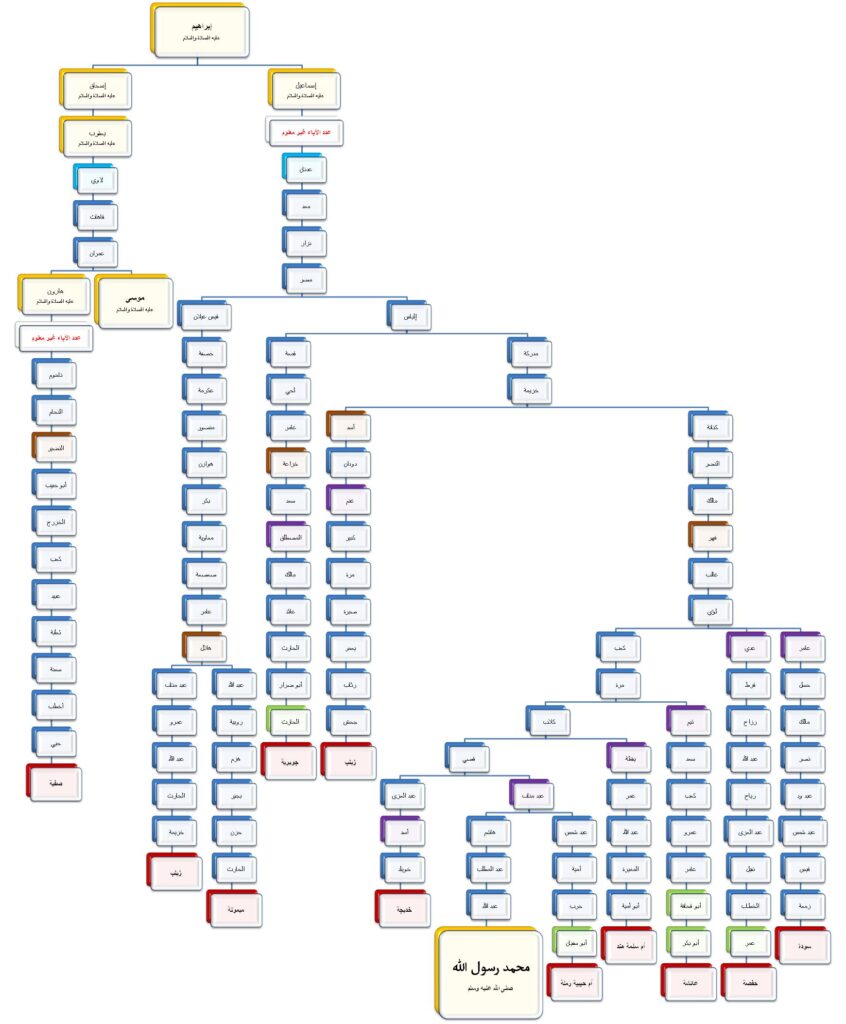
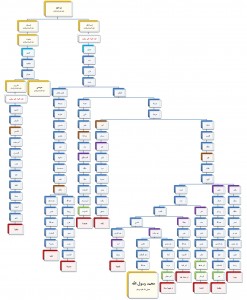
    شجرة نسب أمهات المؤمنين وإلتقاءه بنسب رسول الله صلى الله عليه وسلم
    Genealogical tree of the Prophet (s) showing his family relationships with his wives, the Mothers of the Believers

    A BRIEF SKETCH OF THE LIVES OF THE WIVES OF SAYYIDUNA RASULULLAH (S).  


    A. Sayyida KHADIJAH (r)  

    This noble lady belonged to the Quraish tribe. She is also known as “Khatijatul Kubra” or “Khadijah the Great.”  Sayyiduna Rasulullah (s) married her when he was 25 years old and she was 40 years old. She was a very devoted wife, companion and counselor, ever ready to stand by Sayyiduna Rasulullah (s) in all trials and tribulations. She proved to be an immense support and help to the Cause of Islam. She passed away at the age of 65 years on the 11th of Ramadaan – 10 years after the first revelation. Sayyiduna Rasulullah (s) has said about her: “The noblest women of the world are Sayyida Mariam (alaiha as-salaam) and Sayyida Khadijah (r).” (Bukhari Shareef)  

    B. Sayyida SA’UDA (r) 

    Sayyida Sa’uda (r) was a widow and the daughter of Sayyida Zama (r). She married Sayyiduna Rasulullah (s) after Sayyida Khadijah (r) had passed away. Sayyiduna Rasulullah (sallal laahu alaihi wasallam) was then 55 years old.  She was generous, affectionate and kind. The reason for his marriage was that he needed someone to care for his children so that he could concentrate on the heavy responsibilities of Prophethood. Sayyida Aisha Siddiqa (r) has said about her: “It is only Sa’uda, on seeing whom, I wish my soul lived in her body.” Sayyida Sa’uda (r) passed away in 55 A.H.  

    C. Sayyida AISHA SIDDIQA (r)  

    She was the daughter of Sayyiduna Abu Bakr (r) and was unmarried. In the 10th year of the mission, Sayyiduna Rasulullah (s) married her. Since she was very young at the time of her marriage, she only began to live with him in Madinatul Munawwarah in 2 A.H. He married Sayyida Aisha Siddiqa (r) in order to strengthen the ties of friendship with Sayyiduna Abu Bakr (r), his closest friend and also so that she could teach other women.  Sayyida Aisha (r) led a very simple life without comfort and luxury. She dressed very simple. She served Sayyiduna Rasulullah (s) with utmost devotion and he loved her very much. She led a very pious life.  

    When Sayyiduna Rasulullah (s) passed away, she was 25 years old. Thereafter, she lived for another 48 years and saw the rule of all the four Khulafaa.  She is remembered for her intelligence, intuition, her knowledge of Hadith and principles of religion, secrets of Islamic knowledge, Arabic literature, piety and Islamic Fiqh. She became a great Madani (person of Madinatul Munawwarah) scholar and knew several thousand Ahadith by heart. Sayyiduna Rasulullah (s) himself used to teach her and answer her questions. She used to also teach other women. A great Scholar, Imam Zahri (r), has said about her: “Sayyida Aisha’s (r) knowledge will surpass the knowledge of all the males and Mothers of the Faithful put together.”  

    D. Sayyida HAFSA (r)  

    She was the daughter of Sayyiduna Umar (r) and was a widow. In 2 or 3 A.H. Sayyiduna Rasulullah (s) married her. He also gave his own daughter, Sayyida Umm Kulthum (r), in marriage to Sayyiduna ‘Uthman (r).  She was a very learned person and spent most of her time in reading and writing. Sayyiduna Rasulullah (s) had personally taught her with the result that she was an authority on Islamic knowledge. She was also given the original hand-written copy of the Holy Quran to keep. She was very pious and saintly. She passed away in the month of Shabaan 45 A.H.  

    E. Sayyida ZAYNAB (r)  

    She was the daughter of Khuzaimah. She was a widow and was poverty stricken. Moved by her piety and self-sacrifice, Sayyiduna Rasulullah (s) married her in 3 A.H. Sayyida Zaynab (r) was a very kind-hearted lady and ever ready to help the poor and destitute. She would spend all her income on charity and was called “Ummul Masaakin” or “Mother of the Poor.” She passed away within three months of her marriage and was buried in Jannatul Baqi.  

    F. Sayyida UMME SALMAH (r)  

    She was the daughter of Abu Ummayyah Sohail. When her husband passed away she was left with four children and had no means of maintenance. Sayyiduna Rasulullah (s), now 57 years old, married her in the month of Shawwal in 4 A.H.  She was very beautiful and used to live a very pious life. She did all kinds of good works. She was very learned and had a good knowledge of Hadith. She was able to teach others on Islamic matters. She read the Holy Quran in the same style as Sayyiduna Rasulullah (s). She was almost as learned as Sayyida Aisha (r). She outlived all the Ummahaatul Mu’mineen and passed away at the age of 84 years in 63 A.H.  

    G. Sayyida ZAINAB (r)  

    She was the daughter of Jahsh bin Rabah and married Sayyiduna Zaid bin Harith (r), the adopted son of Sayyiduna Rasulullah (s). After her divorce, she married Sayyiduna Rasulullah (s) in 5 A.H., when he was 58 years old.  Her marriage to Sayyiduna Zaid (r) was a lesson to all not to distinguish between a free person and a slave in social matters. She was very generous to the poor people of Madinatul Munawwarah. She passed away at the age of 53 years in 20 A.H. and lies buried in Jannatul Baqi. When she passed away, Sayyida Aisha (r) said about her: “Alas, the pious respected lady is no more and has left the orphans and widows broken-hearted.”  

    H. Sayyida JUWAIRIYAH (r)  

    She was the daughter of Harith and was a widow. She was a captive of war and set free by Sayyiduna Rasulullah (s) who married her in 5 A.H. As a result of her marriage, the prisoners which belonged to her tribe were set free. This made many accept Islam.  Sayyida Juwairiyah (r) was a highly self-respecting person. She was very religious-minded and spent most of her time in Salaah. She was also very learned. She passed away at the age of 65 years in 56 A.H. and lies buried in Jannatul Baqi.  

    I. Sayyida UMME HABIBAH (r)  

    She was the daughter of Sayyiduna Abu Sufyaan (r) and a widow. Sayyiduna Rasulullah (s) married her when she was 36-37 years old in 6-7 A.H. This marriage also resulted in Sayyiduna Khalid bin Walid (r) accepting Islam.  She was a dedicated wife and feared Almighty Allah much. She had much regard for the poor, down-trodden and destitute and prayed a lot for the Muslims. She passed away at the age of 73 in 44 A.H.  

    J. Sayyida SAFIYAH (r) 

    She was a Jewess and taken captive during the Battle of Khaibar. Sayyiduna Rasulullah (s) married her in 7 A.H. This made a great impact on the Jews, with the result that many accepted Islam.  She was very dignified in her behaviour, patient and polite. She was very much attached to Sayyiduna Rasulullah (s) and he had great regards for her. She was also very generous and kind-hearted. She was also very learned. She passed away at the age of 50 and is buried in Jannatul Baqi.  

    K. Sayyida MAYMUNA (r)  

    She was a widow. Sayyiduna Rasulullah (s) married her in the month of Shawwal when she was 51 years old. Her marriage also drew many towards Islam. She was very pious and humble and fond of advising Muslim women and freeing slaves. She was also very learned. She passed away in 51 A.H.  

    L. Sayyida MARIA QIBTIYA (r)  

    She was given to Sayyiduna Rasulullah (s) as a gift by the Christian King of Egypt. She accepted Islam and was very pious. Her marriage also improved the relationship with the Egyptians. She passed away 5 years after her son passed away and is buried in Jannatul Baqi.  

    CHILDREN OF RASULULLAH (s) 

    Sayyiduna Rasulullah (s) had children from only two of his wives. They were Sayyida Khadijah (r) and Sayyida Maria Qibtiya (r).  

    Sayyida KHADIJAH (r)  

    Sayyida Khadijah (r) had 6 children. They were:  

    A. Sayyiduna Qasim (r): He was the eldest son and passed away in infancy.  

    B. Sayyiduna Abdullah (r): He was born during the period of Prophethood and was called “Tayyab” and “Taahir.” He also passed away in infancy.  

    C. Sayyida Zaynab (r) : She was the eldest daughter. She married Sayyiduna Abul Aas (r) who only accepted Islam just a year after she passed away in 8 A.H. She passed away from a wound she received while on the Hijrah to Madinatul Munawwarah. She had two children – Sayyiduna Ali (r) and Sayyiduna Umama (r).  

    D. Sayyida Ruqayyah (r) : She was first married to Utba, son of Abu Lahab. She did not live with him and he divorced her. She then married Sayyiduna ‘Uthman (r) and migrated with him to Abyssinia and finally settled in Madinatul Munawwarah. They had one son, Sayyiduna Abdullah (r) who passed away at the age of 6. She passed away in 2 A.H. after an illness.  

    E. Sayyida Umme Kulthum (r) : She was first married to Utaibah, another son of Abu Lahab. She did not want to live with him and he divorced her. In 3 A.H. she married Sayyiduna ‘Uthman (r). His first wife, Sayyida Ruqayyah (r), passed away. She passed away in Shabaan of 9 A.H.  

    F. Sayyida Fathima (r) : She was the youngest daughter of Sayyiduna Rasulullah (s). She married Sayyiduna Ali (r). They had 3 sons and 2 daughters. Sayyiduna Imam Hassan, Sayyiduna Imam Hussain, Sayyiduna Mohsin, Sayyida Umme Kulthum and Sayyida Zainab (r). She passed away a few months after Sayyiduna Rasulullah (s) left this world. She is considered to be “Sayyidatun Nisaa min Ahlil Jannah” or “Leader of the Women of Paradise.”  

    Sayyida MARIA QIBTIYA (r): 

    Sayyiduna Ibrahim (r): Sayyida Maria (r) bore Sayyiduna Rasulullah (s) a son, Sayyiduna Ibrahim (r), who passed away in infancy. 

     Compiled by the Imam Ahmed Raza Academy South Africa
  • Sayyidina `Uthman’s Preservation of Qur’an

    Imam al-Bukhari narrates in his Sahih (6:183-184) from Anas ibn Malik (RA) that Hudhayfa ibn al-Yaman came to `Uthman at the time the people of Sham were battling for the conquest of Armenia and Azerbaijan [~year 25H] with the people of Iraq. Their divergences in Qur’anic reading had alarmed Hudhayfa, so he said to `Uthman: “O Commander of the Believers! Rescue (adrik) this Umma before they differ over the Book the way the Jews and Christians differed.” Whereupon `Uthman wrote to Hafsah: “Send us the folios (suhuf) so that we copy them then we shall return them to you.” Hafsa then sent them to `Uthman who ordered Zayd ibn Thabit, `Abd Allah ibn al-Zubayr, Sa`id ibn al-`As, and `Abd Allah ibn al-Harith ibn Hisham who copied those folios into the volumes (masahif). `Uthman said to the group – the three Qurayshis: “If you find yourselves differing, [the three of] you and Zayd ibn Thabit in anything of the Qur’an, write it in the tongue of the Quraysh. For it was not revealed but in their tongue.” They did [as instructed] and when they finished copying the folios into the volumes, `Uthman returned the folios to Hafsa, sent one mushaf to each region from those they had copied, then ordered that all other [copies] of the Qur’an in each and every folio or volume be burnt.

    In his commentary on the above hadith in Fath al-Bari, at the line “when they finished copying the folios into the volumes, `Uthman returned the folios to Hafsa,” Ibn Hajar says:

    “Abu `Ubayd [a tashif for Abu `Ubayda al-Qasim ibn Sallam as proven below] and Ibn Abi Dawud [in Kitab al-Masahif] added: with a chain from Shu`ayb, from Ibn Shihab who said: Salim ibn `Abd Allah ibn `Umar told me:

    “‘Marwan used to send courier to Hafsa – meaning, when he was governor of al-Madina on behalf of Mu`awiya – asking her for the folios from which the Qur’an had been copied [kutiba minha] but she would refuse to give them to him.’ Salim continued: ‘When Hafsa died and we returned from her burial, Marwan sent an imperative request to `Abd Allah ibn `Umar for those folios to be sent to him, whereupon `Abd Allah ibn `Umar sent them to him. Then Marwan gave an order so they were ripped up (fashuqqiqat). He said: ‘I only did this because I feared that after the passing of time, some doubter might foster doubt with regard to those folios.’

    “The wording in Abu `Ubayda’s narration has: ‘so they were torn up’ (famuzziqat). Abu `Ubayd [sic] said: ‘It is unheard of that Marwan tore up the folios except in this narration.’ I say: Ibn Abi Dawud narrated it with a chain from Yunus ibn Yazid, from Ibn Shihab, in a similar wording which has:

    “‘When Marwan was governor of Madina he sent courier to Hafsa asking her for the folios but she refused him access to them.’ He [Ibn Shihab al-Zuhri] said: ‘Salim ibn `Abd Allah [ibn `Umar] narrated to me saying: “When Hafsa died…”‘ and he narrated it [as above] and said in it: ‘So he had them ripped up and burnt’ (fashaqqaqaha wa harraqaha).

    “And this addition also came up in the narration of `Umara ibn Ghuzayya, also an abridged one, but he, also made it part of the narration of Zayd ibn Thabit who said in it: ‘So he had it washed out thoroughly (faghassalaha ghaslan)’…. And all this can be reconciled by saying that this was done with all the folios – renting, them washing out, then burning – and it is possible that the word [harraqaha] be read ‘kharraqaha’ (he had them rent) so that he has them first torn up then washed out, and Allah knows best.”

    These Suhuf were the Mushaf of Abu Bakr (RA) kept by `Umar, then kept by his daughter Hafsa the Mother of the Believers, wAllahu a`lam.  

  • Kissing a Sahabi’s Clothes for Baraka

    العباس-بن-عبد-المطلب-عم-النبيفيها حصل في المدينة والحجاز قحط عظيم فكتب عمر إِلى سائر الأمصار يستعينهم فكان ممن قدم عليه أبو عبيدة من الشام بأربعة آلاف راحلة من الزاد وقسم عمر ذلك على المسلمين حتى رخص الطعام بالمدينة ولما اشتد القحط خرج عمر ومعه العباس وجمع الناس واستسقى مستشفعاً بالعباس فما رجع الناس حتى تداركت السحب وأمطروا وأقبل الناس يتمسحون بأذيال العباس رضي الله عنه‏. (المختصر في أخبار البشر تاريخ أبي الفداء)

    ِA tremendous drought took place in al-Madina and al-Hijaz so Sayyidina `Umar (r) wrote to all the other places asking them for help. From those who came forth was Abu `Ubaidah from Sham, with 4,000 loaded animals carrying provision, and Sayyidina `Umar (r) divided all that among the Muslims until the food was available in Madina. And when the drought intensified, Sayyidina `Umar (r) went out with Sayyidina al-`Abbas (as) and gathered the people and prayed for rain taking al-`Abbas (as) as intercessor, and the people did not return before they encountered clouds and were given rain and the people came forth kissing and touching the jubbah of Sayyidina al-Abbas (as) [seeking barakah from it].

    (Related in the Abridgment of Story of Mankind, a history by Abul-Fida).

  • The Prophet’s (s) Predictions on the Martyrdom of Sayyidina al-Husayn (r)

    قال الهيثمي في مجمع الزوائد: وعن أم سلمة قالت: سمعت الجن تنوح على الحسين بن علي. رواه الطبراني ورجاله رجال الصحيح.

    وعن ميمونة قالت: سمعت الجن تنوح على الحسين بن علي. رواه الطبراني ورجاله رجال الصحيح.

    وعن أم سلمة قالت: ما سمعت نوح الجن منذ قبض النبي صلى الله عليه وسلم إلا الليلة، وما أرى بني إلا قبض تعني الحسين رضي الله عنه، فقالت لجاريتها: اخرجي اسألي فأخبرت أنه قد قتل وإذا جنية تنوح:

    ألا يا عين فاحتفلي بجهدي **** ومن يبكي على الشهداء بعدي
    على رهط تقودهم المنايا **** إلى متجبر في ملك عبد.
    رواه الطبراني وفيه عمرو بن ثابت بن هرمز وهو ضعيف.

    (حديث مقطوع) أَخْبَرَنَا أبو بكر مُحَمَّد بْن شجاع ، أنا عبد الوهاب بْن مُحَمَّد ، أنا الحسن بْن مُحَمَّد ، أنا أَحْمَد بْن مُحَمَّد ، نا عبد الله بْن مُحَمَّد ، حدثني أبو عبد الله التميمي ، نا عَلِيّ بْن عبد الحميد الشيباني ، عن أبي مريد الفقيمي ، قال : كان الجصاصون إذا خرجوا في السحر ، سمعوا نوح الجن عَلَى الْحُسَيْن :

    مسح الرسول جبينه  ***  فله بروق في الخدود
    أبواه في عليا قريش *** جده خير الجدود

    قال : فأجبتهم :

    خرجوا به وفدا إليه ***   فهم له شر الوفود
    قتلوا ابن بنت نبيهم  ***  سكنوا به نار الخلود .

    Imam al-Haytami in Majm`a al-Zawai’d related from Umm Salamah (r)  “I heard the Jinn wailing upon Husain bin Ali (r)” (at-Tabarani, and its narrators are authentic).

    From Maymounah (r) who said, “I heard the Jinn wailing upon Husain bin Ali (r)” (at-Tabarani, and its narrators are authentic).

    From Umm Salamah (r) who said,  “I never heard the Jinn wailing since the Prophet’s passing, except for one night, and I never saw a child except the passing (meaning of al-Husain bin Ali (r)).” She said to her female servant, “Go out and ask” and she was informed that he had been killed, and then she heard a female Jinn wailing upon al-Husain (r):

    O the eyes! Weep as much as you can   *** and who will weep upon the martyrs after me?
    On a group with whom death walks hand in hand  *** towards an arrogant in a kingdom of slaves.

    From Abi’l-Mureed al-Faqeemi who said the plasterers when they went into the desert heard the Jinns reciting the following stanzas on the Shahaadat of Sayyidina l-Hussain (r):

    The Prophet kissed his forehead   ***    and his cheeks shone like lightning
    His parents are the noblest of the Quraysh  ***    his grandfather is the best of all grandfathers

    I answered them:

    A delegation set forth for him    *** and they are the worst of delegations
    they killed the son of the daughter of their Prophet         *** and they abide in the Fire everlasting

    From Ibn Abi Shaibah, who has related from Umm Salamah (r), the wife of Holy Prophet (s), that once al-Husain (r) came to Holy Prophet (s) when I was sitting near the door. I saw that the Holy Prophet (s) had something in his palm, which affected him, making him weep profusely. By now al-Husain (r) had fallen asleep in his lap. I asked about the matter. He replied: “Jibrail has brought the earth of the place where Husain (r) will be martyred and informed me that people of my Ummah will slay him.” [Kanz-ul-Ummaal vol. 2]

    One day, Umm Fadl, wife of al-`Abbas the Prophet’s (s) uncle, approached the Prophet (s) and informed him (s), “O Prophet of Allah! I had a nightmare. I dreamt as if a piece of your flesh was flung in my arms.”

    The Prophet (s) informed me, “The dream is true. Fatimah will give birth to a son and he will be brought to you.” As predicted on al-Husain’s (r) birth, he was brought in my lap. One day, I brought the infant to the Prophet (s). For some time, the Prophet (s) took his eyes away from the infant. When he (s) glanced at the infant again, his eyes welled up with tears.

    I said, “May my father and mother be sacrificed on you O Prophet of Allah, why are you crying?”

    He (s) informed, “I have just been informed by Jibraeel that my nation will kill him.”

    I asked, “Will it be this son?” He replied in the affirmative. “Jibraeel also brought reddish sand for me.” [Al-Mustadrak `alaa al-Sahihain by Haakim Nisapuri, vol 3, pg 176]

  • Sayyidina `Ali ibn Abi Talib (r)

    2000px-rashidun_caliph_ali_ibn_abi_talib_-_%d8%b9%d9%84%d9%8a_%d8%a8%d9%86_%d8%a3%d8%a8%d9%8a_%d8%b7%d8%a7%d9%84%d8%a8-svg

    `Ali ibn Abi Talib `Abd Manaf ibn `Abd al-Muttalib ibn Hashim ibn `Abd Manaf, Abu al-Hasan al-Qurashi al-Hashimi (d. 40), Amîr al-Mu’minîn, the first male believer in Islam, the Prophet’s standard-bearer in battle, the Door of the City of Knowledge, the most judicious of the Companions, and the “Possessor of a wise heart and enquiring tongue.” The Prophet nicknamed him Abu Turâb or Father of Dust. His mother was Fatima bint Asad, whom the Prophet called his own mother and at whose grave he made a remarkable intercession. He accepted Islam when he was eight, or nine, or fourteen, depending on the narrations, but it is established from Ibn `Abbas that he was the first male Muslim after the Prophet, Khadija being the first Muslim. He was killed at age fifty-eight. From him narrated Abu Bakr, `Umar, his sons al-Hasan and al-Husayn, Ibn `Abbas, `Abd Allah ibn al-Zubayr, and countless others.

    `Ali was a skilled and fearless fighter, and the Prophet gave him his standard to carry on the day of Badr and in subsequent battles. At the same time he was the repository of Prophetic wisdom among the Companions. The latter, when asked about difficult legal rulings, deferred to others the responsibility of answering, while `Ali, alone among them, used to say: “Ask me.” `Umar said: “I seek refuge in Allah from a problem which Abu al-Hasan cannot solve.” Similarly `A’isha said: “He is the most knowledgeable about the Sunna among those who remain,” and Ibn `Abbas: “If a trustworthy source tells us of a fatwa by `Ali, we do not seek any further concerning it.” Sulayman al-Ahmusi narrated from his father that `Ali said: “By Allah! No verse was ever revealed except I knew the reason for which it was revealed and in what place and concerning whom. Verily my Lord has bestowed upon me a wise heart and a speaking tongue.” At the same time `Ali humbly declared: “What cools my liver most, if I am asked something I know not, is to say: ‘Allah knows best’.”

    Imam Ahmad said: “There is no Companion concerning whom are reported as many merits as `Ali ibn Abi Talib.” Following are some of the hadiths to that effect.

    On the eve of the campaign of Khaybar, the Prophet said: “I shall give the standard to a man who loves Allah and His Messenger, and whom Allah loves and also His Messenger.” `Umar said: “I never liked to be entrusted leadership before that day.” The next day the Prophet summoned `Ali and gave him the flag.

    Salama ibn `Amr narrated that the day of Khaybar, the Prophet summoned `Ali who came led by the hand, as he was suffering from inflammation of the eyes. The Prophet then blew on his eyes and gave him the flag. Another version states that Ibn Abi Layla told his father to ask `Ali why he wore summer clothes in winter and winter clothes in summer. `Ali said: “The day of Khaybar the Prophet summoned me when my eyes were sore. I said to him: ‘O Messenger of Allah! I have ophtalmia.’ He blew on my eyes and said: ‘O Allah! remove from him hot and cold.’ I never felt hot nor cold after that day.”

    The Prophet left `Ali behind in the campaign of Tabuk. The latter said: “O Messenger of Allah! Are you leaving me behind with the women and children?” The Prophet replied: “Are you not happy to stand next to me like Harun next to Musa, save that there is no Prophet after me?”

    The Prophet said: “I am the city of knowledge and `Ali is its gate.” Another version states: “I am the house of wisdom and `Ali is its gate.”

    When Allah revealed the verse: “Come! We will summon our sons and your sons, and our women and your women, and ourselves and yourselves, then we will pray humbly and invoke the curse of Allah upon those who lie” (3:61), the Prophet summoned `Ali, Fatima, Hasan, and Husayn, and said: “O Allah! These are my Family.”

    The Prophet said: “Anyone whose protecting friend (mawla) I am, `Ali is his protecting friend.” `Umar said: “Congratulations, O `Ali! You have become the protecting friend of every single believer.”

    The Prophet said: “`Ali is part of me and I am part of `Ali! No-one conveys something on my behalf except I or he.” The context of this hadith was the conveyance of Sura Bara’a to the Quraysh and the rescinding of the Prophet’s pact with them. The scholars have explained that the Prophet’s phrase “X is part of me and I am part of X” is a hyperbole signifying oneness of path and agreement in obeying Allah. The Prophet said that phrase also about the following: the Companion Julaybib who was found dead after a battle next to seven enemies killed by him; the Ash`aris; and the Banu Najya.

    Some people complained to the Prophet about `Ali, whereupon he stood and said: “Do not accuse `Ali of anything! By Allah, he is truly a little rough (la’ukhayshan) in Allah’s cause.”

    When the Prophet sent `Ali to Yemen the latter said: “O Messenger of Allah, you are sending me to people who are older than me so that I judge between them!” The Prophet said: “Go, for verily Allah shall empower your tongue and guide your heart.” `Ali said: “After that I never felt doubt as to what judgment I should pass between two parties.”

    The Prophet said: “The most compassionate of my Community towards my Community is Abu Bakr; the staunchest in Allah’s Religion is `Umar; the most truthful in his modesty is `Uthman, and the best in judgment is `Ali.” `Umar said: “`Ali is the best in judgment among us, and Ubayy is the most proficient at the Qur’anic readings.” Ibn Mas`ud similarly said: “We used to say that the best in judgment among the people of Madina was `Ali.” It is a measure of al-Hasan al-Basri’s greatness that `Ali once followed his recommendation in a judicial case.

    `Amr ibn Sha’s al-Aslami complained about `Ali upon returning from Yemen where he had accompanied him. News of it reached the Prophet who said: “O `Amr! By Allah, you have done me harm.” `Amr said: “I seek refuge in Allah from harming you, O Messenger of Allah!” He said: “But you did. Whoever harms `Ali harms me.” The Prophet also used the terms “Whoever harms X has harmed me” about his uncle al-`Abbas.

    Umm Salama said to Abu `Abd Allah al-Jadali: “Is Allah’s Messenger being insulted among you?! [in Kufa]” He said: “Allah forbid!” She said: “I heard Allah’s Messenger say: ‘Whoso insults `Ali, insults me.’”

    `Ali said: “In truth the Prophet has made a covenant with me saying: ‘None loves you except a believer, and none hates you except a hypocrite.” Abu Sa`id al-Khudri subsequently said: “In truth we recognized the hypocrites by their hatred for `Ali.” Jabir said: “We did not know the hypocrites of this Community except by their hatred for `Ali.”

    The innovations of those who bore excessive love and admiration for `Ali appeared in his own lifetime and he himself fought them in word and deed. To those that claimed that the Prophet had appointed him as successor after him he said: “In truth, Allah’s Messenger did not appoint any successor” and: “The Prophet was taken from us, then Abu Bakr was made the successor, so he did as the Prophet had done and according to his path until Allah took him from us; then `Umar was made the successor, so he did as the Prophet had done and according to his path until Allah took him from us.” To those that claimed that he deserved the Caliphate better than Abu Bakr and `Umar he said: “The best of this Community after its Prophet are Abu Bakr and `Umar.” To those that either hated him or overly loved him `Ali said: “Two types of people shall perish concerning me: a hater who forges lies about me, and a lover who over-praises me.” To those that claimed that he or his family possessed other than the Qur’an which all Muslims had he said: “Whoever claims that we have something which we read other than the Qur’an has lied.” Finally, when a group of people came to him saying: “You are He, you are our Lord! (anta Hû anta Rabbuna)” he had them executed and then ordered the bodies burnt.

    When `Ali was given allegiance as Caliph he moved from Madina to Kufa in Iraq and made it his capital. His tenure lasted five years (35-40) marred by three great dissensions which tore apart the fabric of the Muslim Community: the battle of the Camel (year 36) against the party of `A’isha the Mother of the Believers, the battle of Siffin (year 37) aganst the party of Mu`awiya ibn Abi Sufyan, and the campaign against the Khawârij in the following two years, until he was assassinated by one of them in Kufa as he came out for the dawn prayer. The pretext for the meeting of the armies on the day of the Camel and the day of Siffin was the demand for `Uthman’s killers on the part of `A’isha and Mu`awiya, but the winds of war were fanned by sowers of discord from inside all three camps until events escaped the control of the Companions. It is related that `Ali often expressed astonishment at the dissension and opposition that surrounded him. The Prophet had predicted these events, notably the battle of the Camel with the words: “One of you women shall come out riding a long-haired camel, and the dogs of Haw’ab [between Mecca and Basra] will bark at her. Many shall be killed to her right and her left, and she shall escape after near death.” At any rate, Ahl al-Sunna adopted as theirs the position taken by one of the Salaf who said: “Those from whose blood Allah has kept our swords pure, we shall not soil our tongues with their slander.” The most reliable book written on the divergences of the Companions is Abu Bakr ibn al-`Arabi’s (d. 543) al-`Awasim min al-Qawasim fi Tahqiq Mawaqif al-Sahaba Ba`da Wafati al-Nabi Sallallahu `Alayhi wa Sallam.

    Another innovation fought by `Ali was that of the Khawârij or “Seceders,” also known as Hurûriyya after the village of Hurur, near Kufa, where they set up military quarters. They were originally a group of up to twenty thousand pious worshippers and memorizers of the Qur’an (`ubbâd wa qurrâ’) who were part of `Ali’s army but walked out on him after he accepted arbitration in the crises with Mu`awiya ibn Abi Sufyan and `A’isha the Mother of the Believers. Their strict position was on the basis of the verse “The decision rests with Allah only” (6:57, 12:40, 12:67). `Ali said: “A word of truth by which falsehood is sought!” He sent them the expert interpreter of the Qur’an among the Companions, Ibn `Abbas, who recited to them the verses “The judge is to be two men among you known for justice” (5:95) and “Appoint an arbiter from his folk and an arbiter from her folk” (4:35) then said: “Allah has thereby entrusted arbitration to men, although if He had wished to decide He would have decided. And is the sanctity of the Community of Muhammad not greater than that of a man and a woman?” Hearing this, four thousand of the Khawârij came back with him while the rest either left the field or persisted in their enmity and were killed in the battles of Nahrawan (year 38) and al-Nukhayla (year 39).

    The Prophet had predicted that `Ali would fight the Khawârij with the words: “In truth there will be, among you, one who shall fight over the interpretation of the Qur’an just as I fought over its revelation.” Abu Bakr and `Umar asked: “Am I he?” The Prophet said: “No, it is the one who is mending the shoes.” He had given his shoes to `Ali to mend. The Prophet also predicted `Ali’s martyrdom with the words: “This shall be dyed red from this” and he pointed to `Ali’s beard and head respectively.

    The Khawârij are the first doctrinal innovators in Islam. They considered all sinners apostates, as well as all those who opposed them. By this takfîr, they justified to themselves the killing and spoliation of Muslims including women and children. Muslims who joined them were forced to first declare themseves disbelievers then enter Islam again. They distinguished themselves by shaving their heads out of austerity, a practice which they innovated and which the Prophet had foretold. Yet the Khawârij deemed themselves scrupulously pious and the only true Muslims on earth. When `Ali’s murderer, `Abd al-Rahman ibn Muljam al-Muradi, was dismembered and blinded he remained impassive and recited the Sura “Recite! In the Name of Thy Lord” (96:1) in its entirety, but when they moved to pull out his tongue he resisted; asked for the reason he said: “I hate to spend a single moment on earth not mentioning Allah.” He was then executed and burnt. His forehead bore the trace of frequent prostration.

    The Khawârij pre-dated the Rawâfid in their vilification of Abu Bakr and `Umar. `Ali declared it licit to fight them because they had killed the Companion Khabbab ibn al-Arathth and his wife for praising the four Caliphs. The Prophet had predicted their appearance in many hadiths. Among them:

    `Ali sent the Prophet a treasure which the latter proceeded to distribute. The Quraysh became angry and said: “He is giving to the nobility of Najd and leaving us out!” The Prophet said: “I am only trying to win their hearts over to us.” Then a man came with sunken eyes, protruding cheeks, big forehead, profuse beard, and shaven head. He said: “Fear Allah, O Muhammad!” The Prophet replied: “And who shall obey Allah if I disobey him? Does Allah trust me with the people of the earth, so that you should not trust me?” One of the Companions û Khalid ibn Walid û asked permission to kill the man but the Prophet did not give it. He said: “Out of that man’s seed shall come a people who will recite the Qur’an but it will not go past their throats. They will pass through religion the way an arrow passes through its quarry. They shall kill the Muslims and leave the idolaters alone. If I live to see them, verily I shall kill them the way the tribe of `Ad was killed.” Ibn Taymiyya cited this hadith as proof that the Khawârij shaved their heads.

    “The Khawârij are the dogs of Hell-fire.”

    `Ali was described as having white hair which he parted in the middle, a very large white beard, and large, heavy eyes. He was heavyset and his height was medium to short. He was blunt in his renunciation of the world even in his own dress. When Ibn al-Nabbah came to him with the news that the treasury-house was filled with gold and silver `Ali summoned the people of Kufa and distributed everything to them with the words: “O Yellow, O White! Go fool other than me.” Then he ordered the treasury-house swept, and he prayed two rak`a in it. Jurmuz said: “I saw `Ali coming out of his palace wearing a waist-cloth that reached to the middle of his shank and an outer garment tucked up at the sleeves, walking in the marketplace while hitting a small drum (dirra) and enjoining upon people Godwariness and honesty in transactions. He would say: ‘Observe good measure and do not bloat up the meat.’” When one of the Khawârij criticized him for what he was wearing, he said: “What do you want with my clothing? This is farther from arrogance and more suitable for me as I am imitated by Muslims.”

    Al-Hasan ibn `Ali narrated that the morning of his murder `Ali said: “Last night I woke up my family [to pray] because it was the night before Jum`a and the morning of Badr ûthe seventeenth of Ramadan û then I dozed off and the Prophet came before me. I said: ‘O Messenger of Allah! What crookedness and contention have I found coming from your Community!’ He said: ‘Supplicate against them.’ I said: ‘O Allah! Substitute them with something that will be better for me, and substitute me with something that will be worse for them.’” Then `Ali went out to pray preceded by the mu’adhdhin Ibn al-Nabbah and followed by al-Hasan. `Ali came out of the gateway calling the people to prayer and was faced by two men armed with swords. Ibn Muljam struck him on the head with a poisoned sword and was caught, while the other hit the arch of the gate and fled. `Ali said: “Feed the prisoner and give him water, if I live I shall decide about him, and if I die, kill him as I was killed without further enmity. ‘Lo! Allah loves not aggressors’(2:190, 5:87, 7:55).”

    It was decided to make `Ali’s grave a secret lest the Khawârij dig it up. After his son al-Hasan prayed the funeral prayer over him, he was buried at the Caliphal palace in Kufa, then all traces of his grave were effaced. It is also narrated that al-Hasan conveyed the body in a coffin to Madina and that on the way the camel that carried the coffin got lost by night and was found by members of the Tayyi’ tribe who buried the body and slaughtered the camel.

    Among `Ali’s sayings narrated by Abu Nu`aym with his chains:

    From al-Husayn ibn `Ali: “The most sincere of people in their actions and the most knowledgeable of Allah are those who are strongest in their love and awe for the sanctity of the people of lâ ilâha illallâh.”

    From `Abd Khayr: “Goodness does not consist in having much property and children, but in doing many good deeds, increasing your gentle character, and adorning yourself before people with the worship of your Lord. Then, if you do well, glorify Allah; if you do ill, ask forgiveness of Him. There is no good in the world except for two types of people: someone who sins and then follows up with repentence, and someone who races to do good deeds. What is done in Godwariness is never little, and how can something be little if accepted by Allah?”

    From Abu al-Zaghl: “Remember five instructions from me in following which you shall sooner exhaust your camels than run out of their benefit: let no servant hope for anything except from his Lord; let him not fear anything except his own sin; let no ignorant person feel ashamed to ask about what he knows not; let no knowledgeable person, if asked about what he knows not, feel ashamed to say Allah knows best; and patience is in relation to belief like the head to the body, one has no belief if he has no patience.”

    From Muhajir ibn `Umayr: “What I fear most is the hankering after idle desires and long hopes. The former blocks one from the truth and the latter causes forgetfulness of the hereafter. In truth the world has gone its way out, in truth the hereafter has come journeying to us û and each of the two has its own sons. Therefore be a son of the hereafter and do not be a son of the world! Today there are deeds without accounts, and tomorrow, accounts without deeds.”

    From Abu Araka: “I have seen a remnant of the Companions of Allah’s Messenger. I see no-one that resembles them. By Allah! They used to rise in the morning disheveled, dust-covered, pale, with something between their eyes like goat’s knees, as they had spent the night chanting Allah’s Book, turning from their feet to their foreheads. If Allah was mentioned they swayed the way trees sway on a windy day, then their eyes poured out tears untilû by Allah! û they soaked their clothes. By Allah! It is as if folks today sleep in indifference.”

    From al-Hasan ibn `Ali: “Blessed is the servant that cries constantly to Allah, who has known people while they have not known him, and Allah has marked him with His contentment. These are the true beacons of guidance. Allah repels from them every wrongful dissension and shall enter them into His own mercy. They are not the wasteful tale-bearers nor the ill-mannered self-displayers.”

    From `Asim ibn Damura: “The true, the real faqîh is he who does not push people to despair from Allah’s mercy, nor lulls them into a false sense of safety from His Punishment, nor gives them licenses to disobey Allah, nor leaves the Qur’an for something else. There is no good in worship devoid of knowledge, nor in knowledge devoid of understanding, nor in inattentive recitation.” This is comparable to al-Hasan al-Basri’s own definition: “Have you ever seen a faqîh? The faqîh is he who has renounced the world, longs for the hereafter, possesses insight in his Religion, and worships his Lord without cease.”

    From `Amr ibn Murra: “Be wellsprings of the Science and beacons in the night, wearing old clothes but possessing new hearts for which you shall be known in the heaven and remembered on the earth.”

    “This world lasts for an hour: Spend it in obedience.”

    “Thus does Knowledge die: when those who possess it die. By Allah, I do swear it! The earth will never be empty of one who establishes the proofs of Allah so that His proofs ans signs never cease. They are the fewest in number, but the greatest in rank before Allah. Through them Allah preserves His proofs until they bequeath it to those like them (before passing on) and plant it firmly in their hearts. By them knowledge has taken by assault the reality of things, so that they found easy what those given to comfort found hard, and found intimacy in what the ignorant found desolate. They accompanied the world with bodies whose spirits were attached to the highest regard. Ah, ah! How one yearns to see them!”

    Imam al-Nawawi narrated a remarkable patrolinear chain for a hadith going back to `Ali: “Among the best of the narrations of the type ‘sons from fathers’ is that of al-Khatib with a chain going back to `Abd al-Wahhab ibn `Abd al-`Aziz ibn al-Harith ibn Asad ibn al-Layth ibn Sulayman ibn al-Aswad ibn Sufyan ibn Yazid ibn Akina al-Tamimi who said: I heard my father (Yazid) say: I heard my father (Sufyan) say: I heard my father (al-Aswad) say: I heard my father (Sulayman) say: I heard my father (al-Layth) say: I heard my father (Asad) say: I heard my father (al-Harith) say: I heard my father (`Abd al-`Aziz) say: I heard my father (`Abd al-Wahhab) say: I heard `Ali ibn Abi Talib say: ‘The compassionate (al-hannân) is he who comes to the one who shunned him. The granter of favor (al-mannân) is he who extends the favor before he is asked for it.”

    Main sources: Abu Nu`aym, Hilya al-Awliya’ 1:100-128 #4; al-Dhahabi, Siyar A`lam al-Nubala’ 1/2:615-660 #5.

  • Sayyidina `Uthman ibn `Affan (r)

    Sayyidina `Uthman ibn `Affan (r)

    220px-rashidun_caliph_uthman_ibn_affan_-_%d8%b9%d8%ab%d9%85%d8%a7%d9%86_%d8%a8%d9%86_%d8%b9%d9%81%d8%a7%d9%86_%d8%ab%d8%a7%d9%84%d8%ab_%d8%a7%d9%84%d8%ae%d9%84%d9%81%d8%a7%d8%a1_%d8%a7%d9%84%d8%b1

    `Uthman ibn `Affan ibn Abi al-`As ibn Umayya ibn `Abd Shams, Abu `Amr, Abu `Abd Allah, Abu Layla al-Qurashi al-Umawi (d. 35), the Prophet’s Friend, Amîr al-Mu’minîn, the third of the four Rightly-Guided Successors of the Prophet and third of the Ten promised Paradise. He is named Dhu al-Nûrayn or “Possessing Two Lights,” a reference to his marriage with two daughters of the Prophet, Ruqayya then Umm Kulthum. He is among those who emigrated twice: once to Abyssinia, and again to Madina. He gathered together the Qur’an which he had read in its entirety before the Prophet. During his tenure as Caliph, Armenia, Caucasia, Khurasan, Kirman, Sijistan, Cyprus, and much of North Africa were added to the dominions of Islam. He related 146 hadiths from the Prophet. Among the Companions who narrated from him in the Nine Books are Anas, Abu Hurayra, Jundub, `Abd Allah ibn al-Zubayr, `Abd Allah ibn `Abbas, `Abd Allah ibn `Umar. A host of prominent Followers narrated from him, among them al-Zuhri, Ibn al-Musayyib, al-Dahhak, and `Alqama.

    `Uthman was extremely wealthy and generous. When he heard the Prophet say: “Whoever equips the army of al-`Usra, Paradise is for him,” he brought the Prophet a thousand gold dinars which he poured into his lap. The Prophet picked them up with his hand and said repeatedly: “Nothing shall harm `Uthman after what he did today.” It is also narrated that equipped the army of al-`Usra with seven hundred ounces of gold, or seven hundred and fifty camels and fifty horses.

    The Prophet said: “The most compassionate of my Community towards my Community is Abu Bakr; the staunchest in Allah’s Religion is `Umar; and the most truthful in his modesty is `Uthman.” The pebbles were heard by Abu Dharr glorifying Allah in the hands of the Prophet, Abu Bakr, `Umar, and `Uthman. The Prophet particularly praised `Uthman for his modesty and said: “Shall I not feel bashful before a man when even the angels feel bashful before him?”

    He was humble and was seen at the time of his caliphate sleeping alone in the mosque, wrapped in a blanket with no one around him, and riding on a mule with his son Na’il behind him.

    It is related through several sound chains that `Uthman recited the Qur’an in a single rak`a. Ibrahim ibn Rustum al-Marwazi said: “Four are the Imams that recited the entire Qur’an in a single rak`a: `Uthman ibn `Affan, Tamim al-Dari, Sa`id ibn Jubayr, and Abu Hanifa.” Ibn al-Mubarak also narrated that `Uthman used to fast all year round. `Ali ibn Abi Talib said: “`Uthman was one of those who were ‘mindful of their duty and [did] good works, and again [were] mindful of [their] duty, and [believed], and once again [were] mindful of their duty, and did right. Allah loves those who do good.’ (5:93)” Ibn `Umar said that `Uthman was meant by the verse “Is he who pays adoration in the watches of the night, prostrate and standing, bewaring of the Hereafter and hoping for the mercy of his Lord. . .” (39:9).

    Anas narrated: When Hudhayfa campaigned with the people of Iraq and al-Sham in Armenia, the Muslims contended with regard to the Qur’an in a reprehensible manner. Hudhayfa came to `Uthman and told him: “O Commander of the Believers, rescue this Community before they differ in the Qur’an the way Christians and Jews differed in the Books.” `Uthman was alarmed at this and sent word to Hafsa the Mother of the Believers: “Send me all the volumes in which the Qur’an has been written down.” When she did, `Uthman ordered Zayd ibn Thabit, Sa`id ibn al-`As, `Abd Allah ibn al-Zubayr, and `Abd Al-Rahman ibn al-Harith ibn Hisham to copy them into volumes. He said: “If you all differ with Zayd concerning the Arabic, then write it in the dialect of Quraysh, for truly the Qur’an was only revealed in their dialect.” There is Consensus around the integral contents of `Uthman’s volume. This means that one who denies or questions it in whole or in part has left Islam.

    `Uthman was neither tall nor short, extremely handsome, brunet, large-jointed, wide-shouldered, with a large beard which he dyed yellow and long hair which reached to his shoulders, and gold-braced teeth. `Abd Allah ibn Hazm said: “I saw `Uthman, and I never saw man nor woman handsomer of face than him.”

    The plot to kill `Uthman marked the onset of Dissension (fitna) in the Community. Together with deadly division, the great sign of this Dissension was the beginning of falsehood. The timing of the spread of falsehood was foretold by the Prophet in the hadith: “I entrust to you the well-being of my Companions, and that of those that come after them. Then falsehood will spread.” To counter this, the sciences of hadith and hadith criticism were innovated within the half-century which followed `Uthman’s death in order to sift true Prophetic and Companion-reports from false ones. This was done by verifying the authenticity of transmission chains (isnâds) embodied in the honesty and competence of transmitters, and by examining the conditions and contents of transmission in their minutest historical, linguistic, and doctrinal details. Ibn Sirin (d. 110) said: “We used to accept as true what we heard, then lies spread and we began to say: Name your transmitters.” Confirming this is al-Hasan al-Basri’s (d. 110) reaction to someone who requested his isnâd: “O man! I neither lie nor was ever called a liar!” Later scholars such as Ibn al-Mubarak (d. 181) declared: “Isnâd is an integral part of the Religion, otherwise anyone can say anything.”

    The principle of authentication was founded by the Prophet himself and used by the Companions. This is proved by the Prophet’s questioning of the man who said he had seen the new moon of Ramadan: “Do you bear witness that there is no God except Allah and that Muhammad is the Messenger of Allah?” When he replied in the affirmative, the Prophet accepted his news. Similarly, Ibn `Abbas said: “If a trustworthy source tells us of a fatwa by `Ali, we do not seek any further concerning it.” This shows that they already distinguished between true and dubious sources. Furthermore, all the Companions are considered trustworthy sources according to Allah’s saying: “You are the best community that has been raised up for mankind” (3:110) and several other verses and hadiths to that effect. This evidence was listed by al-Khatib in al-Kifaya and Ibn Hajar in al-Isaba.

    The Prophet spoke of `Uthman’s forthcoming martyrdom on numerous occasions:

    “Give him [`Uthman] the tidings of Paradise after a trial that shall befall him.”

    “A dissension shall surge like so many bull’s horns. At that time, he [indicating a man wearing a veil] and whoever is with him are on the side of right.” Ka`b ibn Murra al-Bahzi then ran to the man, lifted his veil, and turned him towards the Prophet saying: “Him, O Messenger of Allah?” The Prophet said yes. It was `Uthman ibn `Affan.

    `Uthman said: “The Prophet took a covenant from me [not to fight at the time of my martyrdom] and I shall fulfill it.”

    “O `Uthman! It may be that Allah shall vest you with a shirt. If they demand that you remove it, do not remove it.”

    Ibn `Umar said: “As `Uthman was delivering a sermon, Jahjah al-Ghafari walked up to him, snatched his stick, and broke it on his knee. A shard of wood entered his thigh and it got gangrened and was amputated. Then he died within the year. Al-Qadi `Iyad relates in his book al-Shifa’, chapter entitled “Esteem for the things and places connected with the Prophet,” that this staff had belonged to the Prophet.

    `Abd Allah ibn Salam said to the Egyptians at the time they were besieging the Commander of the Believers `Uthman ibn `Affan: “Never did Allah’s sword not remain sheathed from harming you since the Prophet came to it until this very day.” Yazid ibn Abi Habib said: “I have heard that most of those that rode to kill `Uthman were later seized by demonic possession.” Al-Dhahabi mentioned that `Ali had pronounced a curse on `Uthman’s killers. One of the reasons for the climate of hatred stirred up against the Caliph was the grievance of some parties from Egypt and Iraq that `Uthman was favoring his relatives among the Banu Umayya with public offices and demanded that he remove them.

    Ibn al-Musayyib related that a group of seven hundred Egyptians came to complain to `Uthman about their governor Ibn Abi Sarh’s tyranny, so `Uthman said: “Chose someone to govern you.” They chose Muhammad ibn Abi Bakr, so `Uthman wrote credentials for him and they returned. On their way back, at three days’ distace from Madina, a black slave caught up with them with the news that he carried orders from `Uthman to the governor of Egypt. They searched him and found a message from `Uthman to Ibn Abi Sarh ordering the death of Muhammad ibn Abi Bakr and some of his friends. They returned to Madina and besieged `Uthman. The latter acknowledged that the camel, the slave, and the seal on the letter belonged to him, but he swore that he had never written nor ordered the letter to be written. It was discovered that the letter had been hand-written by Marwan ibn al-Hakam. `Uthman was besieged for twenty-two days during which he refused both to give up Marwan and to resign. He was killed on the last day of Dhu al-Hijja, on the day of Jum`a, by several men who had crept into his house.

    Ibn `Umar related from `Uthman that the previous night the latter had seen the Prophet in his dream telling him: “Be strong! Verily you shall break your fast with us tomorrow night.” When his assailants came in they found him reading the Qur’an. `Uthman was first stabbed in the head with an arrow-head, then a man placed the point of his sword against his belly, whereupon his wife Na’ila tried to prevent him with her hand, losing several fingers. Then `Uthman and Na’ila’s servant were killed as the latter fought back. She ran out of the house screaming for help and the killers dispersed. It is narrated that `Uthman was killed as he was reading the verse “And Allah will suffice you for defense against them. He is the Hearer, the Knower.” (2:137) Several reports state that at the time of `Uthman’s siege and death Zayd ibn Thabit had marshalled three hundred Ansâr in his defense together with Abu Hurayra, Ibn `Umar, al-Hasan, al-Husayn, `Abd Allah ibn al-Zubayr, but `Uthman forbade all of them to fight.

    Among `Uthman’s sayings:

    “If I were between Paradise and the Fire, unsure where I will be sent, I would choose to be turned into ash before finding out where I was bound.”

    “I swear by Allah that I never committed fornication in the Time of Ignorance nor in Islam. Islam only increased me in modesty.”

    His servant Hani’ narrated: “Whenever `Uthman stood before a grave he wept until his beard was wet. He was asked: ‘You have seen battle and death without a tear, and you cry for this?’ He said: ‘The grave is the first abode of the hereafter. Whoever is saved from it, what follows is easier; whoever is not saved from it, what follows is harder. The Prophet said: “I have not seen anything more frightful than the punishment in the grave.”’” `Uthman also related from the Prophet that whenever the latter finished burying someone, he would stand by the grave and say: “All of you, ask Allah to forgive your brother and make him steadfast, for he is now being questioned.”

    The Prophet said: “More men will enter Paradise through the intercession of a certain man than there are people in the tribes of Rabi`a and Mudar.” The elders considered that this was `Uthman ibn `Affan.

    Main sources: Abu Nu`aym, Hilya al-Awliya’ 1:92-100 #3; al-Dhahabi, Siyar A`lam al-Nubala’ 1/2: 566-614 #4.

  • Virtues of al-Hasan and al-Husayn (r)

    Husayn_is_from_Me_smosaic14حَدَّثَنَا ابْنُ أَبِي عُمَرَ، وَسَعِيدُ بْنُ عَبْدِ الرَّحْمَنِ، قَالاَ حَدَّثَنَا سُفْيَانُ، عَنِ الزُّهْرِيِّ، عَنْ أَبِي سَلَمَةَ، عَنْ أَبِي هُرَيْرَةَ، قَالَ أَبْصَرَ الأَقْرَعُ بْنُ حَابِسٍ النَّبِيَّ صلى الله عليه وسلم وَهُوَ يُقَبِّلُ الْحَسَنَ قَالَ ابْنُ أَبِي عُمَرَ الْحُسَيْنَ أَوِ الْحَسَنَ فَقَالَ إِنَّ لِي مِنَ الْوَلَدِ عَشَرَةً مَا قَبَّلْتُ أَحَدًا مِنْهُمْ ‏.‏ فَقَالَ رَسُولُ اللَّهِ صلى الله عليه وسلم ‏ “‏ إِنَّهُ مَنْ لاَ يَرْحَمْ لاَ يُرْحَمْ ‏”‏

    Abu Hurairah (r) narrated:
    “Al-Aqra’ bin Habis saw the prophet kissing Al-Hasan”- Ibn Abi `Umar (one of the narrators) said:”Al-Hasan and Al-Husain.” So he said: ‘I have ten children and I do not kiss any one of them.’ So the Messenger of Allah said: ‘Whoever shows no mercy, he will be shown no mercy.”

    mosaic14 حَدَّثَنَا رَزِينٌ، قَالَ حَدَّثَتْنِي سَلْمَى، قَالَتْ دَخَلْتُ عَلَى أُمِّ سَلَمَةَ وَهِيَ تَبْكِي فَقُلْتُ مَا يُبْكِيكِ قَالَتْ رَأَيْتُ رَسُولَ اللَّهِ صلى الله عليه وسلم – تَعْنِي فِي الْمَنَامِ – وَعَلَى رَأْسِهِ وَلِحْيَتِهِ التُّرَابُ فَقُلْتُ مَا لَكَ يَا رَسُولَ اللَّهِ ‏.‏ قَالَ ‏ “‏ شَهِدْتُ قَتْلَ الْحُسَيْنِ آنِفًا ‏”‏ ‏.‏ قَالَ هَذَا حَدِيثٌ غَرِيبٌ

    Narrated Salma (r):

    “I entered upon Umm Salamah while she was crying, so I said: ‘What causes you to cry?’ She said: ‘I saw the Messenger of Allah – that is, in a dream – and there was dirt on his head and his beard. so I said: “What is wrong with you, O Messenger of Allah?” He said: ‘I just witnessed the killing of Al-Husain.’” (Jami` at-Tirmidhi, gharib)

    mosaic14 عَنْ أَبِي سَعِيدٍ الْخُدْرِيِّ، رضى الله عنه قَالَ قَالَ رَسُولُ اللَّهِ صلى الله عليه وسلم ‏ “‏ الْحَسَنُ وَالْحُسَيْنُ سَيِّدَا شَبَابِ أَهْلِ الْجَنَّةِ ‏”

    Narrated Abu Sa`eed (r):

    that the Messenger of Allah (ﷺ) said: “Al-Hasan and al-Husain are the chiefs of the youth of Paradise.”  Jami` at-Tirmidhi (sahih)

    mosaic14 عَنْ أَبِي بَكْرَةَ، قَالَ صَعِدَ رَسُولُ اللَّهِ صلى الله عليه وسلم الْمِنْبَرَ فَقَالَ ‏ ‏ إِنَّ ابْنِي هَذَا سَيِّدٌ يُصْلِحُ اللَّهُ عَلَى يَدَيْهِ فِئَتَيْنِ عَظِيمَتَيْنِ ‏” ‏ ‏.‏ قَالَ هَذَا حَدِيثٌ حَسَنٌ صَحِيحٌ ‏.‏ يَعْنِي الْحَسَنَ بْنَ عَلِيٍّ ‏

    Narrated Abu Bakrah (r):

    that the Messenger of Allah (ﷺ) ascended the Minbar and said: “Indeed, this son [Hasan bin `Ali (r)] of mine is a chief, Allah shall bring peace between two [tremendous] parties through his hands.” (Jami` at-Tirmidhi, sahih)

    mosaic14 عَنْ يَعْلَى بْنِ مُرَّةَ، قَالَ قَالَ رَسُولُ اللَّهِ صلى الله عليه وسلم ‏ “‏ حُسَيْنٌ مِنِّي وَأَنَا مِنْ حُسَيْنٍ أَحَبَّ اللَّهُ مَنْ أَحَبَّ حُسَيْنًا حُسَيْنٌ سِبْطٌ مِنَ الأَسْبَاطِ‏”.

    Narrated Ya`la bin Murrah (r):

    that the Messenger of Allah (ﷺ) said: “Husain is from me, and I am from Husain. Allah loves whoever loves Husain. Husain is a Sibt among the Asbat.”  (Jami` at-Tirmidhi, hasan)
    [Asbat, plural of Sibt: A great tribe. Meaning, Al-Husain would have many offspring, such that they would become a great tribe. And this has indeed occurred. See Tuhfat Al-Ahwadhi (4/341).]

    mosaic14 عَنْ عَامِرِ بْنِ سَعْدِ بْنِ أَبِي وَقَّاصٍ، عَنْ أَبِيهِ، قَالَ لَمَّا أَنْزَلَ اللَّهُ هَذِهِ الآيَةَ ‏:‏ ‏(‏ نَدْعُ أَبْنَاءَنَا وَأَبْنَاءَكُمْ ‏)‏ دَعَا رَسُولُ اللَّهِ صلى الله عليه وسلم عَلِيًّا وَفَاطِمَةَ وَحَسَنًا وَحُسَيْنًا فَقَالَ ‏”‏ اللَّهُمَّ هَؤُلاَءِ أَهْلِي ‏”‏ ‏.‏

    Narrated `Amir bin Sa`d bin Abi Waqqas:

    from his father who said: “When this Ayah was revealed: ‘Come, let us call our sons and your sons, our women and your women… [fa-qul ta`alaw nad`u abna’a-na wa abna’a-kum],’ (3:61)’ the Messenger of Allah (ﷺ) called `Ali, Fatimah, Hasan and Husain and said: ‘O Allah! This is my family.’”  (Jami` at-Tirmidhi, hasan gharib sahih)

    mosaic14روي أنهم لما دعوا إلى المباهلة قالوا حتى ننظر فلما تخالوا قالوا للعاقب وكان ذا رأيهم: ما ترى؟ فقال: والله لقد عرفتم نبوته، ولقد جاءكم بالفصل في أمر صاحبكم والله ما باهل قوم نبيا إلا هلكوا، فإن أبيتم إلا إلف دينكم فوادعوا الرجل وانصرفوا، فأتوا رسول الله صلى الله عليه وسلم وقد غدا محتضنا الحسين آخذا بيد الحسن وفاطمة تمشي خلفه وعلي رضي الله عنه خلفها وهو يقول: إذا أنا دعوت فأمنوا، فقال أسقفهم يا معشر النصارى إني لأرى وجوها لو سألوا الله تعالى أن يزيل جبلا من مكانه لأزاله فلا تباهلوا فتهلكوا، فأذعنوا لِرَسُولِ اللَّهِ صَلَّى اللَّهُ عَلَيْهِ وَسَلَّمَ وَبَذَلُوا لَهُ الْجِزْيَةَ أَلْفَيْ حُلَّةٍ حَمْرَاءَ وَثَلَاثِينَ دِرْعًا مِنْ حَدِيدٍ، فَقَالَ عَلَيْهِ الصَّلَاةُ وَالسَّلَامُ: وَالَّذِي نَفْسِي بِيَدِهِ لَوْ تَبَاهَلُوا لَمُسِخُوا قِرَدَةً وَخَنَازِيرَ، وَلَاضْطَرَمَ عَلَيْهِمُ الْوَادِي نَارًا، وَلَاسْتَأْصَلَ اللَّهُ نَجْرَانَ وَأَهْلَهُ حَتَّى الطَّيْرَ عَلَى الشَّجَرِ. وَهُوَ دَلِيلٌ عَلَى نُبُوَّتِهِ وَفَضْلِ مَنْ أَتَى بِهِمْ مِنْ أَهْلِ بَيْتِهِ. 

    It is related that there was once a group of Christians who arrived from Najran and when they were called to al-Mubahala. They responded: “Let us discuss it between us and we’ll get back to you.” They said to al-`Aqib, whose opinion they trusted, “what do you think?” He said, “You have known his prophethood is true. You also know that there is not one prophet that performed mubahala against a people but they perished as a result of it.” The Prophet came out for Mubahala. He held al-Hussain (r) in his arms and he held al-Hasan’s (r) finger. Lady Fatima (r) came behind him, while behind her came Imam Ali (r). The Prophet said to them: “When I pray you should say Ameen.” However, when the head priest saw them, he quietly murmured to his followers: “O you group of Christians! Without doubt I can see such faces (in front of me) that if these people plead to Allah Almighty to move the mountain from its place, then through their invocation Allah Almighty would move the mountain. For the sake of God! do not have a Mubaahalah against them or else we will be destroyed.” So they obeyed the Prophet of Allah (peace and blessings of Allah be upon him) and gave him the tribute of two thousand red robes and thirty shields of iron.
    And he (s) said, “By Him in Whose hand is my soul! If they had entered into imprecation they would have been transformed into monkeys and pigs, and there would have erupted in the valley a conflagration of fire engulfing them all: and surely Allah would have annihilated Najran and its inhabitants even the birds on treetops.” There is in this an evidence of his Prophethood and in the virtue of those who came with him from His Family. (Tafsir al-Baydawi)

    mosaic14 عَنْ سَعِيدِ بْنِ أَبِي رَاشِدٍ، أَنَّ يَعْلَى بْنَ مُرَّةَ، حَدَّثَهُمْ أَنَّهُمْ، خَرَجُوا مَعَ النَّبِيِّ ـ صلى الله عليه وسلم ـ إِلَى طَعَامٍ دُعُوا لَهُ فَإِذَا حُسَيْنٌ يَلْعَبُ فِي السِّكَّةِ قَالَ فَتَقَدَّمَ النَّبِيُّ ـ صلى الله عليه وسلم ـ أَمَامَ الْقَوْمِ وَبَسَطَ يَدَيْهِ فَجَعَلَ الْغُلاَمُ يَفِرُّ هَا هُنَا وَهَا هُنَا وَيُضَاحِكُهُ النَّبِيُّ ـ صلى الله عليه وسلم ـ حَتَّى أَخَذَهُ فَجَعَلَ إِحْدَى يَدَيْهِ تَحْتَ ذَقَنِهِ وَالأُخْرَى فِي فَأْسِ رَأْسِهِ فَقَبَّلَهُ وَقَالَ ‏ “‏ حُسَيْنٌ مِنِّي وَأَنَا مِنْ حُسَيْنٍ أَحَبَّ اللَّهُ مَنْ أَحَبَّ حُسَيْنًا حُسَيْنٌ سِبْطٌ مِنَ الأَسْبَاطِ ‏”

    It was narrated from Sa`eed bin Abu Rashid that Ya`la bin Murrah (r) told them that:

    They had gone out with the Prophet to a meal to which they had been invited, and Husain was there playing in the street. The Prophet came in front of the people and stretched out his hands, and the child started to run here and there. The Prophet made him laugh until he caught him, then he put one hand under his chin and the other on his head and kissed him, and said, “Husain is part of me and I am part of him. May Allah love those who love Husain. Husain is a tribe among tribes.” (Sunan Ibn Majah, hasan)

    mosaic14 عَنْ عَبْدِ اللَّهِ بْنِ بُرَيْدَةَ، عَنْ أَبِيهِ، أَنَّ رَسُولَ اللَّهِ صلى الله عليه وسلم عَقَّ عَنِ الْحَسَنِ وَالْحُسَيْنِ ‏.‏

    It was narrated from `Abdullah bin Buraidah, from his father (r), that:

    the Messenger of Allah offered the `Aqiqah for Al-Hasan and Al-Husain. (Sunan an-Nasa’i, hasan)

    mosaic14 عَنِ ابْنِ عُمَرَ، قَالَ قَالَ رَسُولُ اللَّهِ ـ صلى الله عليه وسلم ـ “‏ الْحَسَنُ وَالْحُسَيْنُ سَيِّدَا شَبَابِ أَهْلِ الْجَنَّةِ وَأَبُوهُمَا خَيْرٌ مِنْهُمَا ‏”

    It was narrated that Ibn `Umar (r) said:

    “The Messenger of Allah said: ‘Hasan and Husain will be the leaders of the youth of Paradise, and their father is better than them.’” (Sunan Ibn Majah, hasan)

    mosaic14 حَدَّثَنَا نَصْرُ بْنُ عَلِيٍّ الْجَهْضَمِيُّ، حَدَّثَنَا عَلِيُّ بْنُ جَعْفَرِ بْنِ مُحَمَّدِ بْنِ عَلِيٍّ، أَخْبَرَنِي أَخِي، مُوسَى بْنُ جَعْفَرِ بْنِ مُحَمَّدٍ عَنْ أَبِيهِ، جَعْفَرِ بْنِ مُحَمَّدٍ عَنْ أَبِيهِ، مُحَمَّدِ بْنِ عَلِيٍّ عَنْ أَبِيهِ، عَلِيِّ بْنِ الْحُسَيْنِ عَنْ أَبِيهِ، عَنْ جَدِّهِ، عَلِيِّ بْنِ أَبِي طَالِبٍ أَنَّ رَسُولَ اللَّهِ صلى الله عليه وسلم أَخَذَ بِيَدِ حَسَنٍ وَحُسَيْنٍ فَقَالَ ‏ “‏ مَنْ أَحَبَّنِي وَأَحَبَّ هَذَيْنِ وَأَبَاهُمَا وَأُمَّهُمَا كَانَ مَعِي فِي دَرَجَتِي يَوْمَ الْقِيَامَةِ ‏” ‏ ‏.‏ قَالَ أَبُو عِيسَى هَذَا حَدِيثٌ حَسَنٌ غَرِيبٌ لاَ نَعْرِفُهُ مِنْ حَدِيثِ جَعْفَرِ بْنِ مُحَمَّدٍ إِلاَّ مِنْ هَذَا الْوَجْهِ ‏.‏

    Narrated Nasr ibn `Ali al-Jahadami narrated `Ali bin Ja`far bin Muhammad bin `Ali from his brother Musa ibn Ja`far  ibn Muhammad from his father, Ja`far  ibn Muhammad from his father Muhammad bin `Ali from his father`Ali bin Husain from his father, from his grandfather, `Ali bin Abi Talib (r):

    “The Prophet (ﷺ) took Hasan and Husain by the hand and said: ‘Whoever loves me and loves these two, and their father and mother, he shall be with me in my level on the Day of Judgement.”  (Jami` at-Tirmidhi, hasan gharib)

    mosaic14 عنِ الْبَرَاءِ، أَنَّ النَّبِيَّ صلى الله عليه وسلم أَبْصَرَ حَسَنًا وَحُسَيْنًا فَقَالَ ‏”‏ اللَّهُمَّ إِنِّي أُحِبُّهُمَا فَأَحِبَّهُمَا ‏” ‏ ‏.‏ قَالَ أَبُو عِيسَى هَذَا حَدِيثٌ حَسَنٌ صَحِيحٌ ‏.‏

    Narrated Al-Bara’ (r):

    that the Prophet (ﷺ) saw Hasan and Husain, so he said: “O Allah, I love them, so love them.” (Jami` at-Tirmidhi, hasan sahih)

    mosaic14 عَنْ أَبِي هُرَيْرَةَ، قَالَ قَالَ رَسُولُ اللَّهِ ـ صلى الله عليه وسلم ـ ‏ “‏ مَنْ أَحَبَّ الْحَسَنَ وَالْحُسَيْنَ فَقَدْ أَحَبَّنِي وَمَنْ أَبْغَضَهُمَا فَقَدْ أَبْغَضَنِي ‏”

    It was narrated that Abu Hurairah (r) said:

    “The Messenger of Allah said: ‘Whoever loves Hasan and Husain, loves me; and whoever hates them, hates me.’” (Sunan Ibn Majah, hasan)

     mosaic14عَنْ عَلِيٍّ، قَالَ الْحَسَنُ أَشْبَهُ بِرَسُولِ اللَّهِ صلى الله عليه وسلم مَا بَيْنَ الصَّدْرِ إِلَى الرَّأْسِ وَالْحُسَيْنُ أَشْبَهُ بِالنَّبِيِّ صلى الله عليه وسلم مَا كَانَ أَسْفَلَ مِنْ ذَلِكَ ‏

    Narrated `Ali (r):

    “Al-Hasan is greater in resemblance to the Messenger of Allah (ﷺ) with regards to what is between the chest and the head, and al-Husain is greater in resemblance to the Messenger of Allah (ﷺ) with regards to what is below that.” (Jami` at-Tirmidhi, hasan sahih gharib)

    mosaic14 عَنْ أَنَسِ بْنِ مَالِكٍ، قَالَ سَمِعْتُ رَسُولَ اللَّهِ ـ صلى الله عليه وسلم ـ يَقُولُ ‏ “‏ نَحْنُ وَلَدَ عَبْدِ الْمُطَّلِبِ سَادَةُ أَهْلِ الْجَنَّةِ أَنَا وَحَمْزَةُ وَعَلِيٌّ وَجَعْفَرٌ وَالْحَسَنُ وَالْحُسَيْنُ وَالْمَهْدِيُّ ‏”

    It was narrated that Anas bin Malik said:

    “I heard the Messenger of Allah (ﷺ) say: ‘We, the sons of `Abdul-Muttalib, will be leaders of the people of Paradise: Myself and Hamzah and `Ali and Ja`far and al-Hasan and al-Husain and al-Mahdi.” (Sunan Ibn Majah, hasan)

    mosaic14 عَنْ أَبِي هُرَيْرَةَ ، قَالَ : قَالَ رَسُولُ اللَّهِ صَلَّى اللَّهُ عَلَيْهِ وَسَلَّمَ : خَيْرُكُمْ خَيْرُكُمْ لأَهْلِي مِنْ بَعْدِي “

    Abu Hurayrah reported that the Messenger of Allah (ﷺ) said:

    The best of you are those who are best to my family after me. (Mustadrak `ala as-sahihayn, sahih)

    mosaic14 عَنْ عَاصِمٍ، حَدَّثَنِي مُوَرِّقٌ، حَدَّثَنِي عَبْدُ اللَّهِ بْنُ جَعْفَرٍ، قَالَ كَانَ النَّبِيُّ صلى الله عليه وسلم إِذَا قَدِمَ مِنْ سَفَرٍ تُلُقِّيَ بِنَا – قَالَ – فَتُلُقِّيَ بِي وَبِالْحَسَنِ أَوْ بِالْحُسَيْنِ – قَالَ – فَحَمَلَ أَحَدَنَا بَيْنَ يَدَيْهِ وَالآخَرَ خَلْفَهُ حَتَّى دَخَلْنَا الْمَدِينَةَ ‏.‏

    `Abdullah b. Ja`far reported that when Allah’s Messenger (ﷺ) came back from a journey he met us. Once he met me, Hasan or Husain, and he mounted one of us before him and the other one behind him until we entered Medina. (Sahih Muslim)

    mosaic14 عَنْ إِيَاسِ بْنِ سَلَمَةَ، عَنْ أَبِيهِ، قَالَ لَقَدْ قُدْتُ نَبِيَّ اللَّهِ صلى الله عليه وسلم وَالْحَسَنَ وَالْحُسَيْنَ عَلَى بَغْلَتِهِ الشَّهْبَاءِ حَتَّى أَدْخَلْتُهُ حُجْرَةَ النَّبِيِّ صلى الله عليه وسلم هَذَا قُدَّامُهُ وَهَذَا خَلْفُهُ ‏.

    Narrated Iyas bin Salamah (r) from his father who said:

    “I guided Allah’s Prophet (ﷺ) and Al-Hasan and Al-Husain, on his gray mule until I brought him to the apartment of the Prophet (ﷺ), this one was in front of him, and this one behind him.” (Jami` at-Tirmidhi, hasan sahih gharib)

    mosaic14 عن أَنَسَ بْنَ مَالِكٍ، يَقُولُ سُئِلَ رَسُولُ اللَّهِ صلى الله عليه وسلم أَىُّ أَهْلِ بَيْتِكَ أَحَبُّ إِلَيْكَ قَالَ ‏”‏ الْحَسَنُ وَالْحُسَيْنُ ‏”‏ ‏.‏ وَكَانَ يَقُولُ لِفَاطِمَةَ ‏”‏ ادْعِي لِي ابْنَىَّ ‏”‏ ‏.‏ فَيَشُمُّهُمَا وَيَضُمُّهُمَا إِلَيْهِ ‏.

    Narrated Anas bin Malik:

    That the Messenger of Allah (ﷺ) was asked: “Which of the people of your house are most beloved to you?” He said: “Al-Hasan and Al-Husain.” And he used to say to Fatimah: “Call my two sons for me.” And he would smell them and hug them. (Jami` at-Tirmidhi, gharib)

    mosaic14 أَخْبَرَنَا أَبُو السَّمْحِ، قَالَ كُنْتُ خَادِمَ النَّبِيِّ ـ صلى الله عليه وسلم ـ فَجِيءَ بِالْحَسَنِ أَوِ الْحُسَيْنِ فَبَالَ عَلَى صَدْرِهِ فَأَرَادُوا أَنْ يَغْسِلُوهُ فَقَالَ رَسُولُ اللَّهِ ـ صلى الله عليه وسلم ـ”‏ رُشَّهُ فَإِنَّهُ يُغْسَلُ بَوْلُ الْجَارِيَةِ وَيُرَشُّ عَلَى بَوْلِ الْغُلاَمِ ‏”‏.‏

    Abu Samh said:

    “I was a servant of the Prophet, and Hasan and Husain was brought to him and (the infant) urinated on his chest. They wanted to wash it, but the Messenger of Allah said: ‘Sprinkle water on it, for the urine of a girl should be washed, but the urine of a boy should be sprinkled over with water.’” (Sunan Ibn Majah, sahih)

    mosaic14 عَنْ أَبِي هُرَيْرَةَ ـ رضى الله عنه ـ قَالَ كَانَ رَسُولُ اللَّهِ صلى الله عليه وسلم يُؤْتَى بِالتَّمْرِ عِنْدَ صِرَامِ النَّخْلِ فَيَجِيءُ هَذَا بِتَمْرِهِ وَهَذَا مِنْ تَمْرِهِ حَتَّى يَصِيرَ عِنْدَهُ كَوْمًا مِنْ تَمْرٍ، فَجَعَلَ الْحَسَنُ وَالْحُسَيْنُ ـ رضى الله عنهما ـ يَلْعَبَانِ بِذَلِكَ التَّمْرِ، فَأَخَذَ أَحَدُهُمَا تَمْرَةً، فَجَعَلَهَا فِي فِيهِ، فَنَظَرَ إِلَيْهِ رَسُولُ اللَّهِ صلى الله عليه وسلم فَأَخْرَجَهَا مِنْ فِيهِ فَقَالَ ‏”‏ أَمَا عَلِمْتَ أَنَّ آلَ مُحَمَّدٍ صلى الله عليه وسلم لاَ يَأْكُلُونَ الصَّدَقَةَ ‏”

    Narrated Abu Huraira:

    Dates used to be brought to Allah’s Messenger (ﷺ) immediately after being plucked. Different persons would bring their dates till a big heap collected (in front of the Prophet). Once Al-Hasan and Al-Husain were playing with these dates. One of them took a date and put it in his mouth. Allah’s Messenger (ﷺ) looked at him and took it out from his mouth and said, “Don’t you know that Muhammad’s offspring do not eat what is given in charity?” (Sahih Bukhari)

    mosaic14  عَنِ ابْنِ عَبَّاسٍ ـ رضى الله عنهما ـ قَالَ كَانَ النَّبِيُّ صلى الله عليه وسلم يُعَوِّذُ الْحَسَنَ وَالْحُسَيْنَ وَيَقُولُ ‏ “‏ إِنَّ أَبَاكُمَا كَانَ يُعَوِّذُ بِهَا إِسْمَاعِيلَ وَإِسْحَاقَ، أَعُوذُ بِكَلِمَاتِ اللَّهِ التَّامَّةِ مِنْ كُلِّ شَيْطَانٍ وَهَامَّةٍ، وَمِنْ كُلِّ عَيْنٍ لاَمَّةٍ ‏”‏‏.‏

    Narrated Ibn `Abbas (r):

    The Prophet (ﷺ) used to seek Refuge with Allah for Al-Hasan and Al-Husain and say: “Your forefather (i.e. Abraham) used to seek Refuge with Allah for Ishmael and Isaac by reciting the following: ‘O Allah! I seek Refuge with Your Perfect Words from every devil and from poisonous pests and from every evil, harmful, envious eye.’ ” (Sahih Bukhari)

    mosaic14 عَنْ مُحَمَّدِ بْنِ أَبِي يَعْقُوبَ، سَمِعْتُ ابْنَ أَبِي نُعْمٍ، سَمِعْتُ عَبْدَ اللَّهِ بْنَ عُمَرَ، وَسَأَلَهُ، عَنِ الْمُحْرِمِ،، قَالَ شُعْبَةُ أَحْسِبُهُ يَقْتُلُ الذُّبَابَ فَقَالَ أَهْلُ الْعِرَاقِ يَسْأَلُونَ عَنِ الذُّبَابِ وَقَدْ قَتَلُوا ابْنَ ابْنَةِ رَسُولِ اللَّهِ صلى الله عليه وسلم، وَقَالَ النَّبِيُّ صلى الله عليه وسلم ‏ “‏ هُمَا رَيْحَانَتَاىَ مِنَ الدُّنْيَا ‏”‏‏.‏

    Narrated Ibn Abi Nu`m:

    A person asked `Abdullah bin `Umar (r) whether a Muslim could kill flies. I heard him saying (in reply). “The people of Iraq are asking about the killing of flies while they themselves murdered the son of the daughter of Allah’s Messenger (ﷺ) . The Prophet (ﷺ) said, They (i.e. Hasan and Husain) are my two sweet basils in this world.” (Sahih Bukhari)

    mosaic14“أهل بيتي كسفينة نوح من تعلق بها نجا ومن تخلف عنها هلك ” أخرجه البزار والطبراني من حديث أبي ذر وابن عباس وأبي سعيد وعبد الله بن الزبير بأسانيد ضعيفة.

    The People of my House are like the Ark of Noah, whoever held fast to it was saved and who separated from it perished. Al-Bazzar and at-Tabarani narrated it with a weak chain from Abu Dharr.

    mosaic14وروى أحمد بن حنبل في مسنده عن ابي هريرة قال: نظر النبي صلى الله عليه وآله وسلم الى علي والحسن والحسين وفاطمة عليهم السلام فقال: (انا حرب لمن حاربكم وسلم لمن سالمكم). (مسند الامام حنبل ورواه ايضاً في المستدرك والخطيب البغدادي في تاريخه .)

    Sayyiduna Abu Hurayra (r), the Holy Prophetﷺ turned his gaze towards Ali, Fatima, Hasan, and Husayn (r) and said:
    “Whoever goes to war against you, I shall declare war on him and whoever makes peace with you, I shall make peace with him.” (Ahmad bin Hanbal in his Musnad, Hakim in al-Mustadrak, al-Khatib al-Baghadadi in his Tarikh)

    mosaic14
    روى بسنده عن عقبة بن عامر : قال : قال رسول الله (ص) : لما استقر أهل الجنة في الجنة ، قالت الجنة : يا رب أليس وعدتني أن تزينني بركنيـن من أركانـك ؟ قال : ألم أزينك بالحسن و الحسين ؟ قال : فماست ( أي تبخرت ) الجنة ميساً كما تميس العروس .

    I was related by `Uqba ibn `Aamir that he said: the Prophet (ﷺ) said:

    When the People of Paradise settle in Paradise, Paradise says, O my Lord! Did You not promise me to decorate me with two pillars from Your Pillars?” Allah replies, “Did I not decorate you with al-Hasan and al-Husayn?” The Prophet (s) said, “then Paradise began to huff and puff like the huffing of a groom.” (Tarikh Baghdad)

    mosaic14 في ترجمة بزيع الأزدي والد عباس ذكر عنه حديثاً ، قال : قال رسول الله (ص) : قالت الجنة : يا رب زينتني فأحسن أركاني ، فأوحى اله تبارك و تعالى إليها إني قد حشوت أركانك بالحسن و الحسين .

    In the transmission of Zee` Al-Azdee father of `Abbas related from him this hadith: that the Prophet (ﷺ) said:

    Paradise said: “O my Lord! You decorated me and my pillars are perfect!” Then Allah revealed to her “Truly I have strengthened your pillars with al-Hasan and al-Husayn” (Asad al-Ghaba fee Ma`rifat as-Sahaba, Ibn Athir)

    mosaic14عن أبي أيوب الأنصاري قال : قال رسول الله (ص) لفاطمة (ع) : نبينا خير الأنبيـاء و هو أبوك ، و شهيدنا خير الشهداء و هم عم أبيك حمزة ، و منا من له جناحان يطير بهما في الجنة حيث شاء و هو ابن عم أبيك ، و منا سبطا هذه الأمـة الحسن و الحسين و هما ابناك ، و منا المهدي . أخرجـه الطبراني في معجمه ، و ذكره المحب الطبري في ذخائر العقبى .

    Prophet (ﷺ) said to Sayyida Fatima (r):

    Our Prophet is the best of the prophets and he is your father, and our martyr is the best of martyrs and he is your uncle Hamza, and from us (Ahl al-Bayt) is the one who possesses two wings with which he flies about in Paradise wheresoever he likes, and he is the son our your father’s uncle, and from us are the two sibts, al-Hasan and al-Husayn and they are your sons, and from us is al-Mahdi (at-Tabarani in his Mu`jam, and al-Muhib at-Tabari in his Dakha’ir al-`Uqba)

  • Sayyidina `Uthman’s (r) Vision of Rasulullah (s)


    Holy Grave of Sayyidina ‘Uthman (r) in Jannat al-Baqi` in the past covered by a magnificent dome. 
    Holy Grave of Sayyidina 'Uthman (r) in Jannat al-Baqi` Holy Grave of Sayyidina ‘Uthman (r) in Jannat al-Baqi` today.

    قال ابن أبي الدنيا: حدثنا إسحاق بن إسماعيل، ثنا يزيد بن هارون، عن فرج بن فضالة، عن مروان بن أبي أمية، عن عبد الله بن سلام. قال: أتيت عثمان لأسلم عليه وهو محصور فدخلت عليه فقال: مرحبا بأخي، رأيت رسول الله صلى الله عليه وسلم الليلة في هذه الخوخة – قال: وخوخة في البيت – فقال: « يا عثمان حصروك؟
    قلت: نعم!
    قال: عطشوك؟
    قلت: نعم،
    فأدلى دلوا فيه ماء فشربت حتى رويت، إني لأجد برده بين ثديي وبين كتفي،
    وقال لي: إن شئت نصرت عليهم، وإن شئت أفطرت عندنا » فاخترت أن أفطر عنده، فقتل ذلك اليوم.  البداية والنهاية – الجزء السابع

    It is related in Ibn Kathir’s al-Bidaya wa’n-Nihaya:

    Sayyiduna Abdullah bin Salam (r) has stated: When the rebels had laid siege to the sanctified house of `Uthman ibn `Affan (r) even a single drop of water was not allowed to supply his blessed home. Sayyiduna `Uthman Al-Ghani would feel restless due to severe thirst. He was observing fast during the day and I went to see him. He looked at me and said, “O! `Abdullah bin Salam, I beheld the Noble Prophet ﷺ through this skylight. The Most Merciful Prophet ﷺ said in a very sympathetic manner, ‘O Uthman! These people have made you restless by thirst blocking the water?’ I respectfully replied, ‘Yes.’ So, the Noble Prophet ﷺ immediately lowered a bucket towards me that was filled with water. I quenched my thirst. I can still feel the soothing effect of that water between both of my breasts and both of my shoulders.”The Prophet ﷺ then said, ‘O `Uthman! If you wish, I’ll help you against these people; or if you like you may come to me and break your fast in my company.’ I respectfully replied, ‘Ya RasoolAllah; breaking my fast in your graceful court is dearer to me.’ Sayyiduna `Abdullah bin Salam stated that he returned that day and Sayyiduna `Uthman was martyred on that same day by the rebels.

    [ibn Abi ad-Dunya, Kitab al-Manamat, Vol. 3, Page 74, Hadith 109]

    Imam Jalal al-Din Suyuti has narrated that Shaykh Ibn Batish deduced that this event of the sighting of the Noble Prophet ﷺ was not a dream, rather it took place whilst awake. [Al-Hawi lil-Fatawi, Vol. 1, Page 151]

  • The Battle of Kerbala

    Close to the end of his life Ameer Muawiyyah bin Abu Sufyaan (RA-Radiallahu `Anhu – May Allah be pleased with him) decided to appoint his son Yazid as khalifa of the Muslims, this was an unprecedented act in the history of Islam. No ruler had prior to this appointed his son or family as successor. Several of the Sahaba (RA) were dissatisfied with this deviation from the standard established by The Meseenger of Allah (Sallalahu `Alaihi wasallam) and his righteous guided Khulafa.

    Of the Sahaba (RA) present at that time `Abdullah bin Umar, `Abdullah bin `Abbas and `Abdur Rahmaan bin Abu Bakr (RA) opted to accept the reign of Yazid to avoid further bloodshed in the Muslim Ummah. They did not want to see the repeat of conflicts of Siffin and Jamal, which cost many Muslim lives and threw the Ummah into turmoil. `Abdullah bin Zubair (RA) took refuge in Makkah and he remained the ruler of Hijaaz (Makkah, Medina and surrounding areas) for a further ten years.

    The other objector to Yazid becoming the Khalifa was Husain (RA) the youngest son of Hazrat `Ali (RA) and Hazrat Fatima (RA). Based on his understanding of the tenets of Islam he understood this to be a deviation from the path of his grandfather, Rasulallah (Sallalahu `Alaihi wasallam). Husain (RA) escaped from Medina to Makkah when the pressures of the governor, Waleed bin `Utba, intensified his efforts to compel Husain (RA) to accept Yazid as the Khalifa of the Muslim Ummah.

    While in Makkah, he began receiving letters of support from Kufa – encouraging him to come to Kufa where he will find many supporters who will help him oppose Yazid. When the number of letters of support exceeded 10’000, Husain (RA) considered going to Kufa, despite the objections of the other Sahaba (RA). He sent his cousin, Muslim bin `Aqeel to investigate the situation. `Abdullah bin `Abbas and `Abdullah bin `Umar (RA) tried in vain to dissuade Husain (RA) from leaving the sanctuary of Makkah and going to Kufa. Realising that he would not heed their advice, they tried to convince him to leave his family in Makkah and make the journey with a few of his companions. But Husain (RA) had committed himself to opposing this deviation from the Path of Islam; and was prepared to sacrifice his life and the lives of his family to ensure that the Sunnah (Path of Nabi Sallalahu `Alaihi wasallam) is not altered. Shariah had established the rules for Mashwera (Mutual consultation).

    When the cousin of Hazrat Husain (RA), Muslim bin Aqeel arrived in Kufa he found tremendous support for Husain. Nearly 15’000 supporters gathered to pray with him demonstrating their backing of Husain (RA). Encouraged by this situation, Muslim bin `Aqeel wrote back saying the situation was favourable and that Husain (RA) should come to Kufa. But the situation quickly deteriorated when the new governor of Kufa, `Ubayd-Allah bin Ziyad took power and began persecuting the supporters of Husain eventually killing Muslim bin `Aqeel on 9 Dhul-Haijjah 60AH (680 AD) without any resistance from the people of Kufa.

    Husain (RA) departed for the 1100km long journey on the 8th Dhul-Hijjah to avoid any conflict in the holy city during Hajj. En-route he heard of the murder of his cousin, Muslim bin `Aqeel and of his supporters deserting his cause, but decided to continue to Kufa saying these famous words:

    “… The death is a certainty for mankind, just like the trace of necklace on the neck of young girls. And I am enamored of my ancestors like eagerness of Ya`qoob  to Yusuf (AS)… Everyone, who is going to devote his blood for our sake and is prepared to meet Allah, must depart with us…” (Lohouf, By Sayyid ibn Tawoos, Tradition No.72)

    Two days outside of Kufa Husain’s group were stopped by the vanguard of Yazid’s army – Hurr bin Riyahi, who refused him to continue his journey to Kufa. Husain requested to return to Medina, but that too, was denied. Forced by the army of Hurr, Husain (RA) and his supporters camped in the barren, dry area of Karbala on the 2nd Muharram. The governor of Kufa, `Ubayd-Allah bin Ziyad ordered Umar bin Sa’ad to lead the army of 5’000 strong against Husain with instructions to initiate the battle on the 6th of Muharram. With further instructions to prevent Husain from access to water despite the close proximity of the mighty Euphrates river.

    On the afternoon of the 9th the army of ibn Sa`ad began advancing to attack – Husain (RA) requested them to delay for one day. That night he spent in prayer and devotion; at Fajr he gathered his men and informed them that they faced certain death and if anyone wished to leave they were free to do so. All his supporters, 32 horsemen and 40 foot-soldiers, emphatically opted to stay by his side. Hearing Husain’s emotional call to defend the family of the Prophet (s), Hurr Al- Riyahi, the commander of one of the enemy battalions left the ranks of Yazid’s army and joined the small group of Husain.

    Fearing that more people may defect to Husain Umar bin Sa`ad, commander of the army started the battle by firing an arrow saying: “Give evidence before the governor that I was the first thrower.” The army attacked with ferocity but were repulsed by the courage of Husain bin `Ali (RA) followers. Despite being charged at by infantrymen these brave soldiers of Allah Ta’ala stood their ground and defended the family of the Prophet (s).

    Husain’s (RA) followers came to bid farewell to him as they plunged into the battle, sacrificing their lives in defense of the grandson of the Master, the Prophet (s). `Abbas bin `Ali (RA) the half-brother of Husain (RA) could not tolerate the suffering of the women and children who had been without water for several days. Penetrating the enemy forces he reached the river and began filling water skins. Laden with water skins and hopelessly outnumbered he made his way back to the camp. The enemy surrounded him determined not to let this brave warrior of Islam succeed in getting water to the camp. Before he died, `Abbas called out to his brother Husain (RA) asking forgiveness that he could not bring the water.

    As the day drew to a close, only Husain (RA) remained from the men. Few of the enemy dared attack him, some out of the dread of attacking the grandson of the Prophet  (Sallalahu `Alaihi wasallam)  others from the fear of his ferocity. Umar bin Sa`ad, commander of Yazid’s forces ordered his men to murder the noble grandson – most were reluctant then Shimr ibn Dhiljawshan advanced to slit the throat of Husain (RA). He severed the head of this noble leader of Islam and placed it on a spear. History will always mark this day – 10th of Muharram 60AH (680AD) as the day the noble grandson of the Master Muhammad (Sallalahu `Alaihi wasallam) gave his life in defense of the established Path of Islam. He would tolerate no deviation from the Shariah (Islamic legal code) or Sunnah. Leaving this world at the age of 57 he became the” Leader of the Youth of Jannah” (Paradise).

    He had 45 wounds from the enemies’ swords and javelins, and 35 arrows pierced his body. His left arm was cut off, and a javelin pierced through his breast. After all that agony, when his head was lifted up on a spear, his face was the placid face of a man of God. All the men of that gallant band were exterminated and their bodies trampled under foot by the horses.

    The only male survivor was a child, Husayn’s son ‘Ali, surnamed Zain-ul-‘Abidin – “The Glory of the Devout.” He lived in retirement, studying, interpreting, and teaching his father’s high spiritual principles for the rest of his life.

    Umar bin Sa`ad ordered his men to gather all the women and children, and to set fire to the tents. The next morning the captives from the family of the Prophet (s) were marched to Kufa and then to Damascus. In the court of Yazid bin Mu`awiyyah the heads were displayed and the prisoners were paraded. Zaynab bint `Ali (RA) fearlessly condemned Yazid for his actions and eulogised Hazrat Husain (RA).

    This is a mere recording of events from authentic Sunni sources. Allah is the Best Judge. Allah Ta`ala makes it clear:

    تِلْكَ أُمَّةٌ قَدْ خَلَتْ لَهَا مَا كَسَبَتْ وَلَكُم مَّا كَسَبْتُمْ وَلاَ تُسْأَلُونَ عَمَّا كَانُواْ يَعْمَلُونَ

    “That was a people that hath passed away. They shall reap the fruit of what they did, and ye of what ye do! Of their merits there is no question in your case”(Qur’an-Surat  al-Baqarah 2:141 and 2:134)

    But it leaves us with the profound question: How much are we willing to sacrifice in the defense of Faith, Truth and the laws of Islam. If each of us were willing to make the sacrifice of Hazrat Husain (RA) then there would be no deviation from the True Path. The call is not only to give up our lives in preserving our religion, but to give up our desires in fulfilling the Orders of Allah Ta`ala.

  • Love and Respect for the Companions of the Prophet (s)

    A Commentary of Al-Qadi `Iyad’s Book Al-Shifa’ Fi Ma`rifa Huquq Al-Mustafa (The Healing in the Knowledge of the Prophet’s Rights):

    Chapter 3, Section 6: Respect for his Companions, devotion to them and recognising what is due to them

    Qadi `Iyad said: Part of respecting and obeying the Prophet consists in respecting his Companions, obeying them, recognizing what is due to them, following them, praising them, asking forgiveness for them, refraining from discussing their differences, showing enmity to those who are hostile towards them and shunning the misguidance of the Shi`a and the innovators and the reports of any historians or ignorant transmitters who detract from any of them. If there is something equivocal which is reported about them regarding the trials that took place between them, then adopt the best interpretation and look for the most correct way out of it since that is what they deserve. None of them should be mentioned in a bad manner nor are they to be blamed for anything. Rather, we mention their good deeds, their virtues and their praiseworthy lives, and are silent about anything else.

    The Prophet said:

    idha dhukira ashabi fa amsiku.“When my Companions are mentioned, hold back.”

    al-Suyuti said in al-Durr al-manthur, in commenting on the verses 97 of Surat al-An`am (“And He it is Who hath set for you the stars that ye may guide your course by them amid the darkness of the land and the sea. We have detailed Our revelations for a people who have knowledge”): al-Khatib narrated from `Umar:

    I heard Allah’s Messenger say: “Do not ask about what is in the stars, and do not explain the Qur’an according to your opinion, and do not insult any of my Companions: that is true faith.”

    Suyuti continues: Ibn Mardawayh, al-Murhabi, and al-Khatib narrated that Maymun ibn Mahran said to Ibn `Abbas: Admonish me. Ibn `Abbas replied: I exhort you to fear Allah, to stay away from astrology because it is an invitation to divination, to beware of mentioning any of the Companions of Allah’s Messenger except in good, otherwise Allah will throw you headlong into Jahannam, for Allah has made this Religion triumph through them; and beware of all talk about the Decree, for two people do not talk about it except one or both of them commit sin.”

    Allah said:

    “Muhammad is the Messenger of Allah, and those who are with him are hard against the unbelievers, merciful to the believers…” (48:29)

    and

    The outstrippers, the first of the Muhajirun and the Ansars,” (9:100)

    and

    “Allah was pleased with the believers when they gave allegiance to you under the tree,” (48:18)

    and

    “Men who were true to their contract with Allah.” (33:23)

    Hudhayfa said that the Messenger of Allah said:

    iqtadu bi al-ladhina min ba`di abi bakrin wa `umar.

    “Take for your leaders/guides those after me, Abu Bakr and ‘Umar.”

    And the Prophet said:

    ashabi kal-nujum bi ayyihim iqtadaytum ihtadaytum.

    “My Companions are like stars. Whichever of them you use as a guide, you will be rightly guided.”

    al-Qari said in his commentary on al-Shifa’ (2:91):

    The Prophet said it, as narrated by `Abd ibn Humayd from Ibn `Umar; “My Companions are like the stars” refers to the totality of the guidance of the stars, for by the stars is one guided in the darkest nights, and by the Companions is one guided to the beauties and the highest levels of the lights of the Shari`a. The hadith may be deduced from Allah’s saying: “Ask the People of dhikr” (16:43) and it is strengthened by the Prophet’s saying: “The Scholars of knowledge are the inheritors of Prophets.” [see below]

    But you must know that “My Companions are like the stars” is another hadith narrated by al-Daraqutni in the Fada’il and Ibn `Abd al-Barr through his chain from Jabir, and he said: “This is a chain through which no proof can be established firmly.” al-Bazzar said of `Abd ibn Humayd’s narration: “It is denounced (munkar) and unsound.” Ibn `Adi narrated it in al-Kamil from Nafi` from Ibn `Umar with a weak chain. Bayhaqi narrated something similar in al-Madkhal from `Umar and Ibn `Abbas and he said: “Its matn is well-known (mashhur) and its chains are weak.” al-Halabi said: “The author should not have cited it as if it were definitely a hadith of the Prophet due to what is known about it among the scholars of this science, and he has done the same thing several times before.” I say: It is possible that he had established a chain for it, or that he considered the multiplicity of its chains to raise its grade from da`if to that of hasan, due to his good opinion of it, although the weak hadith may be put into practice for meritorious acts (fada’il al-a`mal), and Allah knows best.

    The author of Kanz al-`ummal (#1002) cited the similar hadith mahma utitum min kitabillah. . . :

    “Whatever is brought to you from Allah’s Book, it is obligatory to practice it, there is no excuse for leaving it; if it is not from Allah’s book, then a Sunna established by me; if not one of my Sunnas, then what my Companions said; verily, my Companions are equivalent to the stars in the sky: whichever of them you pinpoint, you will be guided, and the differences among my Companions are a mercy for you.”

    Ibn `Abd al-Barr said in his book Jami` bayan al-`ilm (2:84):

    `Umar ibn al-Khattab was angry about the disagreement between Ubayy ibn Ka`b and Ibn Mas`ud on the question of praying in a single cloth: Ubayy said that it was fine and good, while Ibn Mas`ud said that this was done only when clothes were scarce. `Umar said: “Two men disagreeing from among the Prophet’s Companions who are those one looks at and takes [knowledge] from?!” — and this supports the import of the hadith which they have declared weak whereby My Companions are like the stars; whoever among them you use for guidance, you will be rightly guided.

    Anas relates that the Prophet said: “The simile of the scholars of knowledge (al-`ulama’) on the earth is the stars in the sky by which one is guided in the darkness of the land and the sea. When the stars are clouded over, the guides are about to be lost.”

    All the above narrations are confirmed by the hadith in Muslim and Ahmad narrated by Abu Musa al-Ash`ari whereby the Prophet said: “The stars are trust-keepers for the heaven, and when the stars wane, the heaven is brought what was promised (i.e. of the corruption of the world and the coming of the Day of Judgment); and I am a trust-keeper for my Companions, so when I go my Companions will be brought what was promised them (i.e. of fitna and division); and my Companions are trustkeepers for my Community, so when they go my Community will be brought what was promised to you (i.e. following hawa and vying for dunya).”

    This trust-keeping is what `Umar meant when he named the Companions: “Those whom people look at and take (knowledge) from” when he disapproved of the difference of opinion between Ubayy ibn Ka`b and `Abd Allah ibn Mas`ud, as related in Ibn `Abd al-Barr’s Jami` bayan al-`ilm (2:84).

    This is further confirmed by al-Zuhri’s saying related by Darimi in the introduction to his Sunan: “Beware of evaluating things for yourself. By the One in Whose hand is my soul, if you evaluate things for yourself you will assuredly declare lawful the unlawful and declare unlawful the lawful. Rather, whatever reaches you from those who learned from the Companions of Muhammad — peace be upon him — put it into practice.”

    Similar to this is al-Awza`is’ saying: “Knowledge is what comes from the Companions of Muhammad — peace be upon him — and whatever does not come from one of them is not knowledge.” Narrated by Ibn `Abd al-Barr in hisJami` bayan al-`ilm (2:36).

    Anas said that the Messenger of Allah said:

    mathalu ashabi ka mathali al-milhi fi al-ta`am.

    “The likeness of my Companions (among people) is like salt in the food. Food is not good without it.”

    The author of Nasim al-Riyad (3:469) said:

    al-Hasan al-Basri said: “Our salt has disappeared; what good is left in us?” Their good consisted in their direction and rightful guidance, their scrupulousness in obedience, their commanding good and forbidding evil, and their elucidation of the Shari`a and of the matters of the Deen.

    The above hadith is confirmed by the Prophet’s narration in Bukhari’s Sahih from Ibn `Abbas in the book of the merits of the Ansar, whereby the Prophet said during his last illness:

    “O people! People will become numerous, and the Ansar will decrease in number, until they shall be among people in the same way as salt in the food. Therefore, whoever among you holds sway and wields power to harm or benefit, let him accept the good of those who do good among them, and excuse the evil of the evil-doers among them.”

    Ibn al-Qayyim said in his al-Tibb al-nabawi (p. 301, 1993 ed.) which is part of his book Zad al-ma`ad, translated by Shaykh Muhammad al-`Akili as Medicine of the Prophet (p. 314):

    Anas narrated that Allah’s Messenger said: “Salt is the master of your food.” (sayyidu idamikum al-milh – Sunan of Ibn Majah with a chain containing `Isa ibn Abi `Isa, who is matruk — fatally weak.) “Master” here means stabilizer, architect, or the principal substance, and the one that plays a dominant role in affecting others. That is what master (sayyid) means, and in that sense, food is regulated with salt, and most food do not balance unless they contain salt. [Note: this is unrefined salt, which is much healthier than the salt used nowadays.]

    In another prophetic tradition, Allah’s Messenger said: “Perhaps, there will come a day when you will be in the midst of people like salt in the food, and nothing balances food better than salt.”

    `Abd Allah ibn `Umar said: “Allah Almighty sent down four blessings from the skies: iron, fire, water, and salt.”

    The Prophet also said:

    “Allah, Allah! Fear Him with regard to my Companions! Do not make them targets after me! Whoever loves them loves them with his love for me; and whoever hates them hates them with his hatred for me. Whoever bears enmity for them, bears enmity for me; and whoever bears enmity for me, bears enmity for Allah. Whoever bears enmity for Allah is about to perish.”

    al-Qari said in his commentary on al-Shifa’ (2:92):

    The hadith may be deduced from the sum of Allah’s saying: “Lo! those who malign Allah and His messenger, Allah hath cursed them in the world and the Hereafter, and hath prepared for them the doom of the disdained. And those who malign believing men and believing women undeservedly, they bear the guilt of slander and manifest sin.” (33:57-58)

    Ibn Kathir said in his Tafsir, in commenting on the above verses:

    Ibn `Abbas said that the verse “those who harm Allah and His Prophet” was revealed concerning those who condemned the marriage of the Prophet with Safiyya bint Huyayy ibn Akhtab. The external meaning is that the verse is universal and pertains to all those who harm him in something, for those who harm him harm Allah, just as those who obey him obey Allah, as the Prophet said: “Allah, Allah! Fear Him with regard to my Companions! Do not make them targets after me!…” etc.

    Allah’s saying: “And those who harm the believing men and the believing women undeservedly,“that is: they attribute to them something of which they are innocent and which they never did; “those have committed a grievous slander and a manifest sin.” That is the most grievous slander: to convey, concerning the believers, something which they never did, for the purpose of suggesting disgrace and defects in relation to them.

    Most of those who enter into that divine threat are the Rafida (“Rejectionists”), who criticize the Companions, blame them for something of which Allah Himself declared them to be innocent, and attribute to them defects which were never mentioned by Allah. For Allah has said that He was well pleased with the Muhajirun and the Ansar and He praised them, while those ignorant dolts insult them and accuse them of faults and vices, attributing to them what they never did in their lives. Those accusers are in reality diseased of heart, for they injure those who are praised and they praise those who are despised.

    It is narrated from `A’isha that the Prophet once asked his Companions: “What is the worst riba of all ribas?”
    riba of all ribas in Allah’s sight is to treat as licit the honor of a Muslim person” (arba al-riba `ind Allah istihlal `ard imru’in muslimin), then he recited the verse: “And those who harm the believing men and the believing women for other than what they did, those have committed a grievous slander and a manifest sin.”

    The Prophet also said about the Ansar:

    “The Ansar! None loves them except a believer, and none hates them except a hypocrite. Whoever loves them, Allah loves him; and whoever hates them, Allah hates him.”

    The Prophet also said:

    “None of you should come to me with anything (negative) about any of my Companions for I do not want to go out to you except except with a clear heart.”

    The Prophet also said:

    “Do not curse my Companions. If any of you were to spend the weight of Uhud in gold, it still would not reach the measure (mudd) of one of them nor even one-half of it.”

    al-Qari said (Sharh al-shifa’ 2:92):

    Nawawi said that cursing the Companions is one of the most depraved acts (min akbar al-fawahish), while the author (`Iyad) counts it among the major sins (kaba’ir). Such offense is punished with corporeal punishment according to the vast majority, while according to some of the Malikis and Hanafis the offender is executed. In some of the books of the latter, it is stated that to insult the two Shaykhs (Abu Bakr and `Umar) constitutes disbelief (kufr).

    The latter ruling is based in part or in whole on the hadith from Jabir narrated by Daylami and Ibn Asakir: “Love of Abu Bakr and `Umar is iman (or: Sunna), and hatred of them is disbelief.” Suyuti it declared weak in his Jami` al-saghir (#3668).

    Nawawi said in Sharh Sahih Muslim: “Know that to insult the sahaba is haram, and one of the fawahish al-muharramat (grave major indecencies) whether with regard to those of them involved in a fitna (conflict) or other than them, because they entered those conflicts on the conviction of their ijtihad (legal reasoning) and interpretation.” Haytami and Dhahabi, like Qadi Iyad and Nawawi, considered insulting any of the sahaba as one of the major sins (kaba’ir).

    Note also that the true appellation of shaykh al-islam belongs to none else than Abu Bakr and `Umar. al-Sakhawi wrote in his introduction to the biography of his shaykh Ibn Hajar entitled al-Jawahir wa al-durar:

    This title was not common among the earlier generations after the two Shaykhs, al-Siddiq and al-Faruq, and we know that `Ali applied it to them — may Allah be pleased with them all. al-Muhibb al-Tabari related in his book al-Riyad al-nadira (The resplendant groves), without providing a chain of authorities, that Anas said: “A man came to `Ali ibn Abi Talib and said: O Commander of the Faithful, I heard you saying on the pulpit: “O Allah, help me as you helped the rightly-guided and enlightened caliphs. Who are they?” Anas said: Tears welled in `Ali’s eyes and began to pour down, then he replied: Abu Bakr and `Umar, the two leaders of rightful guidance and the two shaykhs of Islam, the two men of Quraysh, the two who are followed after the Messenger of Allah, blessings and peace be upon him. Whoever follows these two gains respect; whoever lives up to the legacy of these two is guided to a straight path; whoever sticks with these two is from Allah’s party, and Allah’s party–they are the saved.”

    al-Dhahabi reported in al-Kashif on the authority of Ibn al-Mubarak — mark him, O Reader, as one who was a Shaykh al-Islam: “The only one to carry the title shaykh al-Islam is Abu Bakr al-Siddiq, who preserved the zakat and fought against the apostates. Know him very well.”

    Following are some additional narrations from Bukhari’s Sahih on the rank of Abu Bakr and `Umar:

    Narrated Ibn `Abbas: While I was standing amongst the people who were invoking Allah for `Umar ibn al-Khattab who was lying (dead) on his bed, a man behind me rested his elbows on my shoulder and said: “(O `Umar!) May Allah bestow His Mercy on you. I always hoped that Allah will keep you with your two companions, for I often heard Allah’s Messenger saying: I, Abu Bakr and `Umar were there; I, Abu Bakr and `Umar did this; I, Abu Bakr and `Umar set out.So I hoped that Allah will keep you with both of them.” I turned back to see that the speaker was `Ali ibn Abi Talib.

    Narrated Ibn `Abbas: When `Umar was placed on his deathbed, the people gathered around him, invoked Allah, and prayed for him before the body was taken away, and I was among them. Suddenly I felt somebody taking hold of my shoulder and saw that it was `Ali ibn Abi Talib. `Ali invoked Allah’s Mercy for `Umar and said: “O `Umar! You have not left behind you a person whose deeds I like to imitate more than yours, nor would I more prefer to meet Allah with other than your deeds. By Allah! I always thought that Allah would keep you with your two companions, for very often I used to hear the Prophet saying: I, Abu Bakr and `Umar went somewhere; I, Abu Bakr and `Umar entered someplace; and I, Abu Bakr and `Umar went out”

    Narrated Abu Musa: While I was with the Prophet in one of the gardens of Medina, a man came and asked me to open the gate. The Prophet said to me: “Open the gate for him and give him the glad tidings that he will enter Paradise.” I opened the gate for him, and behold! It was Abu Bakr. I informed him of the glad tidings the Prophet had said, and he praised Allah. Then another man came and asked me to open the gate. The Prophet said to me: “Open the gate and give him the glad tidings of entering Paradise.” I opened the gate for him, and behold! It was `Umar. I informed him of what the Prophet had said, and he praised Allah. Then another a man came and asked me to open the gate. The Prophet said to me: “Open the gate for him and inform him of the glad tidings of entering Paradise with a calamity which will befall him.” Behold! It was `Uthman. I informed him of what Allah’s Apostle had said. He praised Allah and said, “I seek Allah’s aid.”

    Narrated Anas: Allah’s Apostle ascended the mountain of Uhud with Abu Bakr, `Umar, and `Uthman, and the mountain shook. Allah’s Apostle said: “Be calm, O Uhud!” I think he stroked it with his foot and added: “There is none on you but a Prophet, a siddiq, and two shahid.”

    Narrated Ibn `Umar: During the lifetime of the Prophet we considered Abu Bakr as peerless and then `Umar and then `Uthman and then we used not to differentiate between the companions of the Prophet.

    The Prophet also said:

    “Anyone who curses my Companions has the curse of Allah on him, and of the angels, and of all people. Allah will not accept any exchange nor compensation from him.”

    The Prophet also said in the hadith from Jabir:

    “Allah chose my Companions over everything else in existence except for the Prophets and the Messengers. He chose four of them for me; Abu Bakr, ‘Umar, ‘Uthman and ‘Ali. He made them my best Companions, and all of my Companions are good.”

    Allah Almighty said:

    “Muhammad is the messenger of Allah. And those with him are hard against the disbelievers and merciful among themselves. Thou (O Muhammad) seest them bowing and falling prostrate (in worship), seeking bounty from Allah and (His) acceptance. The mark of them is on their foreheads from the traces of prostration. Such is their likeness in the Torah and their likeness in the Gospel – like as sown corn that sendeth forth its shoot and strengtheneth it and riseth firm upon its stalk, delighting the sowers – that He may enrage the disbelievers with (the sight of) them. Allah hath promised, unto such of them as believe and do good works, forgiveness and immense reward.” (48:29)

    al-Qurtubi commented on this verse in his Jami` li ahkam al-qur’an (1994 Cairo ed. 16:283-286) thus:

    Abu `Urwa al-Zubayri narrated: We were with Malik ibn Anas when they mentioned a certain man who would find fault with the Companions of the Messenger of Allah. When he heard this, Malik recited the verse: “Muhammad is the messenger of Allah. And those with him. . .” until he reached the words “delighting the sowers – that He may enrage the disbelievers with (the sight of) them.”(48:29) Then Malik said: “Whoever among the people has become one who harbors spite towards any one of the Prophet’s Companions, this verse has targeted and reached him.” al-Khatib mentioned it.

    Malik spoke well and his interpretation is correct. Whoever finds fault with a single one of them or questions his reliability as a narrator, has rejected the saying of Allah, the Lord of the Worlds and rendered null and void the laws of the Muslims. Allah said of the Companions:

    “Muhammad is the messenger of Allah. And those with him. . .” (48:29),

    and He said:

    “Allah was well pleased with the believers when they swore allegiance unto thee beneath the tree” (48:18),

    and He said:

    “Of the believers are men who are true to that which they covenanted with Allah. Some of them have paid their vow by death (in battle), and some of them still are waiting; and they have not altered in the least” (33:23),

    and He said:

    “And (it is) for the poor fugitives who have been driven out from their homes and their belongings, who seek bounty from Allah and help Allah and His messenger. They are the loyal”(59:8),

    and He said:

    “Those who entered the city and the faith before them love those who flee unto them for refuge, and find in their breasts no need for that which hath been given them, but prefer (the fugitives) above themselves though poverty become their lot. And whoso is saved from his own avarice – such are they who are successful” (59:9).

    All the above is with Allah’s complete knowledge of their situation and the state to which they are destined. Similarly, the Prophet said:

    “The best of humankind are those in my century, then those that follow them” (Bukhari and Muslim),

    and he said:

    “Do not curse my Companions. If any of you were to spend the weight of Uhud in gold, it still would not reach the measure (mudd) of one of them nor even one-half of it” (see above),

    and in different narrations of the same he said:

    “If any of you were to spend all the wealth of the earth, it still would not reach the measure (mudd) of one of them nor even one-half of it,”

    and in al-Bazzar’s Musnad, narrated from Jabir from the Prophet — and it is sound (sahih):

    “Allah chose my Companions over everything else in existence. . .” (see above),

    and `Uwaym ibn Sa`ida narrated that the Prophet said:

    “Allah has chosen me, and He has chosen my Companions for me. He has made some of them my deputies, my sons-in-law, and my fathers-in-law. Anyone who curses them has the curse of Allah on him, and of the angels, and of all people. Allah will not accept any exchange nor compensation from him” (see above),

    and the hadiths on that topic are many, so woe to the one who opens his mouth against one of them!

    Therefore, whoever attributes a lie to any one of the Companions has left the pale of shari`a, annulled the Qur’an, and cast aspersion on the Prophet; and a Companion that has been accused of lying has been insulted — for there is no worse disgrace after disbelief in Allah than lying — and the Prophet has cursed whoever insults his Companions. Therefore, the person who belies even the least among the Companions — and there is none lesser among them — enters into Allah’s curse which was witnessed to by the Prophet, and which was assured by him for any who dared insult or cast aspersion on any one of the Companions.

    The Companions are all trustworthy witnesses (`udul), Friends of Allah and His Elect in creation after His Prophets and Messengers. This is the school of Ahl al-Sunna, and this is what is held by the entire congregation of the Imams of this Community. An insignificant faction of people have gone the way of claiming that the Companions are like anybody else, and that their trustworthiness is subject to examination and verification. Some of those people make distinctions between an early phase and a later phase, and so they say: “They were true witnesses at first, then their conditions changed and war and bloodshed took place between them, so we must investigate.” This pretext is rejected! For the elite of the Companions and the foremost among them, such as `Ali, Talha, Zubayr, and others among those whom Allah praised and exalted and was pleased with and counted among the dwellers of Paradise when He said “Forgiveness and a tremendous reward,” especially the Ten for whom Paradise is assured as was declared by the Prophet: these constitute the vanguard the Community at the same time as they were fully aware of the dissensions and the affairs that befell them after their Prophet, since he had informed them about them. Yet this in no way lowered their high rank or excellence, for all these matters were based on ijtihad, and every mujtahid is right.

    The Prophet also said:

    “Whoever loves `Umar loves me. Whoever hates `Umar hates me.”

    Malik ibn Anas and others said: “Whoever hates the Companions and curses them does not have any right to Muslim booty. This judgement is taken from the verse:

    “Those who come after them say: Our Lord, forgive us and our brothers, who preceded us in belief, and do not put rancor into our hearts against those who believe.” (59:10)

    Malik said: “Whoever is exasperated by the Companions of Muhammad is an unbeliever, for Allah said:

    “He enrages the unbelievers through them.” (48:29)

    `Abd Allah ibn al-Mubarak said: “There are two qualities which are the cause of salvation for whoever has them: truthfulness and love for the Companions of Muhammad.”

    Ayyub as-Sakhtiyani said: “Whoever loves Abu Bakr has established the deen. Whoever loves `Umar has made the way clear. Whoever loves `Uthman has been illuminated by the light of Allah. Whoever loves `Ali has taken hold of the firm handle. Whoever praises the Companions of Muhammad is free of hypocrisy. Whoever disparages any of them is an innovator opposing the Sunna and the right-acting Salaf. It is feared that none of his actions will rise to heaven until he loves them all and his heart is sound.”

    Khalid ibn Sa`id said that the Prophet said:

    “O people, I am pleased with Abu Bakr, so let that be known! O people, I am pleased with `Umar, `Ali, `Uthman, Talha, al-Zubayr, Sa`d, Sa`id, and `Abd al-Rahman ibn Awf, so let that be known! O people, Allah has forgiven the people of Badr and al-Hudaybiyya. O people, protect me in my Companions and my relations by marriage. Do not let any of them have cause to demand restitution from any of you for an injustice against them. A wrongful claim will not be granted tomorrow on the Day of Rising.”

    A man said to al-Mu`afa ibn `Imran, “Where is Mu`awiya in relation to `Umar ibn `Abd al-`Aziz?” He got angry and said: “One does not compare anyone with the Companions of the Prophet, may Allah bless him and grant him peace! Mu`awiya was his companion, his brother-in-law (being the brother of Umm Habiba the Mother of the Believers), his scribe, and one who was entrusted with the revelation of Allah!”

    al-Qari said in Sharh al-shifa’ (2:95):

    One of the scholars was asked this question and he replied: “The dust in the nostrils of (the Companion) Mu`awiya’s horse is a thousand times better than (the Successor) `Umar ibn `Abd al-`Aziz.” The gist of it is that none of the scholars and shaykhs of this Community can reach the rank of the Companions nor attain the merit of having served the Prophet (like them). For the sight of the Prophet was an elixir(iksir) that immeasurably affected whoever saw him and believed in him, young or old.

    The Prophet came to a man’s funeral but did not pray over him. He said: “He hated `Uthman, so Allah hates him.”

    The Prophet said about the Ansar (as already mentioned in full, narrated by Bukhari and Muslim): “Overlook their faults and give precedence to their good qualities.”

    The Prophet also said:

    “Guard me in my Companions and my relations by marriage. Anyone who guards me in them will be guarded by Allah in this world and the Next. Anyone who does not guard me in them will be abandoned by Allah. Anyone abandoned by Allah is about to perish.”

    The Prophet said:

    “Whoever protects me in my Companions, I will be his guardian on the Day of Rising.”

    The above is also found as part of the larger narration of Ibn `Asakir and Daylami from Jabir, which Suyuti declared weak in al-Jami` al-saghir (#3668), whereby:

    “Love of Abu Bakr and `Umar is iman (or: Sunna), and hatred of them is disbelief, and love of the Ansar is iman, and hatred of them is disbelief, and love of the Arabs is iman, and hatred of them is disbelief. Whoever insults my Companions, Allah’s curse is on him, and whoever protects me in my Companions, I will be his guardian on the Day of Rising.”

    The Prophet said:

    “Whoever protects me in my Companions will come to me at the Basin. Whoever does not protect me in my Companions will not come to me at the Basin and will only see me from a distance.”

    The imperative of guarding the Prophet’s honor in the person of his Companions is confirmed by the sound hadith whereby the Prophet said:

    “Guard me in my Companions, then in those that follow them, then in those that follow the latter. After that time, mendacity will spread everywhere, to the point that a man will testify without having been asked, and he will swear an oath without having been asked.”

    Malik ibn Anas said: “The Prophet taught people the adab to which Allah had guided him and which made him a mercy for the worlds. He went out in the darkness of the night to al-Baqi` (the cemetery of al-Madina), made supplication for the people in the graves and asked forgiveness for them like someone seeing them off on a journey. Allah commanded him to do that and the Prophet commanded people to have love and friendship for them and opposition to anyone who opposes them.”

    It is related from Ka`b (al-Ahbar): “There is none of the Companion of Muhammad but that he will have the power of intercession on the Day of Rising.” Ka`b was asked by al-Mughira ibn Nawfal to intercede for him on the Day of Rising.

    Sahl ibn `Abd Allah at-Tustari said: “Anyone who does not respect the Messenger’s Companions nor gives weight to his commands (to respect them) does not believe in him.”

    © As-Sunna Foundation of America

    Peace and Blessings upon the Prophet, his Family, and his Companions

  • Did Abu Talib Die as a Muslim?

    In Response to the Question:

    Wa `alaykum as-Salam,

    Can one believe that Abu Talib died a Muslim? The reason I a[s]ked regarding Abu Talib is because I read in Allama Shibli Nu`mani’s Sirat un-Nabi that there is a great difference of opinion regarding the Islam of Abu Talib due to conflicting reports.  “As for Abu Talib, the report of his conversion to Islam is inauthentic.” Al-Qari, Sharh al-Fiqh al-Akbar.

    One may believe that Abu Talib died a Muslim but this is not the view of the majority of the `ulama. They follow the patent meaning of the sahih reports and confirm their truth without adding anything further. Allah knows best. I did not find a great difference of opinion on this.

    We say:

    Yet there is a silent committal of the matter to Allah Most High among the highest-adab authorities of the last two centuries and they tend to accept the view of the Mufti of Mecca and Shaykh al-Islam, Sayyid Ahmad Zayni Dahlan in his precious book Asna al-Matalib fi Najat Abi Talib – “The Purest Claims of the Salvation of Abu Talib” (Cairo: Muhammad Effendi Mustafa, 1305/1886).

    Their main argument is that Abu Talib’s positions and sayings regarding the Holy Prophet upon him peace, constitute a long string of confirmations of his Prophetic status. He foretold his high status even before nubuwwah, at his wedding with our Mother Khadijat al-Kubra, Allah be well-pleased with her. He helped him like no one else did. He said to him: “By the falling stars! You never once lied to me” and pressured the Quraysh until they rescinded their 3-year embargo of the Muslims in Mecca and annulled their pact. On this occasion Abu Talib is related to have said:

    Did the news not reach you that the charter was torn to pieces And that everything Allah dislikes is destined to ruin?

    Narrated mursal from al-Zubayr ibn Bakkar (d. 256) by Ibn `Asakir in Tarikh Dimashq (66:320) and without chain by Ibn Ishaq (#209) and, through him, Ibn Hisham (2:222) cf. Isti`ab (2:660), Bidaya (3:97), Khasa’is (1:251), Iktifa’ (1:271). This is one of six verses spoken by Abu Talib at the time. Our teacher Shaykh `Abd al-Hadi al-Kharsa said that a proof for Abu Talib’s salvation is in the words of the Prophet upon him peace – that he interceded for him to be in a shallow level of Hellfire [in al-Bukhari and Muslim] whereas Allah Most High said of the unbelievers {The mediation of no mediators will avail them then} (74:48). However, it can be answered that the verse is excepted (muqayyad) in the first place by the fact that the first, general intercession of the Prophet upon him peace – for mankind at the universal Station (al-Maqam), on the Day of Judgment, includes the disbelievers. So does his ulterior intercession for the lessening of their eternal punishment in the Fire.

    It is also related that some of the Ash`ari Imams such as al-Qurtubi, al-Subki, and al-Sha`rani said that Abu Talib was saved, according to Sayyid Ahmad Zayni Dahlan who cites Imam al-Suhaymi and the Hanafi Mufti of Mecca Shaykh Ahmad ibn `Abd Allah al-Mirghani to that effect. They mention, among other evidence, the narration from al-`Abbas ibn `Abd al-Muttalib by Ibn Sa`d in his Tabaqat (1:118):

    `Affan ibn Muslim told us: Hammad ibn Salama told us: From Thabit [ibn Aslam al-Bunani]: From Ishaq ibn `Abd Allah ibn al-Harith [ibn Nawfal] who said: al-`Abbas said: “I said: ‘Messenger of Allah, do you hope anything for Abu Talib?’ He replied: ‘I hope for everything good [i.e. for him] from my Lord.’”

    The above narrators are all trustworthy and their transmission is sound, except that the meaning of the hadith is unspecific. Further, al-Qurtubi in his Tafsir (for verses 6:26 and 9:53) and Ibn al-Subki in Tabaqat al-Shafi`iyya al-Kubra (1:91-94) hold different positions than those ascribed to them above. Sayyiduna `Ali himself said that Abu Bakr is the only Sahabi to have both parents – Abu Quhafa and Umm al-Khayr – enter Islam. And Allah knows best.

    Indeed, even `Abd al-Muttalib has been affiliated with Islam due to other evidence. As for the two noble parents of the Holy Prophet, upon him and his House blessings and peace, they are saved according to a vast number of the accomplished authorities. Yet none of these items form something we are tasked with confirming, nor taken to task for denying.

    Was-Salam,

    Hajj Gibril Haddad

  • Life Story of Fatima (as) daughter of Muhammad ﷺ

    Translated by Mona Soueid

    The sons of the Prophet were al-Qasim, Abdullah, Tahir/Tayib, and the daughters were Zaynab, Ruqayya, Umm-Kulthoom and Fatima.

    She was born five years before her father was sent as a Prophet. Mohammed ﷺwas 35 years old when she was born. She was born during the year when the Ka’bah was being rebuilt. She became a Muslim when she was 5 years old, as soon as her father was sent as a Prophet. She was the youngest Muslim in Islam.

    What does the name Fatima mean? It comes from the word “fitam” which means the one that is kept away from evil and bad character. Fatima has four nicknames. Does anyone know them? They are ‘Zahraa”, “Batool”, “Umm al-Hasan wal-Husayn” and the last is the nicest nickname “Ummu Abeeha”. From the extent of her love and affection for the Prophet, and the fact that she was always with him and trying to defend him, just as a mother has these feeling towards her child, so she became known as “Umm Abeeha” by the Sahaba and scholars. She was called Zahraa because she greatly resembled the Prophet in that she was white and her cheeks were a rosy, pink colour, or as some scholars say it is because she is the flower of the Prophets peace be upon him life. Why is she called Batool? The word Batool is used to refer to Maryam the mother of Jesus peace be upon him. Fatima’s worship resembled Maryam’s worship as well as her modesty and so she was called Batool. The Prophet said that, “Fatima is the sayyidat of the women of Paradise after Maryam”.

    My intention is for us to love her greatly because she was greatly loved by the Prophet ﷺ. The extent of the Prophet’s love for her was beyond normal bounds. For example, the Prophet ﷺ would say, “Fatima is a part of me, he who upsets her, upsets me”. There is a hadith where the Prophet ﷺ, “Me, Fatima and al-Hasan and al-Husayn and he who loves us comes on the Day of Judgment while the people are being held to account and they sit with us while we eat and drink until people have finished being questioned by Allah” (at-Tabarani).

    There is a hadith where the Prophet ﷺ talks about what will happen on the Day of Judgment, speaking of the intercession where everyone is afraid and they require someone to intercede for them. The Prophet ﷺ says, ‘All the Prophets that Day will be saying, ‘myself, myself’, except me, I will say ‘O my Lord, my Ummah, my Ummah! O my Lord, I do not ask you for my sake nor for the sake of Fatima my daughter’”.

    Also if the Prophet ﷺ would be seated and Fatima would enter he would get up and kiss her between her eyes, all the time. And therefore when he was about to die, she could tell because he was unable to stand up to kiss her. These days fathers don’t even know how to hug their daughters let alone greet them with a kiss. Look at the affection, softness and sweetness of the Prophet ﷺ.

    If the Prophet ﷺ was traveling and entered al-Madina, the first thing he would do when he entered al-Madina would be to enter the Masjid and prays two raka`ats and then he goes and visits Fatima. And if he was leaving Madina the last thing he would do before leaving is to go and see her. Look at our Prophet ﷺ, and this affection and how important she was to him.

    Amongst all this love for her, the Prophet ﷺ still would not be biased in dealing with her. The Prophet ﷺ said, “By Allah, if Fatima the daughter of Mohammed stole something Mohammed would cut off her hand.” Many parents love their kids and so they end up oppressing others because of it, and so they ruin the child. Look at his equality or justice near his love.

    So why is all this love for Fatima and all this honour in that she is the sayyidat of the women of Paradise? One of the reasons is that she is the product of the Prophets peace be upon him upbringing and therefore she resembled him the most. She had the greatest resemblance to the Prophet ﷺ in appearance, character, walking. `Aisha (r) says, “I have never seen anyone resemble the Prophet in his way of dealing with people, or character more than Fatima.” She also said, “I have never seen a greater resemblance in the style of walking of the Prophet ﷺ, then of Fatima. Aisha also said, “I have never seen anyone more truthful or more modest than Fatima other than her father – the Prophet Mohammed”.

    Imagine her maturity. When she was 18 years old the Prophet ﷺ was married to nine women. She never backbit any of them or said anything displeasing about any of them.

    She had an enormous amount of patience. She went through a lot. Her mother died when she was 10years old, and so she lived alone. And she saw her father who was known as “the truthful and trustworthy” being hit and hurt. And she lived through the mihna, the torture and oppression by Quraysh. When her father migrated he left her behind and she then migrated after him. She lost her three sisters and then all her brothers also died. She was patient through all of this. She saw her father as he was dying between her hands. She was patient in her lifestyle, as her husband Ali was poor and she would have nothing to eat.

    She was also one of the only ones who lived through the stages of Islam from the moment that her father was made a Prophet until his death. The only other person was Abu Bakr, so they witnessed everything that happened to the Prophet and they also shared in the suffering right from the start until the end. As a result, she became the person she is.

    Fatima’s Early life in Mecca

    From when she was born until she was 5-years old, when she started maturing, she used to see her father climb up to the cave and then her mother would take her up also to see her father while in the cave. She would see her mother give some food to her father and she would comfort him and then they would return. Once she found her father as he came back from the cave shivering and saying, “cover me, cover me” and she started hearing that this man – her father – is now the Prophet of Allah for this nation. And the Prophet ﷺ after becoming a Messenger, gathered all his relatives and he began saying, “Oh Banu Hashim save yourselves from the fire, Oh Banu `Abdul-Muttalib save yourselves from the fire! O Abbas, (the uncle of the Prophet) save yourself from the fire! O Safiyya (the aunt of the Prophet), save yourself from the fire! O Fatima the daughter of Mohammed, save yourself from the Hellfire, for I can not benefit before Allah”. She was five years old at the time, and from then she decided that she wanted to be a Muslim and to help her father, not just simply be the daughter of the Prophet.

    Fatima used to always follow or accompany her father wherever he would go, she would try to help him if he needed anything, or protect him if anyone would try to harm him, while she was only 6 or 7 years old. She used to witness her father being harmed and hit. When we read the seerah of the Prophet ﷺ, whenever the Prophet ﷺ would be in a harmful situation someone would come to his aid–it would be Fatima. She would not be out playing with the girls her age, she would be looking out for her father.

    Once she saw her father while he was in sujood, and `Uqbah ibn Abi Mu`ayt came and placed the guts of a dead animal on the Prophet’s back while he was praying. The Prophet ﷺ stayed in his position, and Fatima ran to her father and removed the filth off his back while she was crying. The Prophet saw her crying and said, “don’t cry my daughter for indeed Allah will make your father victorious”.

    And a number of times the Prophet ﷺ would enter his house covered with soil, because the unbelievers would throw soil on him. Fatima would run to him before her other sisters did, and she would start wiping off the dirt from him, while she would be crying. And again the Prophet ﷺ would tell her, “don’t cry my daughter for indeed Allah will make your father victorious”.

    She also witnessed her father and mother being surrounded and isolated in Shi`b Abi Talib (like a prison where Quraysh placed all the Muslims in an area of the desert) for three years, and all she would eat is the tree leaves. She was 13 years old at the time. So from 13-16 years old she was in Shi`b Banu Talib, eating the leaves off the trees with the Sahaba. And after that was finished she was shocked to find that her mother was dying. After about two or three months her mother Sayyida Khadija (as) died. She was at that time a girl 16-years of age and yest, while her mother was dying she said, “By Allah I can only say ‘We belong to Allah and to him we shall return, Oh Allah reward me for the death and loss of my mother, Oh Allah I do not know whether I should be upset at the death of my mother or whether I should be happy in regards to what she was given glad tidings of in Paradise”. Just before Sayyida Khadija (as) died, Jibreel (as) came down to the Prophet ﷺ and said “give glad tidings to Khadija of a palace in Paradise. And tell her that Allah says salam to her”.

    After Khadija died and the Prophet’s uncle Abu Talib died, the harm posed and carried out on the Prophet increased. Once ten of the unbelievers gathered around the Prophet and one started hitting him while the other was punching and hitting him. So Fatima came and said, “Woe to you, are you persecuting my father after the death of my mother and uncle, by Allah I will stone you with these rocks”, and she threw stones at them. The Prophet ﷺ said to her, “Make it easy upon yourself, for verily Allah will make your father victorious”.

    Her father migrated to Madina before her, because if he allowed her to go before him Quraysh would have known about it and if he took her with him, it would have posed a big danger to her. So she stayed back and followed him later to Madina.

    Whenever any of the wives of the Prophet needed anything they would say to Fatima, “Tell the Prophet we need this”.

    In Madina she was now 18years old, so the men starting coming to her father requesting Fatima in marriage. They all wanted to be related to the Prophet ﷺ. Abu Bakr, then `Umar ibn al-Khattab, then `Abdur-Rahman ibn `Awf, may Allah be pleased with them, all came asking for Fatima’s hand in marriage, and the Prophet ﷺ in a gentle way turned them back. The Ansar then started saying to `Ali, ‘Why don’t you request the hand of Fatima?’ He said, ‘I don’t have much’. They said, “But the Prophet loves you”. So he went and sat in front of the Prophet (s) and did not say a word. The Prophet (s) said, “why are you silent O Ali?” He did not say anything. The Prophet (s) said, “maybe you came to ask for Fatima’s hand in marriage?” He said, “yes that’s it, that’s it”. The Prophet (s) said “do you have anything to marry her with?” He said, “no, O messenger of Allah”. The Prophet (s) said, “do you not have a dir` (shield) that I gave you once?’ He said “yes, but its not worth more than 250 dirhams.’ The Prophet ﷺ said, “I will let you marry her with it”. He brought the dir` to the Prophet ﷺ, and the Prophet ) sold it for him and came with 250 dirhams, and so he gave a portion of it to Bilal and said, “O Bilal, buy with this some perfume for Fatima” and he gave the rest of the money to Ummu Salamah and said, “buy for Fatima the clothes and necessities of a bride”.

    Sayyidina Ali came after a day or two and said, “O Messenger of Allah, I paid the mahr (dowry), so when am I going to marry Fatima?” (he was embarrassed). The Prophet ﷺ replied, “today if you want”. He said, “yes, O Messenger of Allah”. So they invited the people and slaughtered an animal. The Prophet ﷺ said, “if a person comes to you of whom you are satisfied with his deen and his character then get him married, if you do not there will be fitnah (dissent) on the earth and great fasaad (evil)”. This is in our time now. Fatima was riding on a camel, and Uthman was directing it. And the Sahaba had their swords raised up as a form of celebration. And the women were surrounding Fatima, and some anasheed were being sung.

    Afterwards, Ali and Fatima entered their simple house which was further out from the Madina (not in the city center) because that was all Ali could afford. As they were about to enter the Prophet said, “O Ali don’t get up to anything (don’t get close to her) until I come to you”. Ali says, “so I sat on one side of the house and Fatima sat on the other side”. The Prophet came and placed his hand on her hand, and he began to make du`a, he said, “O Allah, Fatima is a piece of me, O Allah Fatima is beloved to my heart, O Allah Ali is my brother and the most beloved to me, O Allah give them baraka (an increase in all that is good) and place on them baraka and unite them on good, O Ali place your hand on Fatima”s head and say, “O Allah I ask you for the good in her, and for the good that she was created for, and I seek refuge in you from her evil, and the evil that she was created for, O Ali, may Allah place baraka among you”, and the Prophet ﷺ then got up to leave then said to them, “how about you both get up and pray two raka`ats together”, he then closed the door. This was the start of their marriage.

    Their first problem is that their house was far away from the Prophets peace be upon him house. The Prophet’s ﷺ houses were on land belonging to Haritha Ibn al-Nu`man. Whenever the Prophet ﷺ would get married Haritha would give him some land as a gift. The Prophet ﷺ was too embarrassed to ask from him land for Fatima. So Haritha asked him, “do you not miss your daughter Fatima?” The Prophet ﷺ said “yes, but I was too embarrassed to ask because you have given us so much”, Haritha said that “by Allah, the land that I give to you is more beloved to me then the land that I keep with me, so take this piece of land for them. The Prophet ﷺ said, “Allah has given you in return a palace in Paradise”.

    Ali was poor, and they were tired from their duties, he came back one day saying “Oh my back, its sore from carrying all that heavy water” and Fatima said, “Oh from my hands” so he said to her “I heard that the Prophet got a group of slaves, why don’t we go and ask him for a slave?” They went and asked the Prophet Ali was poor, and they were tired from their duties, he came back one day saying “Oh my back, its sore from carrying all that heavy water” and Fatima said, “Oh from my hands” so he said to her “I heard that the Prophet got a group of slaves, why don’t we go and ask him for a slave?” They went and asked the Prophet ﷺ for a slave, he said “no by Allah, these slaves I will sell them and use the money to help those who are in need more than you – the People of Suffah (very poor)”. So they returned home, the Prophet ﷺ then came knocking on the door. Ali opened up while Fatima was still laying in her bed, she quickly tried to get up, the Prophet said “stay in your place” and he came and sat between them on their bed. He said to them, “shall I not direct you to that which is better than a slave, if you get into your bed say subhanallah 33 times, and alhamdullilah 33 times and Allahu Akbar 34 times, Allah will suffice you from needing a slave. Ali says, “by Allah after saying it Allah increased us in strength so we did not need a slave”. for a slave, he said “no by Allah, these slaves I will sell them and use the money to help those who are in need more than you – the People of Suffah (very poor)”. So they returned home, the Prophet (s) then came knocking on the door. Ali opened up while Fatima was still laying in her bed, she quickly tried to get up, the Prophet said “stay in your place” and he came and sat between them on their bed. He said to them, “shall I not direct you to that which is better than a slave, if you get into your bed say subhanallah 33 times, and alhamdullilah 33 times and Allahu Akbar 34 times, Allah will suffice you from needing a slave. Ali says, “by Allah after saying it Allah increased us in strength so we did not need a slave”.

    Once the Prophet ﷺ saw Fatima’s face was yellow from the extent of her hunger, he said, “O Allah, the quencher of hunger, do not let Fatima get hungry”. The Prophet of Allah, and all he could do for his daughter was make du`a for her. Even though Fatima and Ali were poor they still had a happy marriage. The Prophet ﷺ would go to visit them and he would hear their laughter from outside.

    Once the Prophet ﷺ went to visit them, and found only Fatima, he asked where is Ali, she replied, “he upset me and left the house” he found him sleeping in the masjid covered in dust. The Prophet (s) woke him while wiping away the dust saying, “get up father of dust”. The Prophet did not even ask them what they fought about. The Prophet said “O Ali come back with me to your home”.

    The Mubahala (Mutual Cursing)

    It is related that there was once a group of Christians who arrived from Najran and when they were called to al-Mubahala. They responded: “Let us discuss it between us and we’ll get back to you.” They said to al-`Aqib, whose opinion they trusted, “what do you think?” He said, “You have known his prophethood is true. You also know that there is not one prophet that performed mubahala against a people but they perished as a result of it.” The Prophet came out for Mubahala. He held al-Hussain (r) in his arms and he held al-Hasan’s (r) finger. Lady Fatima (r) came behind him, while behind her came Imam Ali (r). The Prophet said to them: “When I pray you should say Ameen.” However, when the head priest saw them, he quietly murmured to his followers: “O you group of Christians! Without doubt I can see such faces (in front of me) that if these people plead to Allah Almighty to move the mountain from its place, then through their invocation Allah Almighty would move the mountain. For the sake of God! do not have a Mubaahalah against them or else we will be destroyed.” So they obeyed the Prophet of Allah (peace and blessings of Allah be upon him) and gave him the tribute of two thousand red robes and thirty shields of iron.

    And he (s) said, “By Him in Whose hand is my soul! If they had entered into imprecation they would have been transformed into monkeys and pigs, and there would have erupted in the valley a conflagration of fire engulfing them all: and surely Allah would have annihilated Najran and its inhabitants even the birds on treetops.” There is in this an evidence of his Prophethood and in the virtue of those who came with him from His Family. (Addition to original article from Tafsir al-Baydawi)

    Ali was once offered to marry the daughter of Abu Jahl, Juwayriyah bint Abu Jahl. The Prophet ﷺ got up on the pulpit and said, “I do not make haram that which is halal, nor do I make halal that which is haram, but it is not feasible for the daughter of the enemy of Allah to unite with the daughter of the Prophet of Allah in the one house”. Ali returned and said, “O Fatima maybe I hurt you with this, can you forgive me?” she said, “yes, I”ll forgive you, O Ali”. And the problem was resolved. Two months later she was pregnant with al-Hasan. They had four children, Hasan, Husayn, Muhsin (who died very shortly after birth) and Umm-Kulthoom. Each time a child would be born the Prophet ﷺ would ask Ali, “O Ali what did you name the child?” Ali says, “we named him Harba – War”, so the Prophet (s) said, “what do you think about naming him Hasan” so they named him Hasan. When the second child came along the Prophet (s) again asked, “O Ali what did you name the child?” Ali says, “we named him Harba – War”, so the Prophet (s) said, “what do you think about naming him Husayn?” so they named him Husayn.

    When she was 28 years old her father died. She went through a very hard time. She entered upon the Prophet ﷺ when he was really tired and ill, and so he was unable to get up and kiss her, as was his usual. So she sat to the right of the Prophet (s) while she was crying. The Prophet ﷺ said “bring your ear closer to me O Fatima”, so he whispered something in her ear, so she cried. The Prophet ﷺ again said “bring your ear closer to me O Fatima” and he whispered something else in her ear, and so she laughed. Aisha later asked her after the death of the Prophet (s), please tell me what he whispered to you, she said, “firstly he said ‘O Fatima I am going to die tonight,’ and so I cried, and when he saw me crying he said, ‘will you not be satisfied that you will be the first from amongst my family to follow me and that you will be sayyidat of the women of Paradise,’ and so I laughed”.

    She entered upon him during his last moments where he was very tired and sweating, she said, “O for the pain of my father” so the Prophet replied, “there is no more pain for your father after today”. After he died she was yelling out, “Oh my father, Allah has answered your du`a, Oh my father, the highest level of Paradise is your abode, O my father to Jibreel we nan`aa, mourn”. She was very tired when they were burying the Prophet ﷺ. Anas Ibn Malik was one of the Sahaba that buried the Prophet ﷺ, and he relates, ‘As I was returning I found Fatima in front of me, and she said ‘How were you able to place the soil on the Prophet face?’ Anas says, ‘She looked at me then she started crying and left.’

    She died six months after the Prophet ﷺ. She made two requests from Sayyidina Ali (r). The first was that after her death he should marry Umamah (the daughter of her sister) for she would be more affectionate with Hasan and Husayn. The second was “When you bury me cover me properly, I don’t want anyone to see anything of me, and bury me during the night for I am embarrassed from the multitude of people attending.”

    Fatima bint Muhammad (as) died she died when she was 29 years old, and according to her instructions, she was buried at night. She was buried on a Tuesday 20th Ramadan 11years after the Hijra. She was buried in Jannat al-Baqee`, and Ali (r) was very much affected by her death and cried a lot. He said, “I have never been more exhausted from anything more than I was as a result of the death of the Prophet ﷺ and Fatima within six months of each other”.

  • Sayyidina ‘Umar ibn al-Khattab

    Sayyidina ‘Umar ibn al-Khattab

    `Umar ibn al-Khattab ibn Nufayl ibn `Abd al-`Uzza ibn Rayyah, Shaykh al-Islam, Amir al-Mu’minin, Abu Hafs al-Qurashi al-`Adawi al-Faruq (d. 23). Among the Companions who narrated from him: `Ali, Ibn Mas`ud, Ibn `Abbas, Abu Hurayra, and especially his son Ibn `Umar upon whose narrations Malik relied in his Muwatta’. He was described as fair-skinned with some reddishness, tall with a large build, fast-paced, and a skilled fighter and horseman. He embraced Islam after having fought it, in the year 6 of the Prophethood, at age twenty-seven. This was the result of the Prophet’s explicit supplication: “O Allah! Strengthen Islam with `Umar ibn al-Khattab.” In his time Islam entered Egypt, Syria, Sijistan, Persia, and other regions. He died a martyr, stabbed in the back while at prayer by a Sabean or Zoroastrian slave, at sixty-six years of age.

    `Umar al-Faruq was second only to Abu Bakr al-Siddiq in closeness to and approval from the Prophet. The latter said: “I have two ministers from the inhabitants of the heaven and two ministers from the inhabitants of the earth. The former are Jibril and Mika’il, and the latter are Abu Bakr and `Umar.” He said of the latter: “These two are [my] hearing and eyesight” and instructed the Companions: “Follow those that come after me: Abu Bakr and `Umar.”

    `Umar was given the gift of true inspiration which is the characteristic of Allah’s Friends named kashf or “unveiling.” The Prophet said: “In the nations long before you were people who were spoken to [by the angels] although they were not prophets. If there is anyone of them in my Community, truly it is `Umar ibn al-Khattab.”This narration is elucidated by the two narrations whereby “Allah has engraved truth on the tongue of `Umar and his heart” and “If there were a Prophet after me verily it would be `Umar.” Al-Tirmidhi said that according to Ibn `Uyayna “spoken to” (muhaddathûn) means “made to understand” (mufahhamûn), while in his narration Muslim added: “Ibn Wahb explained ‘spoken to’ as ‘inspired’ (mulham).” This is the majority’s opinion according to Ibn Hajar who said: “‘Spoken to’ means ‘by the angels’.” Al-Nawawi and Ibn Hajar said respectively in Sharh Sahih Muslim and Fath al-Bari:

    The scholars have differed concerning “spoken to.” Ibn Wahb said it meant “inspired” (mulham). It was said also: “Those who are right, and when they give an opinion it is as if they were spoken to, and then they give their opinion. It was said also: “The angels speak to them…” Bukhari said: “Truth comes from their tongues.” This hadith contains a confirmation of the miracles of the saints (karâmât al-awliya).

    The one among [Muslims] who is “spoken to,” if his existence is ascertained, what befalls him is not used as basis for a legal judgment, rather he is obliged to evaluate it with the Qur’an, and if it conforms to it or to the Sunna, he acts upon it, otherwise he leaves it.

    A claim was raised that since the hadith states “If there is anyone in my Umma, it is `Umar,” it must follow that at most the number of such inspired people is at most one, namely `Umar. Ibn Hajar replied to this with the reminder that it is wrong to think that other Communities had many but this Community only one. Thus what is meant by the hadith is the perfection of the quality of ilhâm û inspiration û in `Umar, not its lack in other Muslims, and Allah knows best.

    `Umar also had the unique distinction of having his views confirmed by the revelation in the Holy Qur’an: He said three things which were confirmed by subsequent revelations:

    I concurred with my Lord in three matters: I said to the Prophet: “O Messenger of Allah! Why do we not pray behind Ibrahim’s Station?” Whereupon was revealed the verse: “. . . Take as your place of worship the place where Ibrahim stood (to pray). . .” (2:125); I said: “O Messenger of Allah! You should order your wives to cover because both the chaste and the wicked go in to see them,” whereupon was revealed the verse: “… And when you ask of them (the wives of the Prophet) anything, ask it of them from behind a curtain. . .” (33:53) Then the Prophet’s wives banded together in their jealousy over him, so I said to them: “It may happen that his Lord, if he divorce you, will give him instead wives better than you, [submissive (to Allah), believing, pious, penitent, inclined to fasting, widows and maids].” (67:5) Whereupon was revealed that verse.

    He was unique in his power of separating truth from falsehood and the Prophet conferred on him the title of al-Fârûq, saying: “In truth, the devil certainly parts ways with (layafruqu min) `Umar.” He memorized Sura al-Baqara in twelve years, and when he had learned it completely he slaughtered a camel. Imam Malik stated that on his suggestion the words “I testify that Muhammad is the messenger of Allah” were added to the adhân, and likewise the words “Prayer is better than Sleep” to the adhân for the dawn prayer. However, the more correct report is that it is Bilal who first inserted the latter formula in the call to the dawn prayer and the Prophet retained it.

    `Umar ibn al-Khattab was the first Muslim ruler to establish a Public Treasury; the first Muslim ruler to levy a customs duty named `ushr; the first Muslim ruler to organize a census; the first Muslim ruler to strike coins; the first Muslim ruler to organize a system of canals for irrigation; and the first Muslim ruler to formally organize provinces, cities, and districts. He established the system of guest-houses and rest-houses on major routes to and from major cities. He established schools throughout the land and allocated liberal salaries for teachers. He was the first to prohibit mut`a or temporary marriage, according to the Prophet’s earlier prohibition. He was the first to place the law of inheritance on a firm basis. He was the first to establish trusts, and the first ruler in history to separate the judiciary from the executive.

    He took pains to provide effective and speedy justice for the people. He set up an effective system of judicial administration under which justice was administered according to the principles of Islam. Qadis or judges were appointed at all administrative levels for the administration of justice and were chosen for their integrity and learning in Islamic law. High salaries were paid to them and they were appointed from the among the wealthy and those of high social standing so as not to be influenced by the social position of any litigants. The qadis were not allowed to engage in trade.

    From time to time, `Umar used to issue firmans or edicts laying down the principles for the administration of justice. One of his firmans read:

    Glory to Allah! Verily Justice is an important obligation to Allah and to man. You have been charged with this responsibility. Discharge this responsibility so that you may win the approbation of Allah and the good will of the people. Treat the people equally in your presence, and in your decisions, so that the weak despair not of justice, and the high-placed harbor no hope of favoritism. The onus of proof lies on the plaintiff, while the party who denies must do so on oath. Compromise is permissible, provided that it does not turn the unlawful into something lawful, and the lawful into something unlawful. Let nothing prevent you from changing your previous decision if after consideration you feel that the previous decision was incorrect. When you are in doubt about a question and find nothing concerning it in the Qur’an or the Sunna of the Prophet, ponder the question over and over again. Ponder over the precedents and analogous cases, and then decide by analogy. A term should be fixed for the person who wants to produce witnesses. If he proves his case, discharge for him his right. Otherwise the suit should be dismissed. All Muslims are trustworthy, except those who have been punished with flogging, those who have borne false witness, or those of doubtful integrity.

    One day Abu Musa al-Ash`ari, the governor of Basra at the time, wrote to `Umar complaining that the ordinances, instructions, and letters from the Caliph were undated and therefore gave rise to problems linked to the sequence of their implementation. Because of this and other similar problems of undatedness, `Umar convened an assembly of scholars and advisors to consider the question of calendar reforms. The deliberations of this assembly resulted in the combined opinion that Muslims should have a calendar of their own. The point that was next considered was from when should the new Muslim calendar era begin. Some suggested that the era should begin from the birth of the Prophet while others suggested that it should begin from the time of his death. `Ali suggested that the era should begin from the date the Muslims migrated from Mecca to Madina, and this was agreed upon. The next question considered was the month from which the new era should start. Some suggested that it should start from the month of Rabi` al-Awwal, some from Rajab, others from Ramadan, others from Dhu al-Hijja. `Uthman suggested that the new era should start from the month of Muharram because that was the first month in the Arabic calendar of that time. This was agreed upon. Since the Migration had taken place in the month of Rabi` al-Awwal, two months and eight days after the first of Muharram that year, the date was pushed back by two months and eight days, and the new Hijri calendar began with the first day of Muharram in the year of the Migration rather than from the actual date of the Migration.

    `Umar was the first Muslim ruler to levy `ushr, the Customs or Import Duty. It was levied on the goods of the traders of other countries who chose to trade in the Muslim dominions, at up to 10% of the goods imported and on a reciprocal basis. `Ushr was levied in a way to avoid hardships, and only on merchandise meant for sale, not goods imported for consumption or for personal use. Goods valued at two hundred dirhams or less were not subject to `ushr. Instructions were issued to the officials that no personal luggage was to be searched, and `ushr was applied only to goods that were declared as being for the purpose of trade. The rate varied for Muslim and non-Muslim citizens of the Muslim dominions. If the former imported goods for the purpose of trade, they paid a lower rate of `ushr: 2+ % , that is, the same rate as for zakât. Hence, this was regarded as part of the zakât and not as a separate tax. Dhimmis or non-Muslim citizens of the Muslim dominions who imported goods for the purpose of trade paid a`ushr of 5%. In order to avoid double taxation, it was established that if the `ushr had been paid once on imported goods, and then these goods were subsequently taken abroad and then brought back into the Muslim dominions within the same year, no additional `ushr was to be levied on such re-imported goods.

    Some among `Umar’s innovations mentioned in Abu Hilal al-`Askari’s Kitab al-Awa’il (“Book of Firsts”) and Tabari’s Tarikh:

    • Establishment of Bayt al-mâl or public treasury.
    • Establishment of courts of justice and appointment of judges.
    • The determination of the Hijra calendar which continues to this day.
    • Assumption of the title of Amîr al-Mu’minîn.
    • Organization of the War Department.
    • Putting army reserves on the payroll.
    • Establishment of the Land Revenue Department.
    • Survey and assessment of lands.
    • Census.
    • Building of Canals.
    • Founding of the cities of Kufa, Basra, al-Jazira, Fustat, and Musal.
    • Division of conquered countries into provinces.
    • Imposition of customs duties.
    • Taxation of the produce of the sea and appointment of officials for its collection.
    • Permission to traders of foreign lands to trade in the country.
    • Organization of jails.
    • Use of the whip.
    • Making rounds at night to inquire into the condition of the people.
    • Organization of the Police Department.
    • Establishment of military barracks at strategic points.
    • Distinction of pedigree and non-pedigree horses.
    • Employment of secret reports and emissaries.
    • Rest-houses on the way from Mecca to Madina for the comfort of travellers.
    • Provision for the care and bringing up of foundlings.
    • Organization of guest-houses in different cities.
    • The ruling that Arabs, whether Muslims or non-Muslims, could not be made slaves.
    • Stipends for the poor among the Jews and the Christians.
    • Establishment of schools.
    • Stipends for school teachers and public lecturers.
    • Persuading Abu Bakr to collect the Qur’an and execution of the work under his own care.
    • Formulation of the principle of qiyâs or judicial analogy.
    • More exact division of inheritance.
    • Insertion of the formula “Prayer is better that sleep” in the call to the dawn prayer. However, as stated before, the more correct report is that it is Bilal who first inserted the formula in the call to the dawn prayer and the Prophet retained it.
    • Ordaining the holding of tarawih prayers in congregation.
    • Three divorces pronounced at one session declared binding
    • Provision of the punishment for drunkenness with eighty stripes
    • Levy of zakât on horses of merchandise
    • Levy of zakât on the Christians of Bani Taghlab in lieu of jizya
    • Method of rnaking trusts
    • Consensus of opinion on four takbîrs in funeral prayers
    • Organization of sermons in mosques
    • Giving salaries to imams and mu’adhdhins.
    • Provision of light in mosques at night
    • Provision of punishment for writing satires and lampoons
    • Probibition of the mention of women’s names in lyric poems although the custom was very ancient in Arabia.

    `Abd Allah ibn `Isa ibn Abi Layla related: “There were two dark lines in `Umar’s face marked by tears.” Al-Hasan al-Basri and Hisham ibn al-Hasan narrated that `Umar sometimes lost consciousness after reciting a verse from the Qur’an, whereupon he would be taken ill and visited for days. Among `Umar’s sayings:

    “O Allah! Grant me to die a martyr, and make my death be in your Prophet’s country.”

    “Take account of yourselves before your are brought to account.”

    Anas said: “I heard `Umar say as he was alone behind a wall: ‘By Allah! You shall certainly fear Allah, O son of al-Khattab, or He will punish you!”

    Jabir said that he heard `Umar ibn al-Khattab say on the pulpit when he married Umm Kulthum, the daughter of `Ali and Fatima: “Do not disparage me [for marrying a young girl], for I heard the Prophet say: ‘On the Judgment Day every means will be cut off and every lineage severed except my lineage.’” He desired to place himself in the Prophet’s lineage through this marriage due to the precedence of Ahl al-Bayt in the Prophet’s intercession. Umm Kulthum bore him two children, Zayd and Ruqayya.

    From `Amir ibn Rabi`a: “I saw `Umar pick up a straw from the ground and say: ‘Would that I were this straw! Would that I were nothing! Would that my mother never bore me!’”

    From `Ubayd Allah ibn `Umar ibn Hafs: `Umar was see carrying a slaughtered animal on his back. He was asked why, and he replied: “I was infatuated with myself and wanted to humble myself.” Al-Hasan narrated: “`Umar gave a sermon when he was Caliph wearing a waist-wrap patched in twelve places.”

    As `Umar’s head lay in Ibn `Umar’s lap after his stabbing he said to him: “Lay my cheek on the ground.” Then he said: “Woe to me, my mother’s woe to me if my Lord does not grant me mercy!” The next morning al-Miswar woke him for the dawn prayer. `Umar rose saying: “Yes, and there is no part in Islam for whoever leaves prayer.” He prayed bleeding from his wounds.

    From Malik al-Dar: The people suffered a drought in `Umar’s khilafa, whereupon a man came to the grave of the Prophet and said: “O Messenger of Allah! Ask for rain for your Community, for verily they have but perished.” After this the Prophet appeared to him in a dream and told him: “Go to `Umar and give him my greeting, then tell him that they will be watered. Tell him: Be clever!” The man went and told `Umar. The latter said: “My Lord! I spare no effort except in what escapes my power.”

    From Mujahid: “We found that the goodness of our lives was patience.”

    From `Urwa ibn al-Zubayr: “Know that greed is poverty and despair sufficiency. When a man despairs of something, he does without it.”

    From al-Sha`bi: “By Allah! My heart has softened for Allah’s sake until it became softer than butter, and it has hardened for Allah’s sake until it became harder than stone.”

    From `Awn ibn `Abd Allah ibn `Utba: “Sit with the Oft-Repentent (al-tawwâbîn), for they are the softest-hearted of people.”

    From Aslam, `Umar’s freedman: “Be the vessels of the Book and the well-springs of the Science, and ask Allah for your sustenance day by day.”

    From Abu `Uthman al-Nahdi: “Winter is the treasure of devotees.”

    From Dawud ibn `Ali: “If a sheep dies on the shore of the Euphrates I fear lest Allah ask me to account for it on the Day of Resurrection.”

    From Yahya ibn Abi Kathir: “If it were announced from the heaven: ‘O people! You are all entering Paradise except one,’ I would fear to be he; and if it were announced: ‘O people! You are all entering the Fire except one,’ I would hope to be he.”

    From al-Aswad ibn Hilal al-Muharibi: When `Umar was made Caliph he stood on the pulpit and said: “O people! I am going to invoke Allah, therefore say âmîn. O Allah! I am coarse, so make me soft, and I am stingy, so make me generous, and I am weak, so make me strong.”

    From `Abd Allah ibn `Umar: “[After `Umar’s death] I saw a palace in my sleep, and was told it belonged to `Umar ibn al-Khattab. Then I saw him come out of it, wearing a cover as if he had just bathed. I said: ‘How did you fare?’ He said: ‘Well, although I would have fallen from my place if I had not found a forgiving Lord.’ Then he asked: ‘How long since I have left you?’ I said: ‘Twelve years.’ He said: ‘I only just finished rendering account.’”

    `Umar was the closed door between the Prophet’s Community and the onset of dissension. His death is one of the earliest signs of the Hour. One day he asked Hudhayfa about the “dissension that shall surge like the waves of the sea” according to the Prophet’s own terms. Hudhayfa answered: “You need not worry about it, for between you and it there is a gate closed shut.” `Umar said: “Will the gate be opened or broken?” Hudhayfa said: “Broken!” `Umar replied: “That is more appropriate than that it be let open.” The narrator [Abu Wa’il] said: “We feared to ask Hudhayfa who was that gate, so we sent Masruq to ask him and he said: That gate was `Umar.”

    Another biography of Sayyidina `Umar

    Main sources: Abu Nu`aym, Hilya al-Awliya’ 1:73-92; al-Dhahabi, Siyar A`lam al-Nubala’ 1/2:509-565 #3; Shibli Nu`mani, `Umar The Great 2:336-338.

  • Sayyidina Abu Bakr as-Siddiq

    Sayyidina Abu Bakr as-Siddiq

    Abu Bakr al-Siddiq, `Atiq ibn Abi Quhafa, Shaykh al-Islam, `Abd Allah ibn `Uthman ibn `Amir al-Qurashi al-Taymi (d. 13), the Prophet’s intimate friend after Allah, exclusive companion at the Prophet’s Basin (hawd) and in the Cave, greatest supporter, closest confidant, first spiritual inheritor, first of the men who believed in him and the only one who did so unhesitatingly, first of his four Rightly-Guided successors, first of the ten promised Paradise, and first of the Prophet’s Community to enter Paradise.
    Alone among the Companions, Abu Bakr repeatedly led the Community in prayer in the lifetime of the Prophet. The latter used to call him by his patronyms of Abu Bakr and Ibn Abi Quhafa, and he named him with the attributes “The Most Truthful” (al-Siddîq) and “Allah’s Freedman From the Fire” (`Atîq Allâh min al-nâr). When the Quraysh confronted the Prophet after the Night Journey, they turned to Abu Bakr and said: “Do you believe what he said, that he went last night to the Hallowed House and came back before morning?” He replied: “If he said it, then I believe him, yes, and I do believe him regarding what is farther than that. I believe the news of heaven he brings, whether in the space of a morning or in that of an evening journey.” Because of this Abu Bakr was named al-Siddîq: the Very Truthful, the One Who Never Lies.
    Among the Companions who narrated from him: Anas, `A’isha, Jabir, Abu Hurayra, the four `Abd Allahs (Ibn `Abbas, Ibn Mas`ud, Ibn `Umar, Ibn `Amr), `Abd Allah ibn al-Zubayr, `Umar, `Uthman, and `Ali. The latter is one of the narrators of the Prophet’s hadith cited by Abu Bakr: “We [Prophets] do not leave anything as inheritance. What we leave behind is charity (sadaqa).”
    `Umar said: “Abu Bakr’s faith outweighs the faith of the entire Umma.” This is confirmed by the following hadith: The Prophet asked: “Did any of you see anything in his dream?” A man said to the Prophet: “O Messenger of Allah, I saw in my dream as if a balance came down from the heaven in which you were weighed against Abu Bakr and outweighed him, then Abu Bakr was weighed against `Umar and outweighed him, then `Umar was weighed against `Uthman and outweighed him, then the balance was raised up.” This displeased the Prophet who said: “Successorship of prophethood (khilâfa nubuwwa)! Then Allah shall give kingship to whomever He will.” `Umar also said: “The best of this Community after its Prophet is Abu Bakr.” `Ali named him and `Umar the Shaykh al-Islam of the Community and said: “The best of this Community after its Prophet are Abu Bakr and `Umar,” “The most courageous of people is Abu Bakr,” and “The greatest in reward among people for the volumes of the Qur’an is Abu Bakr, for he was the first of those who gathered the Qur’an between two covers.” He was also the first to name it mushaf.
    Abu Bakr’s high rank is indicated, among other signs, by the fact that to deny his Companionship to the Prophet entails disbelief (kufr), unlike the denial of the Companionship of `Umar, `Uthman, and `Ali to the Prophet. This is due to the mention of this companionship in the verse: “The second of two when the two were in the cave, and he said unto his companion: Grieve not” (9:40) which refers, by Consensus, to the Prophet and Abu Bakr. Allah further praised him above the rest by saying: “Those who spent and fought before the victory are not upon a level (with the rest of you).” (57:10)
    The Prophet confirmed his high rank in many of his sayings, among them:
    “Allah gave one of His servants a choice between this world and what He has with Him, and that servant chose what Allah has with Him.” Abu Bakr wept profusely and we wondered why he wept, since the Prophet had told of a servant that was given a choice. The Prophet himself was that servant, as Abu Bakr later told us. The Prophet continued: “Among those most dedicated to me in his companionship and property is Abu Bakr. If I were to take an intimate friend other than my Lord, I would take Abu Bakr. But what binds us is the brotherhood of Islam and its love. Let no door [of the Prophet’s mosque] remain open except Abu Bakr’s.”
    “I am excused, before each of my friends, of any intimate friendship with anyone. But if I were to take an intimate friend, I would take Ibn Abi Quhafa as my intimate friend. Verily, your Companion is the intimate friend of Allah!”
    “You [Abu Bakr] are my companion at the Basin and my companion in the Cave.”
    “Call Abu Bakr and his son so that I will put something down in writing, for I fear lest someone ambitious forward a claim, and Allah and the believers refuse anyone other than Abu Bakr.”
    `Amr ibn al-`As asked: “O Messenger of Allah, who is the most beloved of all men to you?” He replied: “Abu Bakr.”
    “It is impermissible for a people among whom is Abu Bakr, to be led by other than him.”
    “Take for your leaders those who come after me: Abu Bakr and `Umar.”
    “O`Ali! Abu Bakr and `Umar are the leaders of the mature inhabitants of Paradise and its youth among the first and the last, except for Prophets and Messengers.”
    “The sun never rose nor set over anyone better than Abu Bakr.”
    “The Prophet used to hold nightly conversations with Abu Bakr in the latter’s house, discussing the affairs of Muslims, and I [`Umar] was present with them.”
    `Umar was angered by Abu Bakr one day and left him in anger. Abu Bakr followed after him, asking his forgiveness, but `Umar refused and shut his door in his face. Abu Bakr then went to the Prophet and took hold of his garment until his knee showed. The Prophet said: “Your companion has been arguing!” Abu Bakr greeted him and said: “There was a dispute between me and `Umar, then I felt remorse and asked him to forgive me but he would not, so I came to you.” The Prophet said, repeating three times: “Allah forgives you, O Abu Bakr! Allah forgives you, O Abu Bakr! Allah forgives you, O Abu Bakr!” Then `Umar felt remorse and went asking for Abu Bakr at his house without finding him. He came to the Prophet and greeted him, but the Prophet’s face changed with displeasure. Seeing this, Abu Bakr sat up on his knees in fear before the Prophet, saying twice: “O Messenger of Allah! I am the one who trangressed. O Messenger of Allah! I am the one who transgressed.” The Prophet said to the people: “Allah sent me to you and you all said: ‘You are lying!’ But Abu Bakr said: ‘He said the truth.’ Abu Bakr gave me solace with his person and property. Will you leave my companion alone once and for all? Will you leave my companion alone once and for all?!” After this Abu Bakr was never harmed again.
    “Jibril came to me, took me by the hand, and showed me the gate through which my Community shall enter Paradise.” Abu Bakr said: “Would that I were with you to see it!” The Prophet said: “Did you not know? You will be the first of all my Community to enter it.”
    Al-Suyuti relates through Ibn Sa`d’s report from `A’isha her description of Abu Bakr: “He was a man with fair skin, thin, emaciated, with a sparse beard, a slightly hunched frame, sunken eyes and protruding forehead, and the bases of his fingers were hairless.” He was the foremost genealogist of the Quraysh and the best of them at interpreting dreams after the Prophet according to Ibn Sirin. `A’isha related that both he and `Uthman had relinquished drinking wine even in the Time of Ignorance. His caliphate lasted two years and three months in which he opened up the lands of Syria and Iraq for the Muslims, suppressed apostasy among the Arab tribes, fought the pseudo-Prophets al-Aswad al-`Ansi, Tulayha al-Asadi who recanted and declared his prophethood in Najd, and Musaylima the Liar who was killed in the devastating battle of al-Yamama.
    Imam al-Nawawi pointed out that Abu Bakr’s genealogical tree alone regroups four successive generations of Companions of the Prophet: his father Abu Quhafa, himself, his daughter Asma’, and her son `Abd Allah, in addition to Abu Bakr’s son `Abd al-Rahman and his grandson Abu `Atiq. Nawawi states that only one hundred and forty-two hadiths of the Prophet are narrated from Abu Bakr. He comments: “The reason for this scarcity, despite the seniority of his companionship to the Prophet, is that his death pre-dated the dissemination of hadiths and the endeavor of the Followers to hear, gather, and preserve them.” Among Abu Bakr’s sayings: “Whoever fights his ego for Allah’s sake, Allah will protect Him against what He hates.”

    Main sources: Al-Nawawi, Tahdhib al-Asma’ wa al-Lughat 2:181-182; Abu Nu`aym, Hilya al-Awliya’ 1:62-72 #1; al-Dhahabi, Siyar A`lam al-Nubala’ 1-2:467-508 #2.

  • Ummahatu ‘l-Mumineen (Mothers of the Believers, Wives of Sayyidina Muhammad)

    Lineages of the Wives of the Prophet
    شجرة نسب أمهات المؤمنين وإلتقاءه بنسب رسول الله صلى الله عليه وسلم

    MOTHERS OF THE FAITHFUL & CHILDREN OF RASULULLAH (s)

    A BRIEF SKETCH OF THE LIVES OF THE WIVES OF SAYYIDUNA RASULULLAH (S).

    Genealogical tree of the Prophet (s) showing his family relationships with his wives, the Mothers of the Believers

    A. Sayyida KHADIJAH (r)  [Bahasu Indonesia]

    This noble lady belonged to the Quraish tribe. She is also known as “Khatijatul Kubra” or “Khadijah the Great.”  Sayyiduna Rasulullah (s) married her when he was 25 years old and she was 40 years old. She was a very devoted wife, companion and counselor, ever ready to stand by Sayyiduna Rasulullah (s) in all trials and tribulations. She proved to be an immense support and help to the Cause of Islam. She passed away at the age of 65 years on the 11th of Ramadaan – 10 years after the first revelation. Sayyiduna Rasulullah (s) has said about her: “The noblest women of the world are Sayyida Mariam (alaiha as-salaam) and Sayyida Khadijah (r).” (Bukhari Shareef)

    B. Sayyida SA’UDA (r)  [Bahasu Indonesia]

    Sayyida Sa’uda (r) was a widow and the daughter of Sayyida Zama (r). She married Sayyiduna Rasulullah (s) after Sayyida Khadijah (r) had passed away. Sayyiduna Rasulullah (sallal laahu alaihi wasallam) was then 55 years old.  She was generous, affectionate and kind. The reason for his marriage was that he needed someone to care for his children so that he could concentrate on the heavy responsibilities of Prophethood. Sayyida Aisha Siddiqa (r) has said about her: “It is only Sa’uda, on seeing whom, I wish my soul lived in her body.” Sayyida Sa’uda (r) passed away in 55 A.H.

    C. Sayyida AISHA SIDDIQA (r)  [Bahasu Indonesia]

    She was the daughter of Sayyiduna Abu Bakr (r) and was unmarried. In the 10th year of the mission, Sayyiduna Rasulullah (s) married her. Since she was very young at the time of her marriage, she only began to live with him in Madinatul Munawwarah in 2 A.H. He married Sayyida Aisha Siddiqa (r) in order to strengthen the ties of friendship with Sayyiduna Abu Bakr (r), his closest friend and also so that she could teach other women.  Sayyida Aisha (r) led a very simple life without comfort and luxury. She dressed very simple. She served Sayyiduna Rasulullah (s) with utmost devotion and he loved her very much. She led a very pious life.

    When Sayyiduna Rasulullah (s) passed away, she was 25 years old. Thereafter, she lived for another 48 years and saw the rule of all the four Khulafaa.  She is remembered for her intelligence, intuition, her knowledge of Hadith and principles of religion, secrets of Islamic knowledge, Arabic literature, piety and Islamic Fiqh. She became a great Madani (person of Madinatul Munawwarah) scholar and knew several thousand Ahadith by heart. Sayyiduna Rasulullah (s) himself used to teach her and answer her questions. She used to also teach other women. A great Scholar, Imam Zahri (r), has said about her: “Sayyida Aisha’s (r) knowledge will surpass the knowledge of all the males and Mothers of the Faithful put together.”

    D. Sayyida HAFSA (r)

    She was the daughter of Sayyiduna Umar (r) and was a widow. In 2 or 3 A.H. Sayyiduna Rasulullah (s) married her. He also gave his own daughter, Sayyida Umm Kulthum (r), in marriage to Sayyiduna ‘Uthman (r).  She was a very learned person and spent most of her time in reading and writing. Sayyiduna Rasulullah (s) had personally taught her with the result that she was an authority on Islamic knowledge. She was also given the original hand-written copy of the Holy Quran to keep. She was very pious and saintly. She passed away in the month of Shabaan 45 A.H.

    E. Sayyida ZAYNAB (r)

    She was the daughter of Khuzaimah. She was a widow and was poverty stricken. Moved by her piety and self-sacrifice, Sayyiduna Rasulullah (s) married her in 3 A.H. Sayyida Zaynab (r) was a very kind-hearted lady and ever ready to help the poor and destitute. She would spend all her income on charity and was called “Ummul Masaakin” or “Mother of the Poor.” She passed away within three months of her marriage and was buried in Jannatul Baqi.

    F. Sayyida UMME SALMAH (r)

    She was the daughter of Abu Ummayyah Sohail. When her husband passed away she was left with four children and had no means of maintenance. Sayyiduna Rasulullah (s), now 57 years old, married her in the month of Shawwal in 4 A.H.  She was very beautiful and used to live a very pious life. She did all kinds of good works. She was very learned and had a good knowledge of Hadith. She was able to teach others on Islamic matters. She read the Holy Quran in the same style as Sayyiduna Rasulullah (s). She was almost as learned as Sayyida Aisha (r). She outlived all the Ummahaatul Mu’mineen and passed away at the age of 84 years in 63 A.H.

    Detailed Biography of Sayyida Umm Salama

    G. Sayyida ZAINAB (r)

    She was the daughter of Jahsh bin Rabah and married Sayyiduna Zaid bin Harith (r), the adopted son of Sayyiduna Rasulullah (s). After her divorce, she married Sayyiduna Rasulullah (s) in 5 A.H., when he was 58 years old.  Her marriage to Sayyiduna Zaid (r) [Bahasu Indonesia] was a lesson to all not to distinguish between a free person and a slave in social matters. She was very generous to the poor people of Madinatul Munawwarah. She passed away at the age of 53 years in 20 A.H. and lies buried in Jannatul Baqi. When she passed away, Sayyida Aisha (r) said about her: “Alas, the pious respected lady is no more and has left the orphans and widows broken-hearted.”

    H. Sayyida JUWAIRIYAH (r)

    She was the daughter of Harith and was a widow. She was a captive of war and set free by Sayyiduna Rasulullah (s) who married her in 5 A.H. As a result of her marriage, the prisoners which belonged to her tribe were set free. This made many accept Islam.  Sayyida Juwairiyah (r) was a highly self-respecting person. She was very religious-minded and spent most of her time in Salaah. She was also very learned. She passed away at the age of 65 years in 56 A.H. and lies buried in Jannatul Baqi.

    I. Sayyida UMME HABIBAH (r)

    She was the daughter of Sayyiduna Abu Sufyaan (r) and a widow. Sayyiduna Rasulullah (s) married her when she was 36-37 years old in 6-7 A.H. This marriage also resulted in Sayyiduna Khalid bin Walid (r) accepting Islam.  She was a dedicated wife and feared Almighty Allah much. She had much regard for the poor, down-trodden and destitute and prayed a lot for the Muslims. She passed away at the age of 73 in 44 A.H.

    J. Sayyida SAFIYAH (r) [Bahasu Indonesia]

    She was a Jewess and taken captive during the Battle of Khaibar. Sayyiduna Rasulullah (s) married her in 7 A.H. This made a great impact on the Jews, with the result that many accepted Islam.  She was very dignified in her behaviour, patient and polite. She was very much attached to Sayyiduna Rasulullah (s) and he had great regards for her. She was also very generous and kind-hearted. She was also very learned. She passed away at the age of 50 and is buried in Jannatul Baqi.

    K. Sayyida MAYMUNA (r)

    She was a widow. Sayyiduna Rasulullah (s) married her in the month of Shawwal when she was 51 years old. Her marriage also drew many towards Islam. She was very pious and humble and fond of advising Muslim women and freeing slaves. She was also very learned. She passed away in 51 A.H.

    L. Sayyida MARIA QIBTIYA (r)

    She was given to Sayyiduna Rasulullah (s) as a gift by the Christian King of Egypt. She accepted Islam and was very pious. Her marriage also improved the relationship with the Egyptians. She passed away 5 years after her son passed away and is buried in Jannatul Baqi.

    CHILDREN OF RASULULLAH (s) 

    Sayyiduna Rasulullah (s) had children from only two of his wives. They were Sayyida Khadijah (r) and Sayyida Maria Qibtiya (r).

    Sayyida KHADIJAH (r)

    Sayyida Khadijah (r) had 6 children. They were:

    A. Sayyiduna Qasim (r): He was the eldest son and passed away in infancy.

    B. Sayyiduna Abdullah (r): He was born during the period of Prophethood and was called “Tayyab” and “Taahir.” He also passed away in infancy.

    C. Sayyida Zaynab (r) [Bahasu Indonesia]: She was the eldest daughter. She married Sayyiduna Abul Aas (r) who only accepted Islam just a year after she passed away in 8 A.H. She passed away from a wound she received while on the Hijrah to Madinatul Munawwarah. She had two children – Sayyiduna Ali (r) and Sayyiduna Umama (r).

    D. Sayyida Ruqayyah (r) [Bahasu Indonesia]: She was first married to Utba, son of Abu Lahab. She did not live with him and he divorced her. She then married Sayyiduna ‘Uthman (r) and migrated with him to Abyssinia and finally settled in Madinatul Munawwarah. They had one son, Sayyiduna Abdullah (r) who passed away at the age of 6. She passed away in 2 A.H. after an illness.

    E. Sayyida Umme Kulthum (r) [Bahasu Indonesia]: She was first married to Utaibah, another son of Abu Lahab. She did not want to live with him and he divorced her. In 3 A.H. she married Sayyiduna ‘Uthman (r). His first wife, Sayyida Ruqayyah (r), passed away. She passed away in Shabaan of 9 A.H.

    F. Sayyida Fathima (r) [Bahasu Indonesia]: She was the youngest daughter of Sayyiduna Rasulullah (s). She married Sayyiduna Ali (r). They had 3 sons and 2 daughters. Sayyiduna Imam Hassan, Sayyiduna Imam Hussain, Sayyiduna Mohsin, Sayyida Umme Kulthum and Sayyida Zainab (r). She passed away a few months after Sayyiduna Rasulullah (s) left this world. She is considered to be “Sayyidatun Nisaa min Ahlil Jannah” or “Leader of the Women of Paradise.”

    Sayyida MARIA QIBTIYA (r): 

    Sayyiduna Ibrahim (r): Sayyida Maria (r) bore Sayyiduna Rasulullah (s) a son, Sayyiduna Ibrahim (r), who passed away in infancy.

     Compiled by the Imam Ahmed Raza Academy South Africa
  • Sayyidina `Umar ibn al-Khattab al-Faruq

    omar_ebn_elkhatab_%d8%b9%d9%85%d8%b1_%d8%a8%d9%86_%d8%a7%d9%84%d8%ae%d8%b7%d8%a7%d8%a8

    He, may Allah be pleased with him, was `Umar ibn al-Khattab ibn Nufail ibn `Abdu’l-`Uzza ibn Riyah ibn Qart ibn Razah ibn `Adi ibn Ka`b ibn Lu`ayy, Amir al- Muminin, Abu Hafs, al-Qurashi, al-`Adawi, al-Faruq.

    He accepted Islam in the sixth year of prophecy when he was twenty-seven years old, says adh-Dhahabi.

    An-Nawawi says: `Umar was born thirteen years after the Elephant, he was one of the nobility of Quraysh, and he had the role of ambassador in the Jahiliyyah; Quraysh, whenever war broke out among them or between them and others, would send him as an ambassador, i.e. a messenger, and when someone called them to judgement often over a matter of standing or lineage then they sent him as a response to that.

    He accepted Islam very early on, after forty other men and eleven women. Some say that it was after thirty-nine men and twenty-three women, and some say, after forty-five men and eleven women. But it was only after he accepted Islam that Islam was shown openly in Makkah and the Muslims rejoiced in him.

    He said: He was one of the outstripping first ones, one of the ten for whom it was witnessed that they were for the Garden, one of the khulafa’ who took the right way, one of the in-laws of the Prophet, may Allah bless him and grant him peace, one of the great men of knowledge of the Companions and one of their abstinent people.

    Five hundred and thirty-nine hadith from the Prophet, may Allah bless him and grant him peace, are related from him. `Uthman ibn `Affan narrated from him, `Ali (ibn Abi Talib), Talhah (ibn ‘Ubaydillah), Sa`d (ibn Abi Waqqas), `Abd ar-Rahman ibn `Auf, Ibn Mas`ud, Abu Dharr, ‘Amr ibn ‘Abasah and his son `Abdullah, Ibn `Abbas, Ibn az-Zubayr, Anas, Abu Hurairah, ‘Amr ibn al-‘As, Abu Musa al-Ash’ari, al-Bara’ ibn ‘Azib, Abu Sa’id al-Khudri, and a great number of the Companions and others, may Allah be pleased with them.

    I say: I attach here some sections in which there are some sections of interest connected to his biography.

    The reports on his acceptance of Islam

    Ibn `Umar narrated that: The Prophet, may Allah bless him and grant him peace, said, ‘O Allah, strengthen Islam with whoever is more beloved to You of these two men: `Umar ibn al-Khattab or Abu Jahl ibn Hisham.’ This has been narrated from hadith of Ibn Mas`ud and Anas, may Allah be pleased with them.

    Ibn `Abbas related that the Prophet, may Allah bless him and grant him peace, said, ‘O Allah, strengthen Islam by `Umar ibn al-Khattab especially.’ This has been narrated in hadith of Abu Bakr as-Siddiq and Thawban.

    `Umar said: I went out to confront the Messenger of Allah, may Allah bless him and grant him peace, and found that he had preceded me to the mosque (of Makkah). I stood behind him and he began by reciting Suratu’l-Haqqah. I was astonished by the composition of the Qur’an, so I said, ‘By Allah, this is a poet as Quraysh say.’ Then he recited, ‘It is truly the saying of a noble messenger, and it is not the saying of a poet, how little you believe…’ (Qur’an 69: 40) to the end of the ayah, and Islam came about in my heart.

    Jabir said: The beginning of `Umar’s Islam was that `Umar said, ‘My sister’s time to give birth came to her at night so I went out of the house, and entered the precincts of the Ka`bah. Then the Prophet, may Allah bless him and grant him peace, came and entered the hijr (the low-walled, semi-circular area to one end of the Ka`bah) and on him there were two rough cloths. He prayed to Allah as much as Allah willed, then he turned away and I heard something I had not heard the like of. He went out and I followed him and he said, “Who is this?” I said, “`Umar.” He said, “`Umar, will you not leave me alone, either by night or by day?” I became afraid that he might supplicate against me, so I said, “I witness that there is no god but Allah and that you are the Messenger of Allah.” He said, “`Umar, keep it secret.” I said, “No, by the One Who sent you with the truth, I will openly declare it just as I openly declared idolatry.”‘ Anas, may Allah be pleased with him, said: `Umar went out wearing his sword, and a man from Bani Zuhrah met him and said, ‘Where do you intend going, `Umar?’ He said, ‘I want to kill Muhammad.’ He said, ‘How will you be safe from Bani Hashim and Bani Zuhrah if you have killed Muhammad?’ He said, ‘I can only believe that you have converted.’ He said, ‘Shall I show you something astonishing; your brother-in-law and your sister have converted and abandoned your deen.’ `Umar walked on and came to the two of them while Khabbab was with them. When he heard the sound of `Umar he hid in the house, and then he (`Umar) entered and said, ‘What is this murmur of lowered voices?’ They had been reciting Taha. They said, ‘Nothing but some conversation which we were holding.’ He said, ‘Perhaps you two have converted?’ His brother-in-law said to him, ‘`Umar, what if the truth were outside of your deen?’ So `Umar leapt upon him and struck him severely. His sister came to push him away from her husband and he struck her a blow with his hand so that her face bled. Then she said, and she was angry, ‘And if the truth were outside of your deen? I witness that there is no god but Allah and that Muhammad is His slave and His Messenger.’ `Umar said, ‘Give me the writing which you have and I will read it,’and `Umar used to read. His sister said to him, ‘You are dirty, and no-one reads it but the purified (so stand and bathe yourself or perform wudu’).’ He stood and performed wudu’, then he took the writing and read Taha until it came to, ‘Truly I, I am Allah there is no god except Me, so worship Me and establish the prayer for My remembrance.’ (Qur’an 20: 14). `Umar said, ‘Show me the way to Muhammad.’ When Khabbab heard the words of `Umar he came out and said, ‘Rejoice, `Umar! Because I hope that you are the (answer to the) supplication which the Messenger of Allah made for you on the night of Thursday, “O Allah, strengthen Islam with `Umar ibn al-Khattab or with ‘Amr ibn Hisham.”‘ The Messenger of Allah, may Allah bless him and grant him peace, was in the lower part of the house which was at the foot of Safa and `Umar went off until he came to the house, at the door of which were Hamzah, Talhah and others. Hamzah said, ‘This is `Umar; If Allah wants good for him he will become a Muslim; and if He wishes other than that, then killing him will be a little thing for us.’ He said: And the Prophet, may Allah bless him and grant him peace, was inside receiving revelation. He came out when `Umar arrived, took hold of the folds of his clothes and the straps of his sword, and said, ‘You won’t give up, `Umar, until Allah visits you with disgrace and punishment like he did al-Walid ibn al-Mughirah.’ `Umar said, ‘I witness that there is no god but Allah and that you are the slave of Allah and His Messenger.’

    Aslam said: `Umar said to us, ‘I was the most severe of people against the Messenger of Allah, may Allah bless him and grant him peace. Then one hot day at midday I was in one of the pathways of Makkah, and a man met me and said, “I am amazed at you, Ibn al-Khattab. You claim that you are like this and like this, and this matter has entered your own house.” I said, “What is that?” He said, “Your sister has become a Muslim.” So I went back in a fury and struck the door. Someone said, “Who is it?” I said, “`Umar.” They hurried and hid from me. They had been reciting a page which they had and they abandoned it and forgot it. My sister got up to open the door, and I said to her, “Enemy of her own self, have you converted?” I struck her upon the head with something that I had in my hand so that the blood flowed and she cried. She said, “Ibn al-Khattab, whatever you are going to do, then do it, for I have converted.” I entered and sat down on the couch. Then I glanced at the page and said, “What is this? Give it to me.” She said, “You are not one of its people, you don’t clean yourself after intercourse, and this is a writing which none touches except for those who have purified themselves.” But I wouldn’t give up until she gave it to me. I opened it and there in it was, “In the name of Allah, the Merciful, the Compassionate.” When I passed by one of the names of Allah, exalted is He, I became afraid of it and I put down the page. Then I came back to myself and picked up the page and there in it was, “There glorifies Allah that which is in the heavens and the earth,” and I became afraid. I read up until, “believe in Allah and His messenger!” (Qur’an 57: 1-7) and so I said, “I witness that there is no god but Allah,” and so they all came out to me hastily, saying, “Allahu Akbar!” and said, “Rejoice! Because the Messenger of Allah, may Allah bless him and grant him peace, supplicated on Monday and said, ‘O Allah strengthen Your deen with whoever is the more beloved of the two men to You, either Abu Jahl ibn Hisham or `Umar.’” They directed me to the Prophet, may Allah bless him and grant him peace, in a house at the foot of As-Safa, and I went to it and knocked on the door. They said, “Who is it?” I said, “Ibn al-Khattab.” They knew my severity against the Messenger of Allah, may Allah bless him and grant him peace, so nobody moved to open the door until he said, may Allah bless him and grant him peace, “Open it for him.” They opened it for me, two men grabbed hold of me by the upper arms and brought me to the Prophet, may Allah bless him and grant him peace, who said, “Leave him alone.” Then he grabbed me by my shirt and dragged me forcibly towards him and said, “Accept Islam, Ibn al-Khattab. O Allah guide him,” and I bore witness and the Muslims said, “Allahu Akbar!” so loudly that it was heard in the valleys of Makkah.

    They had been concealing themselves. I did not wish to see a man striking and being struck but that I experienced it myself and none of that touched me. I went to my uncle Abu Jahl ibn Hisham, who was one of the nobility, and knocked on his door. He said, “Who is it?” I said, “Ibn al-Khattab, and I have converted.” He said, “Don’t do it,” and slammed the door on me. I said, “This isn’t anything,” and went to one of the great ones of Quraysh, called out to him and he came out to me. I said to him the same as I had said to my uncle, he said to me the same as my uncle had said to me, went in and slammed the door on me. I said, “This isn’t anything, the Muslims are being struck and I am not being struck.” A man said to me, “Would you like your acceptance of Islam to be known?” I said, “Yes.” He said, “When people are seated in the hijr go to so-and-so, a man who cannot possibly conceal a secret, and say to him, just between yourself and him, ‘I have converted,’ for it is very rarely that he has ever concealed a secret.” I went and people had already gathered in the hijr. I said, just between me and him, “I have converted.” He said, “Did you really do that?” I said, “Yes.” He cried at the top of his voice, “Ibn al-Khattab has converted.” They ran up to me; I was hitting them, they were hitting me and people gathered around me. Then my uncle said, “What is this group?” Someone said, “`Umar has converted.” He stood upon the hijr and indicated with the palm of his hand, “I have helped the son of my sister.” They dispersed from around me. I did not want to have seen any of the Muslims being struck and striking without seeing it myself, so I said, “This which has happened to me is nothing.” I went to my uncle and said, “Your help is returned to you,” and I continued to hit and be hit until Allah strengthened Islam.’

    Ibn `Abbas, may Allah be pleased with both of them, said: I asked `Umar, may Allah be pleased with him, ‘For what reason were you called Al-Faruq?’ He said, ‘Hamzah accepted Islam three days before me. I went to the mosque, and Abu Jahl hurried up to abuse the Prophet, may Allah bless him and grant him peace, and Hamzah was told about it. He took his bow and came to the mosque, up to the circle of Quraysh in which Abu Jahl was. He leant upon his bow facing Abu Jahl and looked at him, and Abu Jahl recognised the mischief in his face, and said, “What is wrong with you, Abu `Umarah?” He raised his bow and with it struck one of the veins in his neck, cutting it so that blood flowed. Quraysh rectified that from fear of mischief and trouble.’ He said, ‘The Messenger of Allah, may Allah bless him and grant him peace, was concealed in the house of Al-Arqam al-Makhzumi so Hamzah went off and accepted Islam. I went out three days after him and there was so-and-so son of so-and-so al-Makhzumi, and I said to him, “Do you yearn to get out of the deen of your ancestors and follow the deen of Muhammad?” He said, “If I did, then one who has much greater right upon you has also done it.” I said, “Who is he?” He said, “Your sister and your brother in-law.” I went off, found the door locked and heard the murmur of lowered voices. Then the door was opened for me. I entered and said, “What is this I hear with you?” They said, “You didn’t hear anything,” and the conversation continued between us until I took hold of my brother in-law’s head and hit him, making him bleed. My sister stood up to me and took hold of my head and said, “That has happened despite you.” I was ashamed when I saw the blood, so I sat down and said, “Show me this writing.” My sister said, “No-one touches it except for the purified. If you are truthful then get up and bathe yourself.” I got up and bathed myself, then I returned and sat down. They brought me a page in which was, “In the name of Allah, the Merciful, the Compassionate.” I said, “Wholesome and pure names!” “Taha. We have not revealed the Qur’an to you for you to grieve, …” up to His words, “… His are the most beautiful names.” (Qur’an 1-8). It became a great matter in my heart and I said, “From this Quraysh have fled!” I accepted Islam and said, “Where is the Messenger of Allah, may Allah bless him and grant him peace?” She said, “He is in the house of al-Arqam.” I went to the house and knocked on the door. The people gathered and Hamzah said to them, “What is wrong with you.” They said, “`Umar.” He said, “And if it is `Umar? Open the door for him. If he has accepted, then we will accept that from him, and if he turns his back, we will kill him.” The Messenger of Allah, may Allah bless him and grant him peace, heard that and came out. I pronounced the shahadah and the people of the house said, “Allahu Akbar!” in such a way that the people of Makkah heard it. I said, “Messenger of Allah, are we not upon the truth?” He said, “Of course.” I said, “Why do we conceal it?” We went out in two ranks, in one of which I was and in the other Hamzah, until we entered the mosque, and Quraysh looked at me and at Hamzah. There came upon them gloom and depression the like of which had never before come upon them. The Messenger of Allah, may Allah bless him and grant him peace, named me on that day “al-Faruq” because Islam had been shown openly and a separation made between the truth and falsehood.’

    Dhakwan said: I said to `A’ishah, ‘Who named `Umar “al-Faruq”?’ She said, ‘The Prophet, may Allah bless him and grant him peace.’ Ibn `Abbas, may Allah be pleased with them both, said: When `Umar accepted Islam, then Jibril descended and said, ‘Muhammad, the inhabitants of heaven rejoice in `Umar’s acceptance of Islam.” Ibn `Abbas, may Allah be pleased with them both, said: When `Umar accepted Islam, the idolators said, ‘The people have been split in half from us today,’ and Allah revealed, ‘O Prophet, Allah is enough for you; and whoever follows you of the believers.’ (Qur’an 8: 64).

    Ibn Mas`ud, may Allah be pleased with him, said: We did not cease to become mighty since the acceptance of Islam by `Umar.

    Ibn Mas`ud, may Allah be pleased with him, said: The Islam of `Umar was an opening, his emigration was a help and his imamate was a mercy. I saw us unable to pray towards the House until `Umar accepted Islam. When `Umar accepted Islam, he fought them until they left us alone and we prayed.

    Hudhayfah said: When `Umar accepted Islam, Islam was like the man advancing towards you, only increasing in nearness. When `Umar was killed, Islam was like the man backing away from you, only increasing in distance.

    Ibn `Abbas, may Allah be pleased with them both, said: The first man to be open about Islam was `Umar ibn al-Khattab.

    Suhaib said: When `Umar, may Allah be pleased with him, accepted Islam, he was open about it, invited people to it openly; we sat around the House in circles, we made circuits around the House, we took our rights from whoever was tough with us, and we retaliated against him for some of what he brought us.

    Aslam the freed slave of `Umar said: `Umar accepted Islam in Dhu’l-Hijjah of the sixth year of prophethood while he was twenty-six years old.

    His emigration

    `Ali said: I don’t know of anyone who didn’t emigrate in secret except for `Umar ibn al-Khattab; because when he wanted to emigrate he strapped on his sword, put his bow over his shoulder, carried his arrows in his hand, and came to the Ka`bah where the nobles of Quraysh were in the courtyard. He performed seven circuits, and then prayed two raka’at at the Station (of Ibrahim). Then he approached their circle one step at a time and said, “What ugly faces! Whoever wishes to bereave his mother, orphan his children and widow his wife then let him meet me behind this valley.” Not one of them followed him.

    Al-Bara’, may Allah be pleased with him, said: The first of the Muhajirun who came to us was Mus’ab ibn ‘Umayr, then Ibn Umm Maktum, then `Umar ibn al-Khattab mounted among twenty others. We said, ‘What has the Messenger of Allah, may Allah bless him and grant him peace, done?’ He said, ‘He is right behind me.’ Then later, the Prophet, may Allah bless him and grant him peace, came and Abu Bakr, may Allah be pleased with him, along with him.

    An-Nawawi said: `Umar attended, along with the Messenger of Allah, may Allah bless him and grant him peace, all of the battles, and he was one of those who stood firm beside him on the Day of Uhud.

    The hadith on his merit, other than those already quoted in the chapter on as-Siddiq

    Abu Hurairah, may Allah be pleased with him, said: The Prophet, may Allah bless him and grant him peace, said, ‘While I was asleep I saw myself in the Garden, and there was a woman performing wudu’ beside a palace. I said, “Whose is this palace?” They said, “It belongs to `Umar.” Then I remembered your jealousy and turned away.’ `Umar wept and said, ‘Could I be jealous of you, Messenger of Allah?’ Ibn `Umar narrated that the Messenger of Allah, may Allah bless him and grant him peace, said, ‘While I was asleep I drank meaning milk until I saw satiation flowing in my nails, and then I passed it to `Umar.’ They said, ‘How did you interpret it, Messenger of Allah?’ He said, ‘Knowledge.’ Abu Sa’id al-Khudri, may Allah be pleased with him, said: I heard the Prophet, may Allah bless him and grant him peace, saying, ‘While I was sleeping I saw people being shown to me and they had shirts on. Some of them reached to the breast, and some of them reached lower than that. `Umar was shown to me and he had on a shirt which he was dragging along.’ They said, ‘How did you interpret it, Messenger of Allah?’ He said, ‘The deen.’ Sa`d ibn Abi Waqqas said: The Prophet, may Allah bless him and grant him peace, said, ‘Ibn al-Khattab, by Him in Whose hand is my self, the shaytan never met you travelling on a road but that he would travel on a road other than your road.’ Abu Hurairah said: The Prophet, may Allah bless him and grant him peace, said, ‘There were in the nations before you people who were inspired, and if there is one in my ummah it is `Umar.’ Ibn `Umar related that the Prophet, may Allah bless him and grant him peace, said, ‘Allah has put the truth upon `Umar’s tongue and (in) his heart.’ Ibn `Umar said: No affair ever happened among people and they spoke about it and `Umar spoke about it but that the Qur’an was revealed confirming what `Umar said.

    ‘Uqbah ibn ‘Amir said: The Prophet, may Allah bless him and his family and grant them peace, said, ‘If there were to be a prophet after me it would be `Umar ibn al-Khattab.’ This hadith has been narrated by Abu Sa’id al-Khudri, ‘Ismah ibn Malik and Ibn `Umar.

    `A’ishah, may Allah be pleased with her, said: The Prophet, may Allah bless him and grant him peace, said, ‘I am looking at the shaytans of the Jinn and men who have fled from `Umar.’ Ubayy ibn Ka`b said: The Prophet, may Allah bless him and grant him peace, said, ‘The first one whom the Truth will shake hands with is `Umar, the first He will greet (with the greeting of peace), and the first He will take by the hand and enter into the Garden.’

    Abu Dharr said: The Prophet, may Allah bless him and grant him peace, said, ‘Truly Allah has placed the truth upon the tongue of `Umar, it speaks by him (or he speaks by it).’ Abu Hurairah said: The Prophet, may Allah bless him and grant him peace, said, ‘Truly Allah has placed the truth on the tongue of `Umar and (in) his heart.’ This hadith has been narrated by `Umar ibn al-Khattab, Bilal, Mu’awiyah ibn Abi Sufyan, `A’ishah, and Ibn `Umar, may Allah be pleased with them.

    `Ali,may Allah be pleased with him, said: We, the Companions of Muhammad, used not to doubt that the sakinah (tranquility or Divine presence) spoke by the tongue of `Umar.

    Ibn `Umar said: The Prophet, may Allah bless him and grant him peace, said, ‘`Umar is the lamp of the people of the Garden.’ This hadith was narrated by Abu Hurairah and As-Sa’b ibn Juththamah.

    `Uthman ibn Madh’un said: The Prophet, may Allah bless him and grant him peace, said, ‘This one is the lock upon the fitnah (sedition and trials),’ and he indicated `Umar with his hand. ‘There will remain a door strongly locked between you and the fitnah as long as this one lives among you.’ Ibn `Abbas, may Allah be pleased with both him and his father, said: Jibril came to the Prophet, may Allah bless him and grant him peace, and said, ‘Greet `Umar with the greeting of peace and inform him that his anger is might and his good pleasure is judgement.’ `A’ishah, may Allah be pleased with her, said that the Prophet, may Allah bless him and grant him peace, said, ‘The shaytan is afraid of `Umar.’ Buraydah said that the Prophet, may Allah bless him and grant him peace, said, ‘The shaytan is afraid of you, `Umar.’ Ibn `Abbas, may Allah be pleased with both of them (i.e. Ibn `Abbas and his father `Abbas), said: The Prophet, may Allah bless him and grant him peace, said, ‘There is no angel in the heaven that does not respect `Umar, and no shaytan on the earth but that he is afraid of `Umar.’ Abu Hurairah, may Allah be pleased with him, said: The Prophet, may Allah bless him and grant him peace, said, ‘Allah glories in the people of `Arafah generally and He glories in `Umar particularly.’ It has been narrated in a hadith of Ibn `Abbas, may Allah be pleased with them both.

    Al-Fadl ibn `Abbas said: The Prophet, may Allah bless him and grant him peace, said, ‘The truth, after me, is with `Umar wherever he is.’ Ibn `Umar and Abu Hurairah, may Allah be pleased with both of them, said: The Prophet, may Allah bless him and grant him peace, said, ‘While I was asleep I saw myself at a well upon which was a bucket, so I drew from it as long as Allah willed. Then later Abu Bakr took it and drew a full bucket or two, and in his drawing there was some weakness, and Allah will forgive him. Then `Umar ibn al-Khattab came and drew water and it became transformed in his hand into a large bucket, and I have not seen a chief of the people do wonderful deeds such as he did, until the people had satisfied their thirst and settled down (there by the water).’ An-Nawawi said in his Tahdhib: The men of knowledge say, ‘This points to the khilafahs of Abu Bakr and `Umar, and to the great number of conquests and the victory of Islam in the time of `Umar.’ Sadisah said: The Prophet, may Allah bless him and grant him peace, said, ‘The shaytan has not met `Umar since he accepted Islam but that he fell upon his face.’ This hadith has been narrated also by Sadisah from Hafsah.

    Ubayy ibn Ka`b said: The Prophet, may Allah bless him and grant him peace, said, ‘Jibril said to me, “Let Islam weep over the death of `Umar.”‘ Abu Sa’id al-Khudri said: The Prophet, may Allah bless him and grant him peace, said, ‘Whoever is angry with `Umar is angry with me. Whoever loves `Umar loves me. Allah glories in the people on the evening of `Arafah generally, and He glories in `Umar particularly. Allah has not sent a prophet except that he put among his ummah an inspired man and if there is one such in my ummah then it is `Umar.’ They said, ‘Prophet of Allah, how inspired?’ He said, ‘The angels speak by his tongue.’

    Sayings of the Companions and first generations on him

    Abu Bakr as-Siddiq, may Allah be pleased with him, said: There is not on the face of the earth a man more beloved to me than `Umar.

    Someone said to Abu Bakr during his (last) illness, ‘What will you say to your Lord, when you have appointed `Umar?’ He said, ‘I will say to Him, “I have appointed over them the best of them.”‘ `Ali,may Allah be pleased with him, said: When the right-acting ones are mentioned then begin with `Umar. We did not think it unlikely that as-Sakinah (the Divine Presence) spoke with the tongue of `Umar.

    Ibn `Umar, may Allah be pleased with him, said: I have never seen anyone after the Prophet, may Allah bless him and grant him peace, from the time he died, more perceptive and more liberally generous than `Umar.

    Ibn Mas`ud, may Allah be pleased with him, said: Even if the knowledge of `Umar were to be put in one scale of a balance and the knowledge of every living being on the earth were put in the other scale, the knowledge of `Umar would outweigh their knowledge. They used to hold the view that he had gone (i.e. died) with nine-tenths of knowledge.

    Hudhayfah, may Allah be pleased with him, said: It is as if the knowledge of mankind was concealed in the understanding of `Umar.

    Hudhayfah, may Allah be pleased with him, said: By Allah, I do not know a man whom the blame of the one who blames, for the sake of Allah, does not overcome, except for `Umar.

    `A’ishah, may Allah be pleased with her, saidand she mentioned `Umar’He was, by Allah, skilful in managing affairs, absolutely unique.’ Mu’awiyah, may Allah be pleased with him, said: As for Abu Bakr, he did not want the world and it did not want him. As for `Umar, the world wanted him but he did not want it. As for us, we have rolled over in it (like an animal in the dust).

    Jabir, may Allah be pleased with him, said: `Ali entered upon `Umarand he was shroudedand said, ‘The mercy of Allah upon you! There is no-one I would prefer to meet Allah with that which is in his page (the record of his actions), after the companionship of the Prophet, may Allah bless him and grant him peace, than this shrouded one.’ Ibn Mas`ud, may Allah be pleased with him, said: When the right-acting ones are remembered, then begin with `Umar. Truly `Umar was the most knowledgeable of us of the Book of Allah, and the most understanding (literally: having the most fiqh) of us of the deen of Allah, exalted is He.

    Ibn `Abbas was asked about Abu Bakr and he said, ‘He was the good, all of it.’ He was asked about `Umar and said, ‘He was like the apprehensive bird which thinks that on every path there is a snare to catch it.’ He was asked about `Ali and he said, ‘He was full of resolve, sound judgement, knowledge and valour.’ ‘Umayr ibn Rabi’ah related that `Umar ibn al-Khattab said to Ka`b al-Ahbar, ‘How do you find my description?’ He said, ‘I find your description to be a horn of iron.’ He asked, ‘What is a horn of iron?’ He said, ‘A strong commander who, for the sake of Allah, the censure of the one who blames does not overcome.’ He said, ‘Then what?’ He said, ‘There will be after you a khalifah whom a wrong-doing group will kill.’ He said, ‘Then what?’ He said, ‘Then there will be the trial (affliction).’ Ibn Mas`ud, may Allah be pleased with him, said: `Umar ibn al-Khattab excelled people in four: the affair of the prisoners on the Day of Badr, he ordered that they should be killed and Allah revealed, ‘If it were not for a decree of Allah which had preceded …’ (Qur’an 8: 68) to the end of the ayah; and in the matter of the hijab, he ordered the women of the Prophet, may Allah bless him and grant him peace, to veil themselves, so Zaynab said to him, ‘And really you are responsible over us Ibn al-Khattab, and the revelation descends upon us in our houses?’ So Allah revealed, ‘Then if you ask them for some item …’ (Qur’an 33: 53) to the end of the ayah; and by the supplication of the Prophet, may Allah bless him and grant him peace, ‘O Allah, help Islam with `Umar’; and in his view of Abu Bakr, for he was the first one to pledge allegiance to him.

    Mujahid said: We used to say that the shaytans were chained and shackled during the amirate of `Umar, then when he was struck they spread abroad.

    Salim ibn `Abdullah said: News of `Umar was slow in reaching Abu Musa so he went to a woman who had a shaytan in her, and asked her about him. She said, ‘Wait until my shaytan comes to me.’ Then he came and she asked him about him. He said, ‘I left him dressed with a piece of cloth as a waist-wrapper, smearing the camels of the sadaqah (of the zakah) with tar (against the mange or scab). And that is a man whom a shaytan does not see but that he falls flat on his nostrils; the angel is between his two eyes and the Ruh al-Quds (Jibril) speaks with his tongue.’ Section Sufyan ath-Thawri said: Whoever claimed that `Ali had more right to authority than Abu Bakr and `Umar has made a mistake and has accused Abu Bakr, `Umar and all the Muhajirun and the Ansar of making a mistake.

    Sharik said: No-one in whom there is any good advances `Ali before Abu Bakr and `Umar.

    Abu Usamah said: Do you grasp who Abu Bakr and `Umar were? They were the father and mother of Islam.

    Ja’far as-Sadiq said: I am quit of whoever mentions Abu Bakr and `Umar with anything but good.

    The agreements of (the views of) `Umar (with subsequent confirmatory revelations of Qur’an)

    Some of them make them amount to more than twenty.

    Mujahid said: `Umar used to hold a view and Qur’an would be revealed with (confirmation of) it.

    `Ali said: In the Qur’an there are some of the views of `Umar.

    Ibn `Umar said: When people said one thing and `Umar said another, the Qur’an would be revealed with the like of what `Umar said.

    `Umar said: I agreed with my Lord in three things; I said, ‘Messenger of Allah, if only we were to take the Station of Ibrahim as a place of prayer,’ and there was revealed, ‘… and take the Station of Ibrahim as a place of prayer.’ (Qur’an 2: 125). I said, ‘Messenger of Allah, both good and bad people come to visit your wives; if only you would order them to wear hijabs,’ and the ayah of the hijab was revealed. The wives of the Prophet, may Allah bless him and grant him peace, united in jealousy, and so I said, ‘Perhaps his Lord, if he divorces you, will give him in exchange wives better than you, …’ and it was revealed just like that (with exactly the same words, see Qur’an 66: 5).

    In another hadith `Umar said, ‘I agreed with my Lord in three things: in the hijab, in the prisoners at Badr, and in the Station of Ibrahim.’ In this hadith is a fourth instance.

    In at-Tahdhib of an-Nawawi, ‘The Qur’an was revealed in agreement with him on the prisoners at Badr, on the hijab, on the Station of Ibrahim and on the prohibition of wine.’ He added a fifth instance. Its hadith is that he said, ‘O Allah, make clear to us about wine with an explanation which relieves us from all doubt.’ Then Allah revealed its prohibition.

    Anas said: `Umar said, ‘I was in agreement with my Lord in four things: this ayah was revealed, “And certainly We have created man from an extraction of clay,” (Qur’an 23: 12) and when it was revealed I said, “So blessed be Allah the best of creators,” and then it was revealed, “So blessed be Allah the best of creators.”‘ (Qur’an 95: 8). Here he mentioned a sixth instance. The hadith has another chain of transmission from Ibn `Abbas.

    Then I saw in the book Fada’il al-Imamayn of Abu `Abdullah ash-Shaybani that he said, ‘`Umar agreed with his Lord in twenty-one situations,’ and he mentioned these six (aforementioned). He augmented as a seventh the story of `Abdullah ibn Ubayy. I say: Its hadith is in the sound traditions from him (`Umar). He said, ‘When `Abdullah ibn Ubayy died, the Messenger of Allah, may Allah bless him and his family and grant them peace, was invited to perform the funeral prayer over him so he stood up for that. I rose up until I stood up close to his chest and said, “Messenger of Allah, is it over the enemy of Allah, Ibn Ubayy, who said one day such-and-such?” Then, by Allah, it wasn’t very long until it was revealed, “And do not pray over one of them ever …” (Qur’an 9: 84) to the conclusion of the ayah.’ 8. ‘They ask you about wine …’ (Qur’an 2: 219) to the end of the ayah.

    9. ‘O you who believe, do not approach the prayer …’ (Qur’an 4: 43) to the end of the ayah. I say that the two of them, along with the ayah from Al-Ma’idah, are one instance, and the three are in the preceding hadith. 10. When the Messenger of Allah, may Allah bless him and grant him peace, increased in seeking forgiveness for a people, `Umar said, ‘It is equal to them.’ Then Allah revealed, ‘It is equal to them whether you seek forgiveness for them . . .’ (Qur’an 63: 2) to the end of the ayah. This hadith has been narrated of Ibn `Abbas.

    11. When he, may Allah bless him and grant him peace, sought the advice of the Companions about the expedition to Badr, `Umar was in favour of the expedition and so it was revealed, ‘Just as your Lord brought you out of your house by the truth …’ (Qur’an 8: 5) to the end of the ayah.

    12. When he, may Allah bless him and grant him peace, sought the advice of the Companions with respect to the story of the slander (of `A’ishah) `Umar said, ‘Who married you to her, Messenger of Allah?’ He said, ‘Allah.’ He said, ‘Do you think that your Lord would conceal a defect of hers from you? Glory be to You, this is huge slander!’ (Qur’an 24: 16). Then the revelation came down just like that.

    13. His story in the fast when he made love to his wife after waking from sleep (before the pre-dawn meal) and that was forbidden in the beginning of Islam and so it was revealed, ‘It is permitted to you on the night of the fast …’ (Qur’an 2: 187) to the end of the ayah.

    14. His words, Exalted is He, ‘Whoever is an enemy to Jibril …’ (Qur’an 2: 97) to the end of the ayah. I say that it has been narrated from many different narrators the best of which is from `Abd ar-Rahman ibn Abi Layla that: An unbeliever met `Umar and said, ‘Jibril, whom your companion mentions, is an enemy to us.’ So `Umar said, ‘Whoever is an enemy to Allah and His angels and His messengers and Jibril and Mika’il, then truly Allah is an enemy to the disbelievers.’ So it was revealed on the tongue of `Umar.

    15. His words, Exalted is He, ‘Then no! By your Lord, they do not believe …’ (Qur’an 4: 65) to the end of the ayah. I say that its story has been narrated from Abu’l-Aswad. He said: Two men brought a dispute to the Prophet, may Allah bless him and his family and grant them peace, and he gave judgement between them. The one who had judgement given against him said, ‘Let us go to `Umar ibn al-Khattab,’ and so the two of them went to him. The man said, ‘The Messenger of Allah, may Allah bless him and grant him peace, gave judgement in my favour against this man and he said, “Let us go to `Umar.”‘ `Umar said, ‘Is it like that?’ He said, ‘Yes.’ So `Umar said, ‘Stay where you are until I come out to you.’ Then he came out to them wrapping his sword in his garment and struck the one who had said, ‘Let us go to `Umar,’ and killed him. The other returned and said, ‘Messenger of Allah, `Umar killedby Allah!my companion.’ So he said, ‘I wouldn’t have thought that `Umar would have ventured to kill a believer.’ Then Allah revealed, ‘Then no! By your Lord they do not believe …’ to the end of the ayah. He declared, there was to be no retaliation or compensation for the blood of the man and declared `Umar free from any wrong in his killing. There is another text that supports this story which I have related in At-Tafsir al-Musnad.

    16. Seeking permission to enter. That was because his servant entered his room when he was sleeping and he said, ‘O Allah, forbid entrance.’ Then the ayah of seeking permission to enter was revealed.

    17. His saying about the Jews, ‘They are a confused people.’

    18. His words, exalted is He, ‘Many of the first ones and many of the latter ones.’ (Qur’an 56: 39-40). I say that Jabir ibn `Abdullah narrated its story and that it is in the Asbab an-Nuzul.

    19. The lifting (abrogation) of the recitation of, ‘The older man and the older woman when they commit adultery ….’ to the end of the ayah (an ayah whose judgement remains valid although it is not in the mushaf and is not recited).

    20. His words on the Day of Uhud when Abu Sufyan said, ‘Is so-and-so among the people?” (`Umar said) “We will not answer him,’ and the Prophet, may Allah bless him and grant him peace, agreed with him.

    Ash-Shaybani said: We join to this that Ka`b al-Ahbar said, ‘Woe to the king of the earth from the King of heaven.’ Then `Umar said, ‘Except for whoever takes himself to account.’ Ka`b said, ‘By the One in Whose hand is my soul it is in the Tawrah. You have carried it on (the words of the verse) consecutively.’ Then `Umar fell prostrate.

    Then I have seen in Al-Kamil of Ibn `Adi from `Umar that Bilal used to say, when he called the adhan, ‘I witness that there is no god but Allah. Come to prayer.’ Then `Umar said to him, ‘Say after it, “I witness that Muhammad is the Messenger of Allah.”‘ The Prophet, may Allah bless him and grant him peace, said, ‘Say as `Umar said.’

    His miracles

    Ibn `Umar said: `Umar sent an army and he put at the head of them a man called Sariyah. While `Umar was delivering the khutbah he began to cry out, ‘Sariyah, the mountain!’ three times. Then later the messenger of the army came and he asked `Umar, ‘Amir al-Muminin, we were being defeated and in that situation we heard a voice crying out, “Sariyah, the mountain!” three times. We put the mountain to our rear, and then Allah defeated them.’ Someone said to `Umar, ‘You cried out with those words.’ That mountain, where Sariyah was, is close to Nahawand in the land of the non-Arabs (Persian Iraq).

    Ibn `Umar, in another version of the hadith, said: `Umar was delivering the khutbah on the day of Jumu’ah and then he turned aside during his khutbah and said, ‘Sariyah, the mountain! He who asks the wolf to be a shepherd will be wronged.’ People looked about, one to another. Then `Ali said to them, ‘Let him explain what he meant.’ When he had finished they asked him and he said, ‘It occurred to me in my mind that the idolators were defeating our brothers who were passing by a mountain, and that if they were to turn towards it, they would fight on one front only, but if they passed by it they would be destroyed. So there came out of me that which you claim you heard.’ He said: The messenger came a month later and mentioned that they had heard the voice of `Umar on that day, and he said, ‘We turned towards the mountain, and Allah gave us victory.’ ‘Amr ibn al-Harith said: While `Umar (ibn al-Khattab) was upon the mimbar delivering the khutbah on the day of jumu’ah suddenly he left off the khutbah and said, ‘Sariyah, the mountain!’ two or three times. Some of those present said, ‘He has gone mad, he is insane.’ `Abd ar-Rahman ibn `Auf went in to see himand he had confidence in himand he said, ‘You give them room to talk against you. While you were giving the khutbah, suddenly you cried out, “Sariyah, the mountain!” What sort of thing is this?’ He said, ‘By Allah, I could not control it. I saw them fighting near a mountain and they were being attacked from in front of them and from behind them. I could not stop myself from saying, “Sariyah, the mountain!” so that they would reach the mountain.’ Then they waited some time until Sariyah’s messenger came with his letter, ‘The people met us (in battle) on the day of jumu’ah, and we fought them until, when it was time for jumu’ah, we heard someone cry out, “Sariyah, the mountain!” twice, so we reached the mountain. We continued victorious over our enemy until Allah defeated them and killed them.’ Then those people who had accused him said, ‘Leave this man alone, because he is in collusion with him.’

    Ibn `Umar in another hadith said: `Umar ibn al-Khattab said to a man, ‘What is your name?’ He said, ‘Jamrah (a live coal).’ He asked, ‘Whose son?’ He said, ‘The son of Shihab (flame).’ He asked, ‘From what tribe?’ He said, ‘From al-Hurqah (a state of burning).’ He asked, ‘Where is your dwelling?’ He said, ‘At al-Harrah (the heat).’ He asked, ‘In which of them?’ He said, ‘Dhat Ladha (the blazing one).’ `Umar said, ‘Go to your family for they have been burnt.’ The man returned to his family and found that they had been burnt. This hadith is narrated of Yahya ibn Sa’id by Malik and by a number of other compilers of hadith.

    Qais ibn al-Hajjaj, from someone he related from, said: When Egypt was conquered, its people came to ‘Amr ibn al-‘As, when the first day of one of their months arrived, and they said to him, ‘Amir, this Nile of ours has a year in which it does not flow without it.’ He asked, ‘And what is that?’ They said, ‘When eleven nights have elapsed of this month we seek a young virgin from her parents, we obtain the consent of the parents, then we dress her in the best possible clothing and ornaments, and then we throw her in this Nile.’ So ‘Amr said to them, ‘This will never be in Islam. Islam demolishes what precedes it.’ They left, and neither did the Nile flow a little nor a lot, until they intended to emigrate. When ‘Amr saw that, he wrote to `Umar ibn al-Khattab about it. He wrote back to him, ‘You were right in what you said. Truly, Islam demolishes what precedes it.’ He sent a slip of paper inside his letter and wrote to ‘Amr, ‘I have sent you a slip of paper inside my letter, so throw it in the Nile.’ When `Umar’s letter reached ‘Amr ibn al-‘As, he took the slip and opened it, and there in it was, ‘From the slave of Allah `Umar ibn al-Khattab Amir al-Muminin to the Nile of Egypt. Now, if you used to flow before, then don’t flow! If it was Allah who made you flow, then I ask the Overwhelming One to make you flow.’ He threw the slip into the Nile a day before (the Festival of) the Cross. They woke up in the morning, and Allah, Exalted is He, had made it flow (and it rose) sixteen cubits in one night. Allah cut off this sunnah (custom) of the people of Egypt right up to this day.

    Tariq ibn Shihab said: A man was in conversation with `Umar ibn al-Khattab and told him a lie, and he would say, ‘Withhold this.’ Then later he told him something else and he said, ‘Withhold this.’ He said to him, ‘Everything I told you was true except for what you told me to withhold.’ Al-Hasan said: If there was anyone who recognised a lie when he was told it, then it was `Umar ibn al-Khattab.

    Abu Hudbah al-Himsi said: `Umar was told that the people of Iraq had pelted their amir with pebbles and he went out angry. He performed the prayer but was forgetful in his prayer. When he had completed the prayer, he said, ‘O Allah, they have made me confused, so make them confused, and hasten with the youth of (the tribe of) Thaqif who will pass judgement among them with the judgement of Jahiliyyah, who will not accept from their good-doers and he will not pass over their wrong-doers with pardon.’ I say that this indicates al-Hajjaj. Ibn Lahi’ah said, ‘Al-Hajjaj was not yet born at that time.’

    Some particulars of his biography

    Al-Ahnaf ibn Qais said: We were sitting at `Umar’s door and a slave girl passed by, and they said, ‘The concubine of the Amir al-Muminin.’ He said, ‘She is not the concubine of the Amir al-Muminin, and she is not permitted to him. She is of the property of Allah.’ So we said, ‘Then what is permitted to him of the property of Allah, exalted is He?’ He said, ‘There is only permitted to `Umar of the property of Allah two garments, a garment for the winter and a garment for the summer, what I can perform the Hajj and the ‘Umrah with (i.e. an ihram), my sustenance and the sustenance of my family, as a man of Quraysh who is not the wealthiest of them nor the poorest, then I am, after that, a man among the Muslims.’

    Khuzaymah ibn Thabit said, ‘Whenever `Umar appointed a governor, he wrote to him and made a condition on him that he should not ride a birdhaun (a large heavy non-Arabian horse from Asia Minor or Greece), nor eat delicacies, nor dress in finery, nor lock his door against the needy. Then if he did that it would be permitted to punish him.’

    ‘Ikrimah ibn Khalid and others said: Hafsah, `Abdullah and others spoke to `Umar and said, ‘If only you were to eat wholesome food it would strengthen you upon the truth.’ He asked, ‘Are you all of this view?’ They said, ‘Yes.’ He said, ‘I have learnt what your sincere advice is. However, I have left my two companions on a highway, and if I abandon their highway I will not reach them in the house.’ He (‘Ikrimah) said: An affliction befell the people one year, and that year he did not eat clarified butter nor fat.

    Ibn Mulaykah said: ‘Utbah ibn Farqad spoke to `Umar about his food and he said, ‘Mercy on you! Should I eat up my wholesome sweet things in my worldly life and seek to enjoy myself with them?’

    Al-Hasan said: `Umar entered in upon his son ‘Asim when he was eating meat and he said, ‘What is this?’ He said, ‘We had a craving for it. He said, ‘Every time you crave something, do you eat it? It is sufficient wasteful extravagance for a man that he eats everything he has an appetite for.’

    Aslam said: `Umar said, ‘There occurred to my heart a desire for fresh fish.’ He (Aslam) said: Yarfa’ mounted his camel and rode four miles there, four miles back, buying a basketful and bringing it back. Then he went to his camel, washed it, and went to `Umar. He said, ‘Let us go and I will look at the camel.’ He said, ‘Did you forget to wash this sweat beneath its ears? Have you tormented an animal for the appetite of `Umar? No! by Allah! `Umar will not taste of your basket.’

    Qatadah said: `Umar used to dress, while he was khalifah, with a garment of wool patched in parts with leather, and he would go around in the markets with a whip over his shoulder with which he would correct people. He would pass bits of rags and pieces of date-stones, which he would stumble on unexpectedly, and he would throw them into people’s houses for them to make use of.

    Anas said: I saw between `Umar’s shoulder-blades, four patches in his shirt.

    Abu `Uthman an-Nahdi said: I saw `Umar wearing a waist-wrapper patched with leather.

    `Abdullah ibn ‘Amir ibn Rabi’ah said: I performed the Hajj with `Umar and he did not pitch a tent of goat’s hair nor of wool. He used to throw the upper part of his ihram and his leather mat over a bush and seek shelter underneath it. `Abdullah ibn `Isa said: There were two dark furrows in `Umar’s face from his weeping.

    Al-Hasan said: `Umar used to pass by an ayah in his wird (daily portion set aside to recite) and he would fall down (in a faint) until he revived after some days.

    Anas said: I entered a walled garden and heard `Umar saying, while there was a wall between us, ‘`Umar ibn al-Khattab, Amir al-Muminin. Well done! Well done! By Allah, you will fear Allah, Ibn al-Khattab or Allah will punish you.’

    `Abdullah ibn ‘Amir ibn Rabi’ah said: I saw `Umar take up a straw from the ground and say, ‘I wish I was this straw. I wish I was nothing. I wish that my mother had not given birth to me.’

    `Abdullah ibn `Umar ibn Hafs said: `Umar carried a skin full of water upon his neck. Someone spoke to him about that and he said, ‘My self was filling me with conceit and I wished to humble it.’

    Muhammad ibn Sirin said: An in-law of `Umar’s came to see him and asked him to give him something from the bait al-mal and `Umar refused him and said, ‘Do you want me to meet Allah as a treacherous King?’ Then he gave him from his own property ten thousand dirhams.

    An-Nakha’i said: `Umar used to trade while he was khalifah.

    Anas said: `Umar’s stomach rumbled from eating olive oil the year of the drought. He had forbidden himself clarified butter and he tapped on his stomach with his finger and said, ‘There is nothing else for us, until the people have the means of living.’

    Sufyan ibn ‘Uyaynah said: `Umar ibn al-Khattab said, ‘The person I like most is the one who points out to me my defects.’

    Aslam said: I saw `Umar ibn al-Khattab taking hold of the ear of the horse, taking hold, with the other hand, of his own ear and leaping up on the back of the horse.

    Ibn `Umar said: I never saw `Umar become angry, and then Allah was mentioned in his presence or he was made to fear, or a person would recite an ayah from the Qur’an in his presence, but that he stopped short of what he meant to do.

    Bilal said to Aslam, ‘How do you find `Umar?’ He said, ‘The best of people, except that when he becomes angry it is a mighty matter.’ Bilal said, ‘If I was with him when he became angry, I would recite Qur’an to him until his anger went.’

    Al-Ahwas ibn Hakim said, narrating from his father: `Umar was brought meat dressed with clarified butter and he refused to eat the two of them. He said, ‘Both of them are seasonings.’

    All of the aforegoing are from Ibn Sa`d.

    Al-Hasan said: `Umar said, ‘It is an easy thing by which I put right a people, that I exchange them an amir in place of an amir.” His description Zirr said: I went out with the people of Madinah on the day of ‘Eid and I saw `Umar walking barefoot, an old man, balding, of a tawny colour, left-handed, tall, towering over people as if he were on a riding beast. Al-Waqidi said: It is not known among us that `Umar was tawny, unless he saw him in the year of the drought, because his colour changed when he ate olive oil.

    Ibn `Umar described `Umar and said: A man of fair complexion, with a ruddy tint prevailing, tall, balding and grey-haired.

    ‘Ubaydah ibn ‘Umayr said: `Umar used to overtop the people in height.

    Salimah ibn al-Akwa’ said: `Umar was left and right-handed, meaning that he used both hands together.

    Abu Raja’ al-‘Utaridi said: `Umar was a tall stout man, extremely bald, fair but extremely ruddy, in the two sides of his beard a lightness, his moustache was large, and at its extremities there was a redness at the roots of which there was black.

    From various sources it is known that the mother of `Umar ibn al-Khattab was Hantamah the daughter of Hisham ibn al-Mughirah and she was the sister of Abu Jahl ibn Hisham, so that Abu Jahl was his maternal uncle.

    His khilafah

    He took on the khilafah through the covenant of Abu Bakr in Jumada al-Akhirah in the year 13 A.H.

    Az-Zuhri said, ‘`Umar was appointed khalifah on the day that Abu Bakr died which was Tuesday eight days before the end of Jumada al-Akhirah.’ He undertook the command most fully, and there were very many conquests in his days.

    In the year 14 A.H., Damascus was conquered partly both by treaty and force, and Homs (ancient Emessa) and Baalbek by treaty, and Basrah and Ubullah by force.

    ‘In that year `Umar united people in one jama’ah in salat at-tarawih (the optional prayers said at night in Ramadan),’ said al-`Askari in Al-Awa’il (Firsts).

    In the year 15 A.H., all of Jordan was conquered by force except for Tiberias which was by treaty. In this year were the battles of Yarmuk and Qadisiyyah. Ibn Jarir said: In it Sa`d founded Kufa, and `Umar instituted regular wages (for the fighting men), registers, and gave allowances according to priority.

    In the year 16 A.H., Ahwaz and Mada’in were conquered, and in the latter Sa`d established the jumu’ah in the great hall of Khosrau, and this was the first jumu’ah to be held in Iraq. That was in the month of Safar. In it, was the battle of Jalula in which Yezdajird the son of Khosrau was defeated and he retreated back to Rai. In it, Takrit was taken, `Umar travelled and took Al-Bait al-Maqdis (Jerusalem) and gave his famous khutbah in al-Jabiyyah. Kinnasrin, Aleppo, and Antioch were taken by force, Manbij by treaty, and Saruj by force. In that year, Qirqisiya’ was taken by treaty. In Rabi’ al-Awwal, dating was begun from the Hijrah on the advice of `Ali.

    In the year 17 A.H., `Umar increased the size of the Prophet’s Mosque. In it there was drought and famine in the Hijaz and it was called the Year of Destruction, and `Umar prayed for rain for people by means of al-`Abbas.

    Niyar al-Aslami narrated that `Umar, when he came out to pray for rain, came out with the cloak of the Prophet, may Allah bless him and grant him peace, upon him.

    Ibn ‘Aun said: `Umar took hold of the hand of al-`Abbas and raised it up, saying, ‘O Allah, we approach You by means of the uncle of Your Prophet (asking) that You drive away from us the drought, and that You give us to drink from the rain,’ and they didn’t leave before they were given to drink. The sky poured down upon them for days. In that year Ahwaz was taken by treaty.

    In the year 18 A.H., Jundaysabur was taken by treaty, and Hulwan by force. In it, was the plague of Emaus; Urfa (Edessa) and Sumaysat were taken by force; Harran, Nasibin and a part of Mesopotamia by force, and it has been said, by treaty; and Mosul and its environs by force.

    In the year 19 A.H., Cæsarea was taken by force. In the year 20 A.H., Egypt was conquered by force. It is also said that all of Egypt was taken by treaty except for Alexandria which was taken by force. `Ali ibn Rabah said, ‘The whole of the Maghrib (north-western Africa) was taken by force.’ In that year Tustar was taken, Caesar (Heraclius), the great man of the Byzantines, died. In it also, `Umar expelled the tribes from Khaybar and Najran, and he apportioned Khaybar and Wadi’l-Qurra’ (between those who had been present there at the original battles of the Prophet, may Allah bless him and grant him peace).

    In the year 21 A.H., Alexandria was taken by force, and Nahawand, after which the Persians could not muster an army, and Barqah and other places.

    In the year 22 A.H., Azerbaijan was taken by force, and it has been said, by treaty, and Dinaur by force, Masabdhan and Hamadan by force, and Tripoli of North Africa, Rai, ‘Askar and Qumas.

    In the year 23 A.H., there were the conquests of Kirman, Sijistan, Makran in the mountainous lands, and also Isfahan and its environs.

    In the end of this year there was the death of Sayyiduna `Umar, may Allah be pleased with him, after his return from the Hajj; he was killed as a martyr.

    Sa`id ibn al-Musayyab said: When `Umar returned from Mina (to Makkah), he made his camel kneel down in the watercourse, then he threw himself down, raised his hands to the sky and said, ‘O Allah! I am advanced in years, my strength has weakened, and my subjects have increased, so take me to You without (my) being wasteful or falling short.’ Dhu’l-Hijjah had not gone before he was killed.

    Abu Salih as-Saman said: Ka`b al-Ahbar said to `Umar, ‘I find you in the Tawrah killed as a martyr.’ He said, ‘How can I be a martyr when I am in the peninsula of the Arabs?’

    Aslam said: `Umar said, ‘O Allah provide me with martyrdom in Your way, and make my death to be in the city of Your Messenger.’

    Ma’dan ibn Abi Talhah: `Umar gave a khutbah and said, ‘I saw (in a dream) as if a cock pecked at me once or twice, and I can only believe that it means that my term has come. There are people who tell me to appoint a successor, and Allah will not cause His deen to go to waste nor His khilafah. If the matter is hastened for me, then the khilafah is a matter of consultation between these six whom the Messenger of Allah, may Allah bless him and grant him peace, was pleased with when he died.’ Az-Zuhri said: `Umar would not permit a captive who had reached the age of puberty to enter Madinah until al-Mughirah ibn Shu’bah wrote to him and he was the governor of Al-Kufah mentioning to him a slave who had a number of crafts and asking permission that he enter Madinah, saying, ‘He has many trades which are useful to people. He is a blacksmith, engraver and carpenter.’ He gave permission to him to send him to Madinah. Al-Mughirah put a demand for revenue on him (the slave) of one hundred dirhams per month, so the slave came to `Umar to complain of the severity of that imposition. He said, ‘Your demand for revenue is not that much,’ and he turned away in anger and threateningly. `Umar waited some days and then he called him and said, ‘Have I not been informed that you say, “If I wished, I could make a mill which will grind by means of the wind.”‘ Then he turned his face to `Umar with a frown and said, ‘I will make for you a mill which people will talk about.’ When he turned away, `Umar said to his companions, ‘The slave threatened me just now.’ After a while Abu Lu’lu’ah wrapped his garments around a dagger with two heads (to the blade) whose handle was in the middle of it, hid in one of the corners of the mosque in the darkness of the last part of the night, and there he waited until `Umar came out waking people up for the prayer. When he drew near to him, he stabbed him three times.

    ‘Amr ibn Maymun al-Ansari said: Abu Lu’lu’ah, the slave of al-Mughirah, stabbed `Umar with a dagger which had two heads, and he stabbed, along with him, twelve other men of whom six died, then a man from Iraq threw over him a robe. When he became tangled up in it, he killed himself.

    Abu Rafi` said: Abu Lu’lu’ah, the slave of al-Mughirah, used to make mills. Al-Mughirah used to demand as revenue from him four dirhams a day. He met `Umar and said, ‘Amir al-Muminin, al-Mughirah is being very heavy on me, so speak to him.’ He said, ‘Behave well towards your master,’ and `Umar’s intention was to speak to al-Mughirah about it so he (the slave) became angry and said, ‘His justice encompasses all of the people except for me,’ and he secretly decided to kill him. He took a dagger, sharpened it and poisoned it. `Umar used to say, ‘Straighten your ranks,’ before he pronounced the takbir. He came and stood opposite him in the rank, stabbed him in his shoulder and side, and `Umar fell. Then he stabbed thirteen other men with him, of whom six died. `Umar was carried to his family. The sun was about to rise so `Abd ar-Rahman ibn `Auf led the people in prayer with the two shortest surahs. `Umar was brought some nabidh (a drink made from dates left to soak in water) and he drank it and it came out of his wound, but it wasn’t yet distinct (from the blood). So they gave him some milk to drink, and it came out of his wound and they said, ‘There’s no great harm with you.’ He said, ‘If there is any harm in killing, then I have been killed.’ People began to praise him, saying, ‘You were such and such and you were such and such.’ He said, ‘By Allah, I wish that I had gone out of it, independent of others, with nothing against me and nothing for me, and that the companionship of the Messenger of Allah, may Allah bless him and his family and grant them peace, was secure for me.’ Ibn `Abbas praised him, so he said, ‘Even if I had that gold which would fill the earth, I would ransom myself by it from the terror of the Rising. I have made it (the khilafah) a matter of consultation between `Uthman, `Ali, Talhah, az-Zubayr, `Abd ar-Rahman ibn `Auf and Sa`d.’ He ordered Suhayb to lead people in prayer, and gave the six a period of three (days in which to decide).

    Ibn `Abbas said: Abu Lu’lu’ah was a Magian.

    ‘Amr ibn Maimun said: `Umar said, ‘Praise be to Allah Who did not make my decree of death to be at the hands of a man who claimed Islam.’ Then he said to his son, ‘`Abdullah, look and see what debts I have.’ They calculated it and found it to be eighty-six thousand or thereabouts. He said, ‘If the wealth of the family of `Umar is enough, then pay it. If it is not, then ask among Bani `Adi, and if their wealth is not enough, then ask among Quraysh. Go to the Mother of the Believers, `A’ishah, and say, “`Umar asks permission to be buried with his two companions.”‘ He went to her and she said, ‘I wanted it (meaning the burial plot) for myself, but I will definitely prefer him over myself, today.’ `Abdullah came and said, ‘She has given permission,’ so he praised Allah. Someone said to him, ‘Make bequest, Amir al-Muminin, and appoint a successor.’ He said, ‘I see no-one with more right to this command than these six with whom the Prophet, may Allah bless him and grant him peace, was pleased when he died,’ and he named the six, and said, ‘`Abdullah ibn `Umar will be present with them but he has no part in the command. If the office should fall to Sa`d, then he it is, and if not, then let whoever of you is appointed seek help from him, for I did not remove him (from his office) because of any incapacity or treachery.’ Then he said, ‘I counsel the khalifah after me to have fearful obedience of Allah; I counsel him to pay particular care to the Muhajirun and the Ansar, and I counsel him to treat the people of the provinces well,’ and other similar counsels. When he died, we went walking with him, `Abdullah ibn `Umar called out the greeting and said, ‘`Umar seeks permission to enter.’ `A’ishah said, ‘Bring him in.’ He was brought in and placed there with his two companions.

    When they finished burying him and had returned, that group gathered and `Abd ar-Rahman ibn `Auf said, ‘Delegate your authority to three among you.’ Az-Zubayr said, ‘I delegate my authority to `Ali.’ Sa`d said, ‘I delegate my authority to `Abd ar-Rahman.’ Talhah said, ‘I delegate my authority to `Uthman.’ He continued: so there remained these three. `Abd ar-Rahman said, ‘I don’t want it. Which of you two will be quit of this matter and we will entrust it to him (the remaining one)? And Allah is his witness and Islam, let him consider in himself who is the best of them and let him be eager for the benefit of the ummah.’ The two Shaykhs, `Ali and `Uthman were silent. `Abd ar-Rahman said, ‘Delegate me and, Allah is my witness, I will not fail you in choosing the best of you.’ They said, ‘Yes.’ Then he went apart with `Ali and said, ‘You have that precedence in Islam and kinship with the Prophet, may Allah bless him and grant him peace, which you know. Allah is your witness; if I give you authority, will you be just, and if I give authority (to `Uthman) over you, will you hear and obey?’ He said, ‘Yes.’ Then he went apart with the other and said to him the same thing. When he had their agreement, he pledged allegiance to `Uthman and `Ali pledged allegiance to him.

    `Umar said: If my term overtakes me, and Abu ‘Ubaydah al-Jarrah is still alive, then I would appoint him as khalifah. If my Lord asked me, I would say, ‘I heard the Prophet, may Allah bless him and grant him peace, saying, “Every Prophet has a trustworthy (companion), and my trustworthy (companion) is Abu ‘Ubaydah ibn al-Jarrah.”‘ If my term overtakes me, and Abu ‘Ubaydah al-Jarrah has died, I would appoint Mu’adh ibn Jabal as khalifah. If my Lord asked me, ‘Why did you appoint him as khalifah?’ I would say, ‘I heard the Prophet, may Allah bless him and grant him peace, saying, “He will be raised up on the Day of Resurrection a distance in front of the men of knowledge.”‘ They had both died during his khilafah.

    Abu Rafi` narrated that someone spoke to `Umar at his death about the appointment of a khalifah, so he said, ‘I have seen among my companions an unfortunate eagerness. If one of two men had reached me, and then I had entrusted this command to him, I would have been sure of him: Salim the freed slave of Abu Hudhayfah and Abu ‘Ubaydah ibn al-Jarrah.’ `Umar was struck on the Wednesday, four days before the end of Dhu’l-Hijjah, and he was buried on Sunday, the day of the new moon of al-Muharram, the Sacred (month). He was sixty-three years old. It has also been said that he was sixty-six, sixty-one, sixty (which al-Waqidi preferred). It has been said that he was fifty-nine, fifty-five and fifty-four. Suhayb performed the (funeral) prayer over him in the mosque.

    In the Tahdhib of al-Mazini, there is that the engraving on the seal-ring of `Umar was, ‘Death is enough of an admonisher, `Umar.’

    Tariq ibn Shihab said: Umm Ayman said, on the day `Umar was killed, ‘Today Islam has been rent.’ `Abd ar-Rahman ibn Yasar said, ‘I witnessed the death of `Umar ibn al-Khattab and the sun was eclipsed on that day.’ The men who transmitted (this hadith) were trustworthy.

    The things in which he was first

    Al-`Askari said: He was the first to be called ‘Amir al-Muminin’, the first to date events from the Hijrah, the first to take a bait al-mal (see the chapter on Abu Bakr), the first to establish as a sunnah the standing (for prayer) in the month of Ramadan, the first who patrolled at night, the first who punished satire, the first who punished wine-drinking with eighty (lashes), the first who declared al-mut`ah (temporary marriage) haram (rather the Prophet, may Allah bless him and grant him peace, forbade it on the Day of Khaybarsee the Muwatta’ of Imam Malik), the first to forbid the sale of female slaves who had borne children to their masters, the first to assemble for prayers over the dead with four takbirs, the first to have a register, the first to make conquests, the first to survey the Sawad (the cultivated land of Iraq), the first to convey food from Egypt upon the Aylah Sea (Gulf of ‘Aqabah) to Madinah, the first who dedicated sadaqah (purely for the sake of Allah) in Islam, and the first who adjusted the division of inheritances (in cases where the calculated portions add up to more than the total inheritance), the first to take the zakah of horses, the first to say, ‘May Allah lengthen your life,’ (he said it to `Ali) and the first to say, ‘May Allah help you,’ (he said it to `Ali). This is the end of what al-`Askari mentioned.

    An-Nawawi said in his Tahdhib that he was the first to adopt the whip. Ibn Sa`d mentions it in the Tabaqat, and he said: It used to be said, after him, ‘The whip of `Umar is more terrible than your sword.’ He (an-Nawawi) continued: He was the first to appoint Qadis in the provinces, the first who established the provinces of (the cities of) Kufah, Basrah, and of Mesopotamia, Syria, Cairo (Egypt), and Mosul.

    Isma’il ibn Ziyad said: `Ali ibn Abi Talib passed by the mosques in Ramadan and in them there were lamps, so he said, ‘May Allah illuminate `Umar in his grave, as he has illuminated our mosques for us.’

    Ibn Sa`d said: `Umar appointed a meal (flour) house and put flour in it, parched barley meal, dates, raisins and necessities, in order to help the traveller whose journey was interrupted (through need or other causes), and he established between Makkah and Madinah on the road that which would be useful to travellers whose journeys were interrupted. He demolished the Mosque of the Prophet, added to it, expanded it and floored it with pebbles. He was the one who moved the Jewish tribes from the Hijaz (and sent them) to Syria, and moved the people of Najran (and sent them) to Kufah. He was the one who moved the Station of Ibrahim back (from the Ka`bah) to where it is today, and it used to be adjoining the House.

    Some accounts of him and of his judgements

    `Umar ibn `Abd al-‘Aziz asked Abu Bakr ibn Sulayman ibn Abi Hathamah what was the reason that it used to be written, ‘From the Khalifah of the Messenger of Allah, may Allah bless him and grant him peace,’ in the time of Abu Bakr, then later `Umar used to write at first, ‘From the Khalifah of Abu Bakr.’? Then who was the first to write, ‘From the Amir al-Muminin (the Commander of the Believers)’? He said, ‘Ash-Shifa, who was one of the women of the Muhajirun, told me that Abu Bakr used to write, “From the Khalifah of the Messenger of Allah,” and `Umar used to write, “From the Khalifah of the Khalifah of the Messenger of Allah,” until one day `Umar wrote to the governor of Iraq, to send him two strong men whom he could ask about Iraq and its inhabitants. He sent to him Labid ibn Rabi’ah and `Adi ibn Hatim, and they came to Madinah and entered the mosque where they found ‘Amr ibn al-‘As. They said, ‘Get permission for us (to visit) the Amir al-Muminin.’ ‘Amr said, ‘You two, by Allah, have hit upon his name!’ Then ‘Amr went in to him and said, ‘Peace be upon you, Amir al-Muminin.’ He said, ‘What occurred to you about this name? You must explain what you have said.’ He told him and said, ‘You are the amir (commander) and we are the muminun (the believers).’ Thus letters have continued to be written with that from that day.

    An-Nawawi said in his Tahdhib: `Adi ibn Hatim and Labid ibn Rabi’ah named him thus when they came as a deputation from ‘Iraq. It has been said that al-Mughirah ibn Shu’bah named him with this name. It has also been said that `Umar said to people, ‘You are the believers and I am your amir,’ and so he was called Amir al-Muminin, and before that he was known as the Khalifah of the Khalifah of the Messenger of Allah, but they changed from that expression because of its length.

    Mu’awiyyah ibn Qurrah said: It used to be written ‘From Abu Bakr the Khalifah of the Messenger of Allah,’ and then when it was `Umar ibn al-Khattab they wanted to say, ‘The Khalifah of the Khalifah of the Messenger of Allah.’ `Umar said, ‘This is lengthy.’ They said, ‘No. But we have appointed you as amir over us, so you are our amir.’ He said, ‘Yes, and you are the believers, and I am your amir.’ Then it became written Amir al-Muminin.

    Ibn al-Musayyab said: The first to write the date was `Umar ibn al-Khattab two and a half years into his khilafah, and it was written down as the sixteenth year of the Hijrah, through the advice of `Ali.

    Ibn `Umar related from `Umar that he wished to record the sunan (customary practices of the Prophet, may Allah bless him and grant him peace, and of his companions), so he sought Allah’s choice in the matter (through the supplication known as the istikharah) for a month. Then he arose one morning with a clear resolve and said, ‘I remembered a people who were before you who wrote a book, and then they turned to it and abandoned the Book of Allah.’ Shaddad said: The first words that `Umar would say when he ascended the mimbar were, ‘O Allah, I am severe, so make me gentle, I am weak, so strengthen me, and I am miserly, so make me generous.” `Umar said, ‘I have placed myself in respect to Allah’s property in the same relation as the guardian of the orphan to his (the orphan’s) wealth. If I am in good circumstances, I will refrain from it, and if I am in need I will eat of it in moderation, and if (again later) I am in good circumstances, I will repay.” Ibn `Umar said that when `Umar ibn al-Khattab was in need, he used to go to the man in charge of the bait al-mal and seek a loan from him. Often he might be in difficulty and the man in charge of the public treasury would come to him, seek repayment of the debt and would oblige him to pay it, and `Umar would be evasive to him. Then often `Umar would receive his stipend and so pay his debt.

    Al-Bara’ ibn Ma’rur said that `Umar went out one day until he came to the mimbar and he had been suffering from a complaint. The good qualities of honey were mentioned to him, and there was a receptacle (made of kid-skin) of it in the Bait al-mal. He said, ‘If you give me permission I will take it, but if not then it is haram for me.’ They gave him permission.

    Salim ibn `Abdullah said that `Umar used to insert his hand into the saddle sore of his camel and say, ‘I fear that I will be asked about what is (wrong) with you.’ Ibn `Umar said: When `Umar meant to forbid people from some wrong action, he would come to his family and say, ‘If I come to know of anyone who becomes involved in something I have forbidden, I will double the punishment for him.’ `Umar ibn al-Khattab went out one night to patrol Madinah and he used to do that a lot when he came upon one of the women of the Arabs whose door was bolted against her (locking her in) and she was saying:

    ‘This night, whose stars creep slowly, is wearisome and makes me sleepless, because I have no bedfellow with whom to sport, For, by Allah, if it were not that Allah’s punishments are feared, his rights would have been removed from this couch.

    However, I fear a Watchful One Who is in charge of our selves and Whose recorder is not negligent for an instant.

    Fear of my Lord and modesty prevent me, and I honour my husband (too much) that his noble station should be conferred (on another).’ So he (`Umar) wrote to his governors about military expeditions that no-one should be absent for more than four months.

    Salman said that `Umar said to him, ‘Am I a king or a khalifah?’ Salman said to him, ‘If you collect a dirham from the land of the Muslims, or less or more, then you put it to an improper use, you are a king, not a khalifah.’ `Umar took warning from it.

    Sufyan ibn Abi’l-‘Arja’ said: `Umar ibn al-Khattab said, ‘By Allah, I do not know whether I am a khalifah or a king, for if I am a king then this is a tremendous matter.’ Someone said, ‘Amir al-Muminin, there is a distinction between the two of them.’ He said, ‘What is it?’ He said, ‘A khalifah does not take except what is due and he does not use it except in the right way, and you, praise be to Allah, are like that. The king treats people unjustly, and takes from this one and gives to that one.’ `Umar was silent.

    Ibn Mas`ud, may Allah be pleased with him, said: `Umar mounted a horse and his robe disclosed his thigh. The people of Najran saw on his thigh a black mole and said, ‘This is the one whom we find in our Book will exile us from our land.’ Ka`b al-Ahbar said to `Umar, ‘We find you in the Book of Allah at one of the gates of Jahannam preventing people from falling into it. When you die, they will carry on plunging into it until the Day of Resurrection.’ Abu Mash`ar said: Our Shaykhs told us that `Umar said, ‘This matter will not be correct but with the severity that has no haughtiness in it, and with the gentleness that has no weakness in it.’

    Hakim ibn ‘Umayr said: `Umar ibn al-Khattab said, ‘Let not the amir of an army or a raiding party whip anyone for a hadd punishment until he arrives at Darb (Derbe near the Cilician Gates, a mountain pass through which the Muslims passed returning from raids into Byzantine territory) so that the rage of the shaytan does not carry him to the point that he joins with the kuffar.’

    Ash-Sha’bi said: The Byzantine Emperor wrote to `Umar ibn al-Khattab, ‘My messengers have come to me from you claiming that among you there is a tree which is not like anything else among trees: it produces something like the ears of the ass, it opens out (to reveal) something like a pearl, it becomes green so that it is like the green emerald, it reddens until it is like the red ruby, then later it ripens and matures so that it becomes like the sweetest honey-cake ever eaten, then later it dries until it becomes a defence (against want) for the house-dweller and a provision for the traveller. If my messengers have told me the truth, I can only imagine that this is one of the trees of the Garden.’ `Umar wrote to him, ‘From the slave of Allah, `Umar, the Amir al-Muminin, to Caesar, the king of the Byzantines. Truly your messengers have told you the truth. This tree, which is with us, is the tree which Allah made to grow over Maryam when she gave birth to `Isa her son. So fear Allah and do not take `Isa as a god apart from Allah, for truly, “The likeness of `Isa with Allah is as the likeness of Adam, He created him from dust, …”‘ (Qur’an 3: 59) to the end of the ayah.

    Ibn `Umar narrated that `Umar ordered his governors, so they recorded their properties, and among them was Sa`d bin Abi Waqqas. Then `Umar shared with them in their properties and took a half and gave them a half.

    Ash-Sha’bi said that when `Umar used to appoint a governor he would record his property.

    Abu Imamah ibn Sahl ibn Hunayf said: `Umar remained some time not eating anything at all from the property of the bait al-mal, until poverty and constriction came upon him in that. He sent for the Companions of the Prophet, may Allah bless him and grant him peace, to seek their advice. He said, ‘I have occupied myself with this command, so what is fitting for me from it?’ `Ali said, ‘The midday and evening meals.’ `Umar took that.

    Ibn `Umar narrated that `Umar performed the Hajj in the year twenty-three (A.H.) and spent sixteen dinars upon his Hajj. He said, ‘`Abdullah we have been extravagant with this property.’ Qatadah and ash-Sha’bi said: A woman came to `Umar and said, ‘My husband stands at night (in prayer) and fasts during the day.’ `Umar said, ‘You have praised your husband excellently well.’ Ka`b ibn Sawwar said, ‘She was complaining.’ `Umar said, ‘How?’ He said, ‘She claims that she has no share in her husband (in his time).’ He said, ‘If you understood that much, then you decide between them.’ He said, ‘Amir al-Muminin, Allah has permitted him four (wives). So she has one day of every four days, and one night of every four nights.’ Ibn Jarir said: One I trust informed me that `Umar, while he was patrolling, heard a woman saying:

    ‘This night stretches out and is grievous, and that I have no intimate to sport with has made me sleepless, For, if it were not for fear of Allah Whom nothing is like, his rights would have been removed from this couch.’ `Umar said, ‘What is wrong with you?’ She said, ‘You sent my husband on an expedition some months ago, and I long for him.’ He said, ‘Do you mean to do wrong?’ She said, ‘(I seek) the refuge of Allah!’ He said, ‘So restrain yourself; it is only (a matter of) the post to him.’ He sent a message to him. Then he went to Hafsah and said, ‘I want to ask you about a matter which concerns me, so dispel it for me. How long does a woman long for her husband?’ She lowered her head and was shy. He said, ‘Truly Allah is not shy of the truth.’ She gestured with her hand, indicating three months, and if that is not possible, then four months. `Umar wrote that armies must not be kept on service for more than four months.

    Jabir ibn `Abdullah narrated that he came to `Umar to complain to him of the treatment he received from his women-folk. `Umar said to him, ‘We also find that, so much so that when I intend (going out for) some necessity, she says to me, “You are only going to the girls of Bani so-and-so to look at them.”‘

    `Abdullah ibn Mas`ud said to him, ‘Has it not reached you that Ibrahim, peace be upon him, complained to Allah about Sarah’s character and it was said to him, “She has been created from a rib so have the enjoyment of her company as long as you don’t see in her any unsoundness in her deen.”‘

    `Ikrimah ibn Khalid said: One of `Umar ibn al-Khattab’s sons went in to see him. He had combed and oiled his hair and dressed up in the very best clothing. `Umar struck him with a whip until he made him weep. Hafsah asked him, ‘Why did you strike him?’ He said, ‘I saw that his self had made him conceited, and I wanted to make it (his self) small for him.’

    Layth ibn Abi Salim narrated that `Umar said, ‘Do not name yourselves with the name al-Hakam (the ruler and judge) nor Abu’l-Hakam (possessor of judgement) for truly Allah, He is al-Hakam (the ruler) and don’t call a road a sikkah.’ (Sikkah is literally both a ‘row’ and a ‘plough’ and it is possible there is a reference to the tradition that ‘The sikkah (plough) has not entered the abode of a people but that it humiliated them.’)

    Ad-Dahhak said: Abu Bakr said, ‘By Allah, I wish that I were a tree by the side of the road which a camel passed by, and it took me into its mouth, chewed me, swallowed me, passed me out as dung, and that I were not a man.’ `Umar said, ‘Would that I were my family’s ram, which they were fattening as much as seemed right to them, until when I became as fat as could be, some people whom they love visit them, and they sacrifice me for them, make some of me into roasted meat, some of me into sun-dried meat, then eat me, and that I were not a human being.’

    Abu’l-Bakhtari said: `Umar ibn al-Khattab used to give the khutbah on the mimbar. Al-Hussein ibn `Ali,may Allah be pleased with him, stood up before him and said, ‘Come down from my father’s mimbar.’ `Umar said, ‘It is the mimbar of your father and not the mimbar of my father. Who told you to do this?’ `Ali stood and said, ‘By Allah, no-one told him to do this. I will certainly cause you (al-Hussein) some pain, traitor.’ He (`Umar) said, ‘Don’t hurt the son of my brother, for he has told the truth, it is the mimbar of his father.’

    Abu Salamah ibn `Abd ar-Rahman and Sa`id ibn al-Musayyab narrated that `Umar ibn al-Khattab and `Uthman ibn `Affan were arguing over a certain question until an onlooker said, ‘They will never reach an agreement.’ Yet they only separated on the best and most beautiful terms.

    Al-Hasan said: The first khutbah which `Umar delivered, he praised Allah and then said, ‘Right. I have been tested by you and you have been tested by me, and I have succeeded to the khilafah, amongst you, after my two companions. Whoever is here present, we will manage their affairs in person, and whoever is not here with us, we will appoint over him strong and trustworthy people. Whoever acts excellently well, we will increase him in excellent treatment, and whoever acts wrongly we will punish, and may Allah forgive us and you.’

    Jubayr ibn al-Huwayrith narrated that `Umar ibn al-Khattab, may Allah be pleased with him, sought the advice of the Muslims on the recording of a register. `Ali said to him, ‘Divide up every year what is collected for you of property, and don’t keep any of it.’ `Uthman said, ‘I see much wealth, which is sufficient for the people and if it is not counted so that whoever takes is distinguished from whoever does not take, I am afraid that the matter will become confused.’ Al-Walid ibn Hisham ibn al-Mughirah said, ‘Amir al-Muminin, I went to Syria and I saw that its kings had recorded registers and organised the troops, so record registers and organise the troops.’ He took his advice, and he called ‘Aqil ibn Abi Talib, Makhramah ibn Naufal and Jubayr ibn Mut’im, who were genealogists of Quraysh, and said, ‘Record people according to their ranks.’ They recorded them beginning with Banu Hashim, then they followed with Abu Bakr and his people, then `Umar and his people, according to the order of their khilafahs. When `Umar saw it, he said, ‘Begin with the close relatives of the Prophet, may Allah bless him and grant him peace, the closest, then the next closest until you place `Umar where Allah placed him.’

    Sa’id ibn al-Musayyab said: `Umar recorded the register in al-Muharram of the year 20 A.H.

    Al-Hasan said: `Umar wrote to Hudhayfah, ‘Give the people their stipends and their provisions.’ He wrote back to him, ‘We have done that and a great deal remains.’ `Umar wrote to him, ‘It is their spoils which Allah has given them. It is not `Umar’s nor `Umar’s family’s. Divide it up among them.’ Jubayr ibn Mut’im said: While `Umar was standing on the mountain of `Arafah he heard a man calling out, saying, ‘Khalifah of Allah!’ Another man heard him, and they were taking provisions for the way, so he said, ‘What is wrong with you, may Allah split your uvulas?’ I went towards the man and shouted at him. Jubayr continued: Then the next morning, I was standing with `Umar at al-‘Aqabah (the major pillar of stones in Mina) and he was stoning it, when there came a stray pebble and split (the skin on) `Umar’s head. I turned that way and heard a man from the mountain saying, ‘I make it known, by the Lord of the Ka`bah, that `Umar will not stand in this place after this year,’ and it was the one who had called out among us the day before, and that disturbed me greatly.

    `A’ishah, may Allah be pleased with her, said: At the time of the last Hajj which `Umar performed with the Mothers of the Believers (the wives of the Prophet, may Allah bless him and grant him peace), when we returned from `Arafah, I passed by al-Muhassab and I heard a man upon his camel saying, ‘Where was `Umar, the Amir al-Muminin?’ I heard another man saying, ‘Here was the Amir al-Muminin.’ He made the camel kneel down upon its breast, then he raised his voice in a wail saying:

    ‘Upon you peace from an imam and may the hand of Allah bless that much-rent skin, Whoever hurries on or mounts the two wings of the ostrich, in order to overtake what you sent ahead the day before, will be outstripped.

    You decided matters, then after them you left behind trials and misfortunes in their sleeves, not yet unloosed.’

    That rider did not move and it was not known who he was, and we used to say that he was one of the Jinn, for `Umar came back from that Hajj, was stabbed by the dagger and died.

    `Abd ar-Rahman ibn Abza said that `Umar said, ‘This authority is among the people of Badr as long as one of them remains, then it is among the people of Uhud as long as one of them remains, and among such and such, and such and such, and there is no part in it for a freed captive, nor the son of a freed captive, nor those who became Muslims at the Conquest (of Makkah).’ An-Nakha’i narrated that a man said to `Umar, ‘Will you not appoint `Abdullah ibn `Umar as khalifah?’ He said, ‘May Allah fight you! By Allah, I never wanted this of Allah. Shall I appoint as khalifah a man who did not know how to divorce his wife properly?’ Ka`b said: There was among the Tribe of Isra’il a king whom, when we remember him we are reminded of `Umar, and when we remember `Umar we are reminded of him. He had by his side a prophet who received revelation. Allah revealed to the prophet, peace be upon him, to say to him, ‘Make your covenant and write your testament to me, for you are dead after three days.’ The prophet informed him of that. When it was the third day, he fell down (dead) between the wall and the couch. He came to his Lord and said, ‘O Allah, if You knew that I was just in my rule; that when matters differed, I followed Your guidance; and I was such and such, and such and such, then increase my life-span until my infant son grows up and my nation increases.’ Allah revealed to the prophet that, ‘He has said such and such and it is true and I have added fifteen years to his life-span. That is enough for his infant son to grow up and his nation to increase.’ When `Umar was stabbed, Ka`b said, ‘If `Umar were to ask his Lord, Allah would definitely let him stay.’ `Umar was told about that. He said, ‘O Allah take me back to You without (my) being powerless and incapable or blameworthy.’ Sulayman ibn Yasar related that the Jinn wailed in mourning for `Umar.

    Malik ibn Dinar said: A voice was heard on the mountain of Tabalah when `Umar, may Allah be pleased with him, was killed:

    ‘Let him weep for Islam, whoever would weep, for they are on the point of being thrown to the ground and (their) appointed time has not been exceeded, And the world has declined and the best of it has gone, turning its back, and whoever is sure of the promise has become weary of it.’
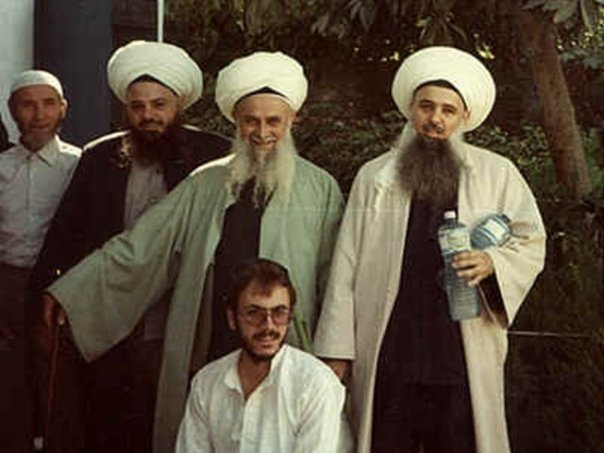
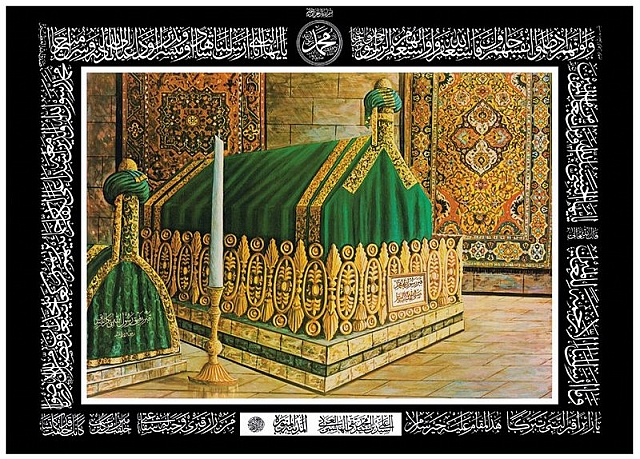
  • Love & Respect for the Companions of Sayyidina Muhammad (s)

    A COMMENTARY OF AL-QADI `IYAD’S BOOK AL-SHIFA’ FI MA`RIFA HUQUQ AL-MUSTAFA

    (THE HEALING IN THE KNOWLEDGE OF THE PROPHET’S RIGHTS) :

    Chapter Three, Section 6: Respect for his Companions, devotion to them and recognising what is due to them

    Qadi `Iyad said: Part of respecting and obeying the Prophet consists in respecting his Companions, obeying them, recognizing what is due to them, following them, praising them, asking forgiveness for them, refraining from discussing their differences, showing enmity to those who are hostile towards them and shunning the misguidance of the Shi`a and the innovators and the reports of any historians or ignorant transmitters who detract from any of them. If there is something equivocal which is reported about them regarding the trials that took place between them, then adopt the best interpretation and look for the most correct way out of it since that is what they deserve. None of them should be mentioned in a bad manner nor are they to be blamed for anything. Rather, we mention their good deeds, their virtues and their praiseworthy lives, and are silent about anything else.

    The Prophet said:

    idha dhukira ashabi fa amsiku.

    “When my Companions are mentioned, hold back.”

    al-Suyuti said in al-Durr al-manthur, in commenting on the verses 97 of Surat al-An`am (“And He it is Who hath set for you the stars that ye may guide your course by them amid the darkness of the land and the sea. We have detailed Our revelations for a people who have knowledge”): al-Khatib narrated from `Umar:

    I heard Allah’s Messenger say: “Do not ask about what is in the stars, and do not explain the Qur’an according to your opinion, and do not insult any of my Companions: that is true faith.”

    Suyuti continues: Ibn Mardawayh, al-Murhabi, and al-Khatib narrated that Maymun ibn Mahran said to Ibn `Abbas: Admonish me. Ibn `Abbas replied: I exhort you to fear Allah, to stay away from astrology because it is an invitation to divination, to beware of mentioning any of the Companions of Allah’s Messenger except in good, otherwise Allah will throw you headlong into Jahannam, for Allah has made this Religion triumph through them; and beware of all talk about the Decree, for two people do not talk about it except one or both of them commit sin.”

    Allah said:

    “Muhammad is the Messenger of Allah, and those who are with him are hard against the unbelievers, merciful to the believers…” (48:29)

    and

    “The outstrippers, the first of the Muhajirun and the Ansars,” (9:100)

    and

    “Allah was pleased with the believers when they gave allegiance to you under the tree,” (48:18)

    and

    “Men who were true to their contract with Allah.” (33:23)

    Hudhayfa said that the Messenger of Allah said:

    iqtadu bi al-ladhina min ba`di abi bakrin wa `umar.

    “Take for your leaders/guides those after me, Abu Bakr and ‘Umar.”

    And the Prophet said:

    ashabi kal-nujum bi ayyihim iqtadaytum ihtadaytum.

    “My Companions are like stars. Whichever of them you use as a guide, you will be rightly guided.”

    al-Qari said in his commentary on al-Shifa’ (2:91):

    The Prophet said it, as narrated by `Abd ibn Humayd from Ibn `Umar; “My Companions are like the stars” refers to the totality of the guidance of the stars, for by the stars is one guided in the darkest nights, and by the Companions is one guided to the beauties and the highest levels of the lights of the Shari`a. The hadith may be deduced from Allah’s saying: “Ask the People of dhikr“ (16:43) and it is strengthened by the Prophet’s saying: “The Scholars of knowledge are the inheritors of Prophets.” [see below]

    But you must know that “My Companions are like the stars” is another hadith narrated by al-Daraqutni in the Fada’il and Ibn `Abd al-Barr through his chain from Jabir, and he said: “This is a chain through which no proof can be established firmly.” al-Bazzar said of `Abd ibn Humayd’s narration: “It is denounced (munkar) and unsound.” Ibn `Adi narrated it in al-Kamil from Nafi` from Ibn `Umar with a weak chain. Bayhaqi narrated something similar in al-Madkhal from `Umar and Ibn `Abbas and he said: “Its matn is well-known (mashhur) and its chains are weak.” al-Halabi said: “The author should not have cited it as if it were definitely a hadith of the Prophet due to what is known about it among the scholars of this science, and he has done the same thing several times before.” I say: It is possible that he had established a chain for it, or that he considered the multiplicity of its chains to raise its grade from da`if to that of hasan, due to his good opinion of it, although the weak hadith may be put into practice for meritorious acts (fada’il al-a`mal), and Allah knows best.

    The author of Kanz al-`ummal (#1002) cited the similar hadith mahma utitum min kitabillah. . . :

    “Whatever is brought to you from Allah’s Book, it is obligatory to practice it, there is no excuse for leaving it; if it is not from Allah’s book, then a Sunna established by me; if not one of my Sunnas, then what my Companions said; verily, my Companions are equivalent to the stars in the sky: whichever of them you pinpoint, you will be guided, and the differences among my Companions are a mercy for you.”

    Ibn `Abd al-Barr said in his book Jami` bayan al-`ilm (2:84):

    `Umar ibn al-Khattab was angry about the disagreement between Ubayy ibn Ka`b and Ibn Mas`ud on the question of praying in a single cloth: Ubayy said that it was fine and good, while Ibn Mas`ud said that this was done only when clothes were scarce. `Umar said: “Two men disagreeing from among the Prophet’s Companions who are those one looks at and takes [knowledge] from?!” — and this supports the import of the hadith which they have declared weak whereby My Companions are like the stars; whoever among them you use for guidance, you will be rightly guided.

    Anas relates that the Prophet said: “The simile of the scholars of knowledge (al-`ulama’) on the earth is the stars in the sky by which one is guided in the darkness of the land and the sea. When the stars are clouded over, the guides are about to be lost.”

    All the above narrations are confirmed by the hadith in Muslim and Ahmad narrated by Abu Musa al-Ash`ari whereby the Prophet said: “The stars are trust-keepers for the heaven, and when the stars wane, the heaven is brought what was promised (i.e. of the corruption of the world and the coming of the Day of Judgment); and I am a trust-keeper for my Companions, so when I go my Companions will be brought what was promised them (i.e. of fitna and division); and my Companions are trustkeepers for my Community, so when they go my Community will be brought what was promised to you (i.e. following hawa and vying for dunya).”

    This trust-keeping is what `Umar meant when he named the Companions: “Those whom people look at and take (knowledge) from” when he disapproved of the difference of opinion between Ubayy ibn Ka`b and `Abd Allah ibn Mas`ud, as related in Ibn `Abd al-Barr’s Jami` bayan al-`ilm (2:84).

    This is further confirmed by al-Zuhri’s saying related by Darimi in the introduction to his Sunan: “Beware of evaluating things for yourself. By the One in Whose hand is my soul, if you evaluate things for yourself you will assuredly declare lawful the unlawful and declare unlawful the lawful. Rather, whatever reaches you from those who learned from the Companions of Muhammad — peace be upon him — put it into practice.”

    Similar to this is al-Awza`is’ saying: “Knowledge is what comes from the Companions of Muhammad — peace be upon him — and whatever does not come from one of them is not knowledge.” Narrated by Ibn `Abd al-Barr in his Jami` bayan al-`ilm (2:36).

    Anas said that the Messenger of Allah said:

    mathalu ashabi ka mathali al-milhi fi al-ta`am.

    “The likeness of my Companions (among people) is like salt in the food. Food is not good without it.”

    The author of Nasim al-Riyad (3:469) said:

    al-Hasan al-Basri said: “Our salt has disappeared; what good is left in us?” Their good consisted in their direction and rightful guidance, their scrupulousness in obedience, their commanding good and forbidding evil, and their elucidation of the Shari`a and of the matters of the Deen.

    The above hadith is confirmed by the Prophet’s narration in Bukhari’s Sahih from Ibn `Abbas in the book of the merits of the Ansar, whereby the Prophet said during his last illness:

    “O people! People will become numerous, and the Ansar will decrease in number, until they shall be among people in the same way as salt in the food. Therefore, whoever among you holds sway and wields power to harm or benefit, let him accept the good of those who do good among them, and excuse the evil of the evil-doers among them.”

    Ibn al-Qayyim said in his al-Tibb al-nabawi (p. 301, 1993 ed.) which is part of his book Zad al-ma`ad, translated by Shaykh Muhammad al-`Akili as Medicine of the Prophet (p. 314):

    Anas narrated that Allah’s Messenger said: “Salt is the master of your food.” (sayyidu idamikum al-milh – Sunan of Ibn Majah with a chain containing `Isa ibn Abi `Isa, who is matruk — fatally weak.) “Master” here means stabilizer, architect, or the principal substance, and the one that plays a dominant role in affecting others. That is what master (sayyid) means, and in that sense, food is regulated with salt, and most food do not balance unless they contain salt. [Note: this is unrefined salt, which is much healthier than the salt used nowadays.]

    In another prophetic tradition, Allah’s Messenger said: “Perhaps, there will come a day when you will be in the midst of people like salt in the food, and nothing balances food better than salt.”

    `Abd Allah ibn `Umar said: “Allah Almighty sent down four blessings from the skies: iron, fire, water, and salt.”

    The Prophet also said:

    “Allah, Allah! Fear Him with regard to my Companions! Do not make them targets after me! Whoever loves them loves them with his love for me; and whoever hates them hates them with his hatred for me. Whoever bears enmity for them, bears enmity for me; and whoever bears enmity for me, bears enmity for Allah. Whoever bears enmity for Allah is about to perish.”

    al-Qari said in his commentary on al-Shifa’ (2:92):

    The hadith may be deduced from the sum of Allah’s saying: “Lo! those who malign Allah and His messenger, Allah hath cursed them in the world and the Hereafter, and hath prepared for them the doom of the disdained. And those who malign believing men and believing women undeservedly, they bear the guilt of slander and manifest sin.” (33:57-58)

    Ibn Kathir said in his Tafsir, in commenting on the above verses:

    Ibn `Abbas said that the verse “those who harm Allah and His Prophet” was revealed concerning those who condemned the marriage of the Prophet with Safiyya bint Huyayy ibn Akhtab. The external meaning is that the verse is universal and pertains to all those who harm him in something, for those who harm him harm Allah, just as those who obey him obey Allah, as the Prophet said: “Allah, Allah! Fear Him with regard to my Companions! Do not make them targets after me!…” etc.

    Allah’s saying: “And those who harm the believing men and the believing women undeservedly,” that is: they attribute to them something of which they are innocent and which they never did; “those have committed a grievous slander and a manifest sin.” That is the most grievous slander: to convey, concerning the believers, something which they never did, for the purpose of suggesting disgrace and defects in relation to them.

    Most of those who enter into that divine threat are the Rafida (“Rejectionists”), who criticize the Companions, blame them for something of which Allah Himself declared them to be innocent, and attribute to them defects which were never mentioned by Allah. For Allah has said that He was well pleased with the Muhajirun and the Ansar and He praised them, while those ignorant dolts insult them and accuse them of faults and vices, attributing to them what they never did in their lives. Those accusers are in reality diseased of heart, for they injure those who are praised and they praise those who are despised.

    It is narrated from `A’isha that the Prophet once asked his Companions: “What is the worst riba of all ribas?” They replied: “Allah and His Prophet know best.” He said: “The worst riba of all ribas in Allah’s sight is to treat as licit the honor of a Muslim person” (arba al-riba `ind Allah istihlal `ard imru’in muslimin), then he recited the verse: “And those who harm the believing men and the believing women for other than what they did, those have committed a grievous slander and a manifest sin.”

    The Prophet also said about the Ansar:

    “The Ansar! None loves them except a believer, and none hates them except a hypocrite. Whoever loves them, Allah loves him; and whoever hates them, Allah hates him.”

    The Prophet also said:

    “None of you should come to me with anything (negative) about any of my Companions for I do not want to go out to you except except with a clear heart.”

    The Prophet also said:

    “Do not curse my Companions. If any of you were to spend the weight of Uhud in gold, it still would not reach the measure (mudd) of one of them nor even one-half of it.”

    al-Qari said (Sharh al-shifa’ 2:92):

    Nawawi said that cursing the Companions is one of the most depraved acts (min akbar al-fawahish), while the author (`Iyad) counts it among the major sins (kaba’ir). Such offense is punished with corporeal punishment according to the vast majority, while according to some of the Malikis and Hanafis the offender is executed. In some of the books of the latter, it is stated that to insult the two Shaykhs (Abu Bakr and `Umar) constitutes disbelief (kufr).

    The latter ruling is based in part or in whole on the hadith from Jabir narrated by Daylami and Ibn Asakir: “Love of Abu Bakr and `Umar is iman (or: Sunna), and hatred of them is disbelief.” Suyuti it declared weak in his Jami` al-saghir (#3668).

    Nawawi said in Sharh Sahih Muslim: “Know that to insult the sahaba is haram, and one of the fawahish al-muharramat (grave major indecencies) whether with regard to those of them involved in a fitna (conflict) or other than them, because they entered those conflicts on the conviction of their ijtihad (legal reasoning) and interpretation.” Haytami and Dhahabi, like Qadi Iyad and Nawawi, considered insulting any of the sahaba as one of the major sins (kaba’ir).

    Note also that the true appellation of shaykh al-islam belongs to none else than Abu Bakr and `Umar. al-Sakhawi wrote in his introduction to the biography of his shaykh Ibn Hajar entitled al-Jawahir wa al-durar:

    This title was not common among the earlier generations after the two Shaykhs, al-Siddiq and al-Faruq, and we know that `Ali applied it to them — may Allah be pleased with them all. al-Muhibb al-Tabari related in his book al-Riyad al-nadira (The resplendant groves), without providing a chain of authorities, that Anas said: “A man came to `Ali ibn Abi Talib and said: O Commander of the Faithful, I heard you saying on the pulpit: “O Allah, help me as you helped the rightly-guided and enlightened caliphs. Who are they?” Anas said: Tears welled in `Ali’s eyes and began to pour down, then he replied: Abu Bakr and `Umar, the two leaders of rightful guidance and the two shaykhs of Islam, the two men of Quraysh, the two who are followed after the Messenger of Allah, blessings and peace be upon him. Whoever follows these two gains respect; whoever lives up to the legacy of these two is guided to a straight path; whoever sticks with these two is from Allah’s party, and Allah’s party–they are the saved.”

    al-Dhahabi reported in al-Kashif on the authority of Ibn al-Mubarak — mark him, O Reader, as one who was a Shaykh al-Islam: “The only one to carry the title shaykh al-Islam is Abu Bakr al-Siddiq, who preserved the zakat and fought against the apostates. Know him very well.”

    Following are some additional narrations from Bukhari’s Sahih on the rank of Abu Bakr and `Umar:

    Narrated Ibn `Abbas: While I was standing amongst the people who were invoking Allah for `Umar ibn al-Khattab who was lying (dead) on his bed, a man behind me rested his elbows on my shoulder and said: “(O `Umar!) May Allah bestow His Mercy on you. I always hoped that Allah will keep you with your two companions, for I often heard Allah’s Messenger saying: I, Abu Bakr and `Umar were there; I, Abu Bakr and `Umar did this; I, Abu Bakr and `Umar set out. So I hoped that Allah will keep you with both of them.” I turned back to see that the speaker was `Ali ibn Abi Talib.

    Narrated Ibn `Abbas: When `Umar was placed on his deathbed, the people gathered around him, invoked Allah, and prayed for him before the body was taken away, and I was among them. Suddenly I felt somebody taking hold of my shoulder and saw that it was `Ali ibn Abi Talib. `Ali invoked Allah’s Mercy for `Umar and said: “O `Umar! You have not left behind you a person whose deeds I like to imitate more than yours, nor would I more prefer to meet Allah with other than your deeds. By Allah! I always thought that Allah would keep you with your two companions, for very often I used to hear the Prophet saying: I, Abu Bakr and `Umar went somewhere; I, Abu Bakr and `Umar entered someplace; and I, Abu Bakr and `Umar went out.”

    Narrated Abu Musa: While I was with the Prophet in one of the gardens of Medina, a man came and asked me to open the gate. The Prophet said to me: “Open the gate for him and give him the glad tidings that he will enter Paradise.” I opened the gate for him, and behold! It was Abu Bakr. I informed him of the glad tidings the Prophet had said, and he praised Allah. Then another man came and asked me to open the gate. The Prophet said to me: “Open the gate and give him the glad tidings of entering Paradise.” I opened the gate for him, and behold! It was `Umar. I informed him of what the Prophet had said, and he praised Allah. Then another a man came and asked me to open the gate. The Prophet said to me: “Open the gate for him and inform him of the glad tidings of entering Paradise with a calamity which will befall him.” Behold! It was `Uthman. I informed him of what Allah’s Apostle had said. He praised Allah and said, “I seek Allah’s aid.”

    Narrated Anas: Allah’s Apostle ascended the mountain of Uhud with Abu Bakr, `Umar, and `Uthman, and the mountain shook. Allah’s Apostle said: “Be calm, O Uhud!” I think he stroked it with his foot and added: “There is none on you but a Prophet, a siddiq, and two shahid.”

    Narrated Ibn `Umar: During the lifetime of the Prophet we considered Abu Bakr as peerless and then `Umar and then `Uthman and then we used not to differentiate between the companions of the Prophet.

    The Prophet also said:

    “Anyone who curses my Companions has the curse of Allah on him, and of the angels, and of all people. Allah will not accept any exchange nor compensation from him.”

    The Prophet also said in the hadith from Jabir:

    “Allah chose my Companions over everything else in existence except for the Prophets and the Messengers. He chose four of them for me; Abu Bakr, ‘Umar, ‘Uthman and ‘Ali. He made them my best Companions, and all of my Companions are good.”

    Allah Almighty said:

    “Muhammad is the messenger of Allah. And those with him are hard against the disbelievers and merciful among themselves. Thou (O Muhammad) seest them bowing and falling prostrate (in worship), seeking bounty from Allah and (His) acceptance. The mark of them is on their foreheads from the traces of prostration. Such is their likeness in the Torah and their likeness in the Gospel – like as sown corn that sendeth forth its shoot and strengtheneth it and riseth firm upon its stalk, delighting the sowers – that He may enrage the disbelievers with (the sight of) them. Allah hath promised, unto such of them as believe and do good works, forgiveness and immense reward.” (48:29)

    al-Qurtubi commented on this verse in his Jami` li ahkam al-qur’an (1994 Cairo ed. 16:283-286) thus:

    Abu `Urwa al-Zubayri narrated: We were with Malik ibn Anas when they mentioned a certain man who would find fault with the Companions of the Messenger of Allah. When he heard this, Malik recited the verse: “Muhammad is the messenger of Allah. And those with him. . .” until he reached the words “delighting the sowers – that He may enrage the disbelievers with (the sight of) them.” (48:29) Then Malik said: “Whoever among the people has become one who harbors spite towards any one of the Prophet’s Companions, this verse has targeted and reached him.” al-Khatib mentioned it.

    Malik spoke well and his interpretation is correct. Whoever finds fault with a single one of them or questions his reliability as a narrator, has rejected the saying of Allah, the Lord of the Worlds and rendered null and void the laws of the Muslims. Allah said of the Companions:

    “Muhammad is the messenger of Allah. And those with him. . .” (48:29),

    and He said:

    “Allah was well pleased with the believers when they swore allegiance unto thee beneath the tree” (48:18),

    and He said:

    “Of the believers are men who are true to that which they covenanted with Allah. Some of them have paid their vow by death (in battle), and some of them still are waiting; and they have not altered in the least” (33:23),

    and He said:

    “And (it is) for the poor fugitives who have been driven out from their homes and their belongings, who seek bounty from Allah and help Allah and His messenger. They are the loyal” (59:8),

    and He said:

    “Those who entered the city and the faith before them love those who flee unto them for refuge, and find in their breasts no need for that which hath been given them, but prefer (the fugitives) above themselves though poverty become their lot. And whoso is saved from his own avarice – such are they who are successful” (59:9).

    All the above is with Allah’s complete knowledge of their situation and the state to which they are destined. Similarly, the Prophet said:

    “The best of humankind are those in my century, then those that follow them” (Bukhari and Muslim),

    and he said:

    “Do not curse my Companions. If any of you were to spend the weight of Uhud in gold, it still would not reach the measure (mudd) of one of them nor even one-half of it” (see above),

    and in different narrations of the same he said:

    “If any of you were to spend all the wealth of the earth, it still would not reach the measure (mudd) of one of them nor even one-half of it,”

    and in al-Bazzar’s Musnad, narrated from Jabir from the Prophet — and it is sound (sahih):

    “Allah chose my Companions over everything else in existence. . .” (see above),

    and `Uwaym ibn Sa`ida narrated that the Prophet said:

    “Allah has chosen me, and He has chosen my Companions for me. He has made some of them my deputies, my sons-in-law, and my fathers-in-law. Anyone who curses them has the curse of Allah on him, and of the angels, and of all people. Allah will not accept any exchange nor compensation from him” (see above),

    and the hadiths on that topic are many, so woe to the one who opens his mouth against one of them!

    Therefore, whoever attributes a lie to any one of the Companions has left the pale of shari`a, annulled the Qur’an, and cast aspersion on the Prophet; and a Companion that has been accused of lying has been insulted — for there is no worse disgrace after disbelief in Allah than lying — and the Prophet has cursed whoever insults his Companions. Therefore, the person who belies even the least among the Companions — and there is none lesser among them — enters into Allah’s curse which was witnessed to by the Prophet, and which was assured by him for any who dared insult or cast aspersion on any one of the Companions.

    The Companions are all trustworthy witnesses (`udul), Friends of Allah and His Elect in creation after His Prophets and Messengers. This is the school of Ahl al-Sunna, and this is what is held by the entire congregation of the Imams of this Community. An insignificant faction of people have gone the way of claiming that the Companions are like anybody else, and that their trustworthiness is subject to examination and verification. Some of those people make distinctions between an early phase and a later phase, and so they say: “They were true witnesses at first, then their conditions changed and war and bloodshed took place between them, so we must investigate.” This pretext is rejected! For the elite of the Companions and the foremost among them, such as `Ali, Talha, Zubayr, and others among those whom Allah praised and exalted and was pleased with and counted among the dwellers of Paradise when He said “Forgiveness and a tremendous reward,” especially the Ten for whom Paradise is assured as was declared by the Prophet: these constitute the vanguard the Community at the same time as they were fully aware of the dissensions and the affairs that befell them after their Prophet, since he had informed them about them. Yet this in no way lowered their high rank or excellence, for all these matters were based on ijtihad, and every mujtahid is right.

    The Prophet also said:

    “Whoever loves `Umar loves me. Whoever hates `Umar hates me.”

    Malik ibn Anas and others said: “Whoever hates the Companions and curses them does not have any right to Muslim booty. This judgement is taken from the verse:

    “Those who come after them say: Our Lord, forgive us and our brothers, who preceded us in belief, and do not put rancor into our hearts against those who believe.” (59:10)

    Malik said: “Whoever is exasperated by the Companions of Muhammad is an unbeliever, for Allah said:

    “He enrages the unbelievers through them.” (48:29)

    `Abd Allah ibn al-Mubarak said: “There are two qualities which are the cause of salvation for whoever has them: truthfulness and love for the Companions of Muhammad.”

    Ayyub as-Sakhtiyani said: “Whoever loves Abu Bakr has established the deen. Whoever loves `Umar has made the way clear. Whoever loves `Uthman has been illuminated by the light of Allah. Whoever loves `Ali has taken hold of the firm handle. Whoever praises the Companions of Muhammad is free of hypocrisy. Whoever disparages any of them is an innovator opposing the Sunna and the right-acting Salaf. It is feared that none of his actions will rise to heaven until he loves them all and his heart is sound.”

    Khalid ibn Sa`id said that the Prophet said:

    “O people, I am pleased with Abu Bakr, so let that be known! O people, I am pleased with `Umar, `Ali, `Uthman, Talha, al-Zubayr, Sa`d, Sa`id, and `Abd al-Rahman ibn Awf, so let that be known! O people, Allah has forgiven the people of Badr and al-Hudaybiyya. O people, protect me in my Companions and my relations by marriage. Do not let any of them have cause to demand restitution from any of you for an injustice against them. A wrongful claim will not be granted tomorrow on the Day of Rising.”

    A man said to al-Mu`afa ibn `Imran, “Where is Mu`awiya in relation to `Umar ibn `Abd al-`Aziz?” He got angry and said: “One does not compare anyone with the Companions of the Prophet, may Allah bless him and grant him peace! Mu`awiya was his companion, his brother-in-law (being the brother of Umm Habiba the Mother of the Believers), his scribe, and one who was entrusted with the revelation of Allah!”

    al-Qari said in Sharh al-shifa’ (2:95):

    One of the scholars was asked this question and he replied: “The dust in the nostrils of (the Companion) Mu`awiya’s horse is a thousand times better than (the Successor) `Umar ibn `Abd al-`Aziz.” The gist of it is that none of the scholars and shaykhs of this Community can reach the rank of the Companions nor attain the merit of having served the Prophet (like them). For the sight of the Prophet was an elixir (iksir) that immeasurably affected whoever saw him and believed in him, young or old.

    The Prophet came to a man’s funeral but did not pray over him. He said: “He hated `Uthman, so Allah hates him.”

    The Prophet said about the Ansar (as already mentioned in full, narrated by Bukhari and Muslim): “Overlook their faults and give precedence to their good qualities.”

    The Prophet also said:

    “Guard me in my Companions and my relations by marriage. Anyone who guards me in them will be guarded by Allah in this world and the Next. Anyone who does not guard me in them will be abandoned by Allah. Anyone abandoned by Allah is about to perish.”

    The Prophet said:

    “Whoever protects me in my Companions, I will be his guardian on the Day of Rising.”

    The above is also found as part of the larger narration of Ibn `Asakir and Daylami from Jabir, which Suyuti declared weak in al-Jami` al-saghir (#3668), whereby:

    “Love of Abu Bakr and `Umar is iman (or: Sunna), and hatred of them is disbelief, and love of the Ansar is iman, and hatred of them is disbelief, and love of the Arabs is iman, and hatred of them is disbelief. Whoever insults my Companions, Allah’s curse is on him, and whoever protects me in my Companions, I will be his guardian on the Day of Rising.”

    The Prophet said:

    “Whoever protects me in my Companions will come to me at the Basin. Whoever does not protect me in my Companions will not come to me at the Basin and will only see me from a distance.”

    The imperative of guarding the Prophet’s honor in the person of his Companions is confirmed by the sound hadith whereby the Prophet said:

    “Guard me in my Companions, then in those that follow them, then in those that follow the latter. After that time, mendacity will spread everywhere, to the point that a man will testify without having been asked, and he will swear an oath without having been asked.”

    Malik ibn Anas said: “The Prophet taught people the adab to which Allah had guided him and which made him a mercy for the worlds. He went out in the darkness of the night to al-Baqi` (the cemetery of al-Madina), made supplication for the people in the graves and asked forgiveness for them like someone seeing them off on a journey. Allah commanded him to do that and the Prophet commanded people to have love and friendship for them and opposition to anyone who opposes them.”

    It is related from Ka`b (al-Ahbar): “There is none of the Companion of Muhammad but that he will have the power of intercession on the Day of Rising.” Ka`b was asked by al-Mughira ibn Nawfal to intercede for him on the Day of Rising.

    Sahl ibn `Abd Allah at-Tustari said: “Anyone who does not respect the Messenger’s Companions nor gives weight to his commands (to respect them) does not believe in him.”

    © As-Sunna Foundation of America; all rights reserved.

  • Love of Ahl Al-Bayt

    al-islam@swbell.net wrote in message <7imsua$lgk$1@waltz.rahul.net>…

    > al-Shafi’i said: > > If the love of the members of the House of the Prophet is Rafd >(rejection), let mankind and the Jinns testify that I > am a rejecter (Rafidi).”

    The above emphasizes love of the Prophet’s House — Allah bless and greet him and his Family — and in no way signifies praise of rafd and shi`ism.

    Al-Buwayti asked: “Should I pray behind the Rafidi?” Imam al-Shafi`i said: “Do not pray behind the Rafidi, nor behind the Qadari, nor behind the Murji’.” Al-Buwayti said: “Define them for us.” He replied: “Whoever says ‘Belief consists only in speech’ is a Murji’, and whoever says ‘Abu Bakr and `Umar are not Imams’ is a Rafidi, and whoever attributes destiny to himself is a Qadari.”

    Another student of al-Shafi`i, Imam Ahmad, defined the Rafidi as “He who insults Abu Bakr and `Umar.” Both Imams forbade from praying behind such as these, not because they were apostates but because they were innovators. It is not authentically related from any of the Four Imams that they declared Rafidis to be disbelievers, and Allah knows best.

    Imam al-Dhahabi wrote in Siyar A`lam al-Nubala’:

    To prefer `Ali [to `Uthman] is neither Rafd nor a bid`a, for several of the Companions and Successors did. Both `Uthman and `Ali possess great merits and precedence and are among the foremost martyrs. However, the vast majority of the Community agree to give precedence to `Uthman, and this is our position also; and better than both of them without doubt are Abu Bakr and `Umar. Whoever differs with this is a hardened Shi`i. Whoever disrespects the Two Shaykhs [Abu Bakr and `Umar] while accepting the validity of their imamate is a disgusting Rafidi. As for those who both insult them and reject the validity of their imamate, they are extremist Rafidis – may Allah lead them to perdition!

    > Ibn Manzur says the following in his lexicon Lisan al-Arab where he >defines the Shi`as: > > The Shi`as are the people who love what the Prophet’s Progeny loves, >and they are loyal to such Progeny. [ Refer > to p. 189, Vol. 8, of Lisan al-Arab lexicon by Abul-Fadl Jamal ad-Din >Muhammad Ibn Manzur (630 – 711 > A.H./1233 – 1311 A.D.)]. > > Commenting on this statement, Dr. Sa`id Abd al-Fattah Ashoor says: > > “If the Shi`as love whatever the Prophet’s Progeny loves and are loyal >to such Progeny, who among the Muslims > would refuse to be a Shi`a?!”

    Without doubt, the true Shi`a or party of our master `Ali are those who love him without committing calumny and slander in his name, and without exceeding bounds in recognizing the rank given to him by Allah’s Messenger — Allah bless and greet him.

  • Who Are Ahl al-Bayt

    Q. A brother asked me about who exactly are the ahl al-bait, because all he knows is that when he hears ahl al-bait, he thinks the 12 imams. Is it just from Fatimah, or more than just from her…like Ibn Abbas?

    Note to begin that Ahl and Al are the same in meaning. However, Ibn Manzur said in Lisan al-`arab, Al is nobler in usage. Note that in Arabic a man’s “bayt” denotes his wife, and that is also one of the meanings of a man’s “ahl.” See Lisan al-`arab under both entries, where it is also said that “Al” means “ahl” in all the senses of “family,” relatives,” and “wives.”

    The following terms all have the same meaning:

    a) Ahl al-Bayt = People of the House b) Al al-Nabi (s) = Family of the Prophet; the Umma c) Al Bayt al-Nabi (s) = Family of the House of the Prophet d) `Itrat al-Nabi = [People of the] Mantle of the Prophet

    However, in common usage, (a) and (d) have a more restrictive meaning, coinciding with (I) below, whereas (b) and (c) is more inclusive, usually coincide with (I), (II), and (III). The term “Al” (b) is the most inclusive of all, since Nawawi reports among its meanings: “All of the Community.” See his Tahdhib al-asma’ wa al-lughat as well as his Tahrir al-tanbih under the entry “Al.”

    The People of the House of the Prophet are those for whom it is unlawful to receive zakat and whom the Prophet ordered all Muslims to respect, honor, and follow. They are:

    I. `Ali, Fatima, Hasan, and Husayn (in addition to their descendants: Muhassan, Zaynab, and Umm Kulthum [other children of `Ali and Fatima]; among the children of al-Hasan: Zayd, al-Qasim, Abu Bakr, `Abd Allah, `Umar, al-Hasan, `Abd al-Rahman, al-Husayn, `Amr, Muhammad, Ya`qub, Ja`far, Hamza, and Talha; among the children of al-Husayn: Abu Bakr, `Abd Allah, `Ali al-Kabir, `Ali Zayn al-`Abidin, `Umar, Fatima, Sukayna, Zaynab al-Sughra, and Umm Kulthum al-Sughra).

    II. The wives of the Prophet [except that zakat is lawful for them by consensus, as reported by Ibn Hajar in Fath al-Bari (3:277) from Ibn Battal]:

    1. Khadija bint Khuwaylid. She gave birth to: al-Qasim, `Abd Allah, Zaynab, Fatima al-Zahra’, Ruqiyya, & Umm Kulthum.

    2. Sawda bint Zam`a

    3. `A’isha bint al-Siddiq

    4. Hafsa bint `Umar

    5. Zaynab bint Khuzayma

    6. Umm Salama, Hind bint Umayya

    7. Zaynab bint Jahsh

    8. Juwayriyya bint al-Harith

    9. Safiyya bint Huyayy

    10. Umm Habiba bint Abi Sufyan

    11. Maymuna bint al-Harith

    12. Marya al-Qibtiyya, she was a surriyya (concubine). She gave birth to Ibrahim.

    III. The Banu Hashim and the Banu al-Muttalib. [Except that zakat may be given to the wives of the Banu Hashim and to the freedmen of Banu al-Muttalib, by consensus as stated by Ibn Battal: related by Shawkani in Nayl al-awtar (4:175) and by Nawawi in Sharh Sahih Muslim (5:36).]

    Allah said of the People of the House:

    “Allah’s wish is but to remove uncleanness far from you, O Folk of the Household, and cleanse you with a thorough cleansing.” (33:33)

    Umm Salama related that when that verse was revealed, the Prophet surrounded with his garment `Ali, Fatima, al-Hasan, and al-Husayn, and said: “O Allah! These are the People of my House, therefore remove uncleanness far from them and cleanse them with a thorough cleansing.” Ahmad narrated it in his Musnad with six chains, also Tirmidhi with several chains and he said: hasan sahih, al-Hakim, and Tabarani.

    Muslim, Tirmidhi (hasan sahih gharib), al-Hakim, and others also narrated that when Allah revealed the verse:

    “… say (unto him): Come! We will summon our sons and your sons, and our women and your women, and ourselves and yourselves, then we will pray humbly (to our Lord) and (solemnly) invoke the curse of Allah upon those who lie” (3:61)

    Sa`d ibn Abi Waqqas said: the Prophet summoned `Ali, Fatima, Hasan, and Husayn, and said: “O Allah! These are my Family” (allahumma ha’ula’u ahli).

    Allah has given the People of the House the right to (fay‘) and (khumus) when He said:

    “That which Allah giveth as spoil unto His messenger from the people of the townships, it is for Allah and His messenger and for the near of kin and the orphans and the needy and the wayfarer…” (59:7)

    “And know that whatever ye take as spoils of war, lo! a fifth thereof is for Allah, and for the messenger and for the kinsman (who hath need) and orphans and the needy and the wayfarer” (8:41)

    The Prophet said: “I am leaving among you the two weighty matters: Allah’s Book and the People of my House.” Narrated by Muslim, Tirmidhi, and Ahmad through many chains. Some of these narrations state: “I am leaving among you the two weighty matters: Allah’s Book and (the People of) my mantle: these two shall never part ways until they come to me at the Pond. Therefore attend to how you act with them after me.”

    The dictionary Mu`jam maqayis al-lugha (4:217) defines a man’s `itra (mantle) as: “His relatives such as his children, grandchildren, and paternal cousins.”

    From Hasan ibn `Ali, Umm Kulthum daughter of `Ali, and others: “Sadaqa is not lawful for the family of Muhammad.” Bukhari in the book of zakat, Ahmad through five chains and al-Darimi in his Sunan, book of Salat.

    Ahmad in his Musnad and Muslim in his Sahih narrated from Zayd ibn Arqam, also al-Hakim, Ibn Hibban, al-Darimi, al-Bazzar, and al-Tabarani:

    The Messenger of Allah stood to speak to us beside a pond which is known as Khum, located between Mecca and Medina. He praised Allah and admonished us to remember Him, then said: “O people! I am a human being and the time is near when my Lord’s Messenger shall come to me (with death) and I shall answer him. Behold! I am leaving among you two weighty matters. The first of them is the Book of Allah, in which is the guidance and the light… And the People of my House. I remind you by Allah of the People of my House! I remind you by Allah of the People of my House! I remind you by Allah of the People of my House!” Huswayn ibn Sabra said to Zayd: “Who are the People of his House, O Zayd? Are not his wives among the People of his House?” Zayd replied: “His wives are the People of his House, however, the People of his House are those for whom sadaqa is unlawful after the Prophet.” Huswayn said: “And who are they?” He replied: “The family of `Ali, the family of `Aqil (a son of Abu Talib), the family of Ja`far (another son of Abu Talib), and the family of `Abbas. Sadaqa is unlawful for all of these.”

    The above hadith is not in Tirmidhi. The version narrated by Tirmidhi (he said: hadith hasan gharib) states that Zayd ibn Arqam said:

    The Messenger of Allah said: “I am leaving among you that which, if you hold fast to it, you will never go astray after me. One of them is greater than the other: that is, the Book of Allah, the rope that is extended down from the heaven to the earth; and my mantle — the People of my House. These two shall never part ways until they both come to me at the Pond. Therefore attend to how you act with them after me.”

    We are ordered to invoke blessings on the Family of the Prophet including his wives. When the Companions asked the Prophet how they should invoke blessings on him, he said:

    Say: “O Allah, bless Muhammad, his wives, and his offspring as you blessed Ibrahim; and further grant blessing on Muhammad, his wives, and his offspring, as you granted blessing on Ibrahim. Verily, Yours is all the Majesty and Glory.”

    It is narrated by Bukhari with two chains, Nasa’i, Abu Dawud, Ahmad, Ibn Majah, and Malik.

    Abu Ya`la narrated from Abu Hurayra that the Prophet said: “The best among you are the best towards my Family after me.” al-Haythami cited it in Majma` al-zawa’id (6:40) and said: “Abu Ya`la narrates it and its narrators are all trustworthy.”

    Ibn ‘Abbas said that the Messenger of Allah said, “Allah divided people into two groups, and He put me in the best group. Allah talks of ‘The Companions of the Right’ and ‘the Companions of the Left.’ I am among the Companions of the Right and I am the best of the Companions of the Right. Then He divided the two groups into three and put me in the best of the three. He says, ‘The Companions of the Right and the Companions of the Left and the Outstrippers, the Outstrippers.’ (56:9) I am among the Outstrippers and I am the best of the Outstrippers. Then He divided the three into tribes and He put me in the best tribe. Allah says, ‘We have appointed you races and tribes that you may know one another. Indeed the noblest among you is the most god fearing. Allah is Knowing, Aware.‘ (49:13) I am the most god fearing of the sons of Adam and the noblest in the sight of Allah, and it is no boast. Then He divided the tribes and put me in the best house. He says, ‘Allah only desires to remove impurity from you, People of the House, and to purify you. (33:33) (Hadith from at-Tabarani and al-Bayhaqi.)

    The following is from Ash-Shifa of Qadi ‘Iyad in the chapter “Devotion to his family, descendants and wives”:

    Part of respect for the Prophet and devotion to him is devotion to his family, his descendants and his wives, the Mothers of the believers, as he urged and as the Salaf did.

    Allah said, “Allah wants to remove impurity from you, people of the House.”(33:33) He said, “His wives are their mothers.” (33:6) Zayd ibn Arqam related that the Messenger of Allah said, “I implore you by Allah! The people of my House!” three times . we asked Zayd who constituted the people of his House and he said, “The family of Ali by the People of his House, and he said, “The family of ‘Ali, the family of Ja’far.(A son of Abu Talib.) the family of `Aqil, (Another son of Abu Talib.) and the family of al-‘Abbas.”(Muslim.)

    The Prophet said, “I am leaving you something, taking hold of which will prevent you form going astray: the Book of Allah and my family, the People of my House. So take care how you follow me regarding them.”(No source given.)

    One of the ‘ulama’ said, “‘Recognition’ in this case means recognising their place in relation to the Prophet. Recognition of that brings with it recognition of rights and respect that are due to them because of it.”

    ‘Umar ibn Abi Salama said that “Allah wants to remove impurity from you, People of the House,”(33:33) was revealed in Umm Salama’s house. The Prophet summoned Fatima. Hasan, and Husayn and enfolded them in a garment and ‘Ali was behind him. Then he said, ” O Allah! These are the People of my House, so remove all impurity from them and purify them completely!”(At-Tirmidhi.)

    Sa’d ibn Abi Waqqas said that when the ayat of mutual cursing (“And whosoever disputes with you concerning him after the knowledge that has come to you, say, ‘Come, let us call our sons and your sons, our wives and your wives, our selves and your selves, then let us humbly pray and so lay the curse of Allah upon the ones who lie.’“(3:61) was revealed, the Prophet called ‘Ali, Hasan, Husayn and Fatima, and said, “O Allah! These are my family.”(Muslim.)

    The Prophet said about ‘Ali, “Whoever has me for a master, ‘Ali is his master. O Allah, befriend the one who befriend him and oppose the one who opposes him! (Ibn Hanbal.)

    He also said to him, “Only a believer will love you and only a hypocrite will hate you.”(Muslim.)

    He said to al-‘Abbas, “By the One who has my soul in His hand, belief will not enter a man’s heart until he loves Allah and His Messenger. Whoever harms my uncle has harmed me. A man’s uncle is like his father.”(At-Tirmidhi and Ibn Majah.)

    He also said al-‘Abbas, “Feed ‘Ali with your children, my uncle.” Then he gathered them and wrapped them with his robe, saying, “This is my uncle any my father’s twin and these are the people of my house, so veil them from the Fire as I am veiling them.” The lintel of the door and the walls of the house said, “Amen! Amen!”(Al-Bayhaqi.)

    He used to take the hand of Usama ibn Zayd and al-Hasan and say’ “Love them, O Allah, for I love them.”(Al-Bukhari.) Abu Bakr said, “Respect Muhammad by respecting the People of his House.” He also said, “By the One who has my soul in His hand, the near kin of the Messenger of Allah are dearer to me than my own kinsfolk.” These two reports are narrated by Bukhari in his Sahih.

    The Prophet said, “Allah loves those who love Hasan.”(At- Tirmidhi.)

    He also said, “Whoever loves these two(Al-Hasan and al- Husayn ibn ‘Ali ibn Abi Talib.)

    The Prophet said, “Whoever demeans Quraysh, Allah will demean him.(At-Tirmidhi.)

    The Prophet said, “Give preference to Quraysh and do not precede them.”(Al-Bazzar.)

    He said to Umm Salama, “Do not injure me by injuring ‘A’isha.”(Al-Bukhari.)

    ‘Uqba ibn al-Harith said, “I saw Bakr putting al-Hasan on his shoulders, saying, “By my father, he resembles the Prophet! He does not resemble ‘Ali!” ‘Ali was laughing.

    It is related that ‘Abdullah ibn Hasan ibn Husayn sad, “I came to ‘Umar ibn ‘Abdu’l-‘Aziz when I was in need of something and he said, ‘If you have need, then send for me or write to me. I am ashamed before ‘Allah to see you at my door.’”(Even though he was the Khalif, he was ashamed to have someone form the Prophet’s family asking for something in public.)

    Ash-Shab’i said. “Zayd ibn Thabit prayed in his mother’s funeral prayer and then brought his mule near so he could mount it. Ibn ‘Abbas came and took hold of the stirrup. Zayd said, ‘Let go, nephew of the Messenger of Allah!’ He said, ‘This is the way we act with men of knowledge.’ Then Zayd kissed the hand of Ibn ‘Abbas. He said, ‘This is the way I was commanded to act with the people of the House of the Prophet.’”(His mother was al-Nuwwar bint Malik.)

    Ibn ‘Umar saw Muhammad ibn Usama ibn Zayd and said, :Would that he were my slave!” He was told, “That is Muhammad ibn Usama.” Ibn ‘Umar bowed his head and struck the earth with his hand and said, “If the Messenger of Allah had seen him he would have loved him.”

    Al-Awza’i said, “The daughter of Usama ibn Zayd, the Prophet’s Companion, went to see ‘Umar ibn ‘Abdu’l-‘Aziz. A mawla of hers was with her holding her hand. ‘Umar rose for her and walked to her and put her hand in his and then placed his hand on his garment. Then he walked some way with her, sat her in his own place and then sat down in front of her. He did not leave any request she had ungranted.”

    When ‘Umar ibn al-Khattab allotted his son ;Abdullah three thousand and Usama ibn Zayd three thousand five hundred, ‘Abdullah said to his father, “Why did you give him more than me? By Allah, he did not get to the battle ahead of me! He said, Because Zayd was dearer to the Messenger of Allah that your father, and Usama was dearer to him than you, so I preferred the love of the Messenger of Allah to my love.” Mu’awiya heard that Kabis ibn Rabi’a resembled the Messenger of Allah. When he came to him, he got up from his seat, met him and kissed him between the eyes and gave him al-Mirghab (A very valuable piece of land.) as a fief because of his resemblance to the Messenger of Allah.

    It is related that when Ja’far ibn Sulayman (Abbasid governor of Madina for the Khalif, Ja’far al-Mansur; he was a descendant of al-‘Abbas.) flogged Malik ibn Anas and he was carried out unconscious, the people came in to him. He regained consciousness and said, “I testify to you that I have made my flogging a lawful act!” Later he was asked about that and said, “I am afraid of dying and meting the Prophet with the shame that one of his family entered the Fire because of me.”

    It is said that the Khalif al-Mansur said that he could take retaliation on Ja’far. Malik said to him, “I seek refuge in Allah! every time the whip left my body I made it lawful because of his kinship to the Messenger of Allah.”

    Abu Bakr ibn ‘Ayyash said, “If Abu Bakr, ‘Umar and ‘Ali had come to me, I would have begun with what ‘Ali needed first. Because of his kinship to the Messenger of Allah I would rather fall from heaven to earth than prefer them to him.”

    Someone said to Ibn ‘Abbas, “So-and-so has died”, referring to one of the Prophet’s wives. He prostrated and people asked him, “Do you prostrate at this hour?” He replied, What sign could be greater than the departure of one of the wives of the Prophet?” (This is a reference to the prayer that is performed during an eclipse of the sun or moon.)

    Abu Bakr and ‘Umar used to visit Umm Ayman, the Prophet’s mawla, They said: “The Messenger of Allah used to visit her.”

    When Halima as-Sa’diyya (The Prophet’s wet-nurse.) came to the Prophet, he spread out his cloak for her and took care of what she needed. When the Prophet died, she came up to Abu Bakr and ‘Umar and they did the same for her.

    Blessings and peace upon the Prophet, his Family, Wives, and Children, and his Companions. May Allah grant us to love Him, His Prophet, all His Prophet’s Companions, as well as to love the People of the House of the Prophet, and may He raise us under his banner and enter us into Paradise with the Pious: the Prophets, the Truthful, the Martyrs, and the Righteous; what an excellent company! And praise belongs to Allah.

  • Nafisa at-Tahira

    Nafisa at-Tahira

    Nafisa at-Tahira

    Rare Lady Saint of the Egpytians

    [Excerpted from From the Light of Ahl al-Bayt: My Spiritual Experiences Unveiled]

    by Imam Metawalli ash-Sha`rawi

    Sayyida Nafisa was born in Makkah on the 11th of Rabi`a al-Awwal, the same night that the Prophet (s) was born, in the year 145 H. Her father had been appointed governor of Madinat al-Munawwara in the year 150 H. She accompanied her father to Madina at the tender age of five. There she memorized the entire Qur`an and studied Islamic jurisprudence in depth. Being extremely intelligent she also became adept in explaining the Qur`an despite her young age.

    She was the daughter of al-Hasan al-Anwar, the son of Zaid al-Ablaj, son of al-Imam al-Hasan (r), brother of al-Imam al-Husayn (r), son of the Daughter of the Prophet (s) Sayyida Fatimat al-Zahra (r). She is from the family of the Prophet (s) about which Allah said in the Holy Qur`an “Allah only desires to keep away the uncleanness from you, O people of the House! and to purify you a (thorough) purifying.” [33: 33]

    Young Nafisa frequented the grave of her grandfather the Prophet (s) (mulazamat qabri jaddiha al-Mustafa). The People of Madina loved her deeply. She became renowned for her abstemiousness (zuhd) and piety (taqwa), for fasting the day, spending the nights in prayer and for her excessive devotion to worshipping Allah (swt).

    Sayyida Nafisa had many titles by which she was known among the people, derived from her many different miracles (karamat ). She is known as Nafisat al-`ilmi wal-ma`rifat, (the Rare Lady of Knowledge and Gnosis) because of what she achieved and accumulated from knowledge of the Family of the Holy Prophet (s). She is called Nafisat al-Tahira, the Rare Lady of Purity, and Nafisat al-`Abida, the Rare Worshipful Lady, and Nafisat al-Darayn, the “Rare one among ladies in this life and the next”, and Sahibat al-Karamat, “the Lady of Miracles”, and Sayyidat Ahl al-Fatwa, “the Leading Lady in deriving rulings and verdicts”, and Umm al-Awaajiz, “the Mother of Elderly Women”, and Nafisat al-Masriyyin, “the Rare Lady of the Egyptians”, because of the Egyptian people’s intense love for her and her love for them, and her being their recourse for their every problem – collectively and individually.

    Sayyida Nafisa used to pray the five prayers regularly behind her father in Masjid an-Nabawi (s) from the age of six. Her father used to take her by the hand and enter inside the room of the grave of the Holy Prophet (s), which is the house of Sayyida `Ayesha (r). He would address the Prophet (s) directly saying: “Ya Rasullullah!, O Beloved Prophet of Allah! I am pleased with my daughter Nafisa!” He continued these visits repeatedly until one day the Prophet (s) appeared to him in a dream saying to him, “Ya Hasan, I am pleased with your daughter Nafisa, because you are pleased with her, and Allah is pleased with her because I am pleased with her.

    Intercession

    Here Imam Metawalli Ash-Sha`rawi has elucidated the true meaning of intercession (shafa`a) in the understanding of the scholars and saints (awliya) of Islam, showing that it is a method chosen by the early spiritual pioneers of Islam (as-salaf as-salih) as the most excellent means of approach to Allah and His good pleasure – the path to perfection and purification.

    On the 5th of Rajab, 161 H. at the age of sixteen years, Nafisa married her cousin Ishaq al-Mu’taman, a direct descendant of Imam al-Husayn (s). She bore from him a son named Al-Qassim (r) and a daughter they named Umm-Kulthum (r).

    She performed hajj (pilgrimage to Mecca) thirty times ‑ most of them on foot. She would say, “I am following my grandfather Imam al-Husayn (r) in doing that, for he said, ‘I feel shy to meet my Lord having never walked to His House,’” for which reason he used to make the pilgrimage walking.

    It is said that on her circumambulation around the Ka`aba, she asked Allah (swt) “O Allah! be satisfied with me (mati`ani bi-ridaaka `annee), I see nothing that veils You from me.”

    She memorized the Qur`an and its explanation. It is said that when she recited Qur`an she would pray, “O Allah make it easy for me to visit the grave of Sayiddina Ibrahim al-Khalil,” for she knew he was the father of prophets and father of her grandfather Prophet Muhammad (s). She knew that the mission of her grandfather Prophet Muhammad (s) was due to the prayer of Ibrahim (as), when he said, “Our Lord! And raise up in their midst a messenger from among them who shall recite unto them Thy revelations, and shall instruct them in the Scripture and in wisdom and shall purify them. Lo! Thou, only Thou, art the Mighty, Wise.” [2: 125]

    Visit to Ibrahim al-Khalil (as)

    It was only after many years that Allah (swt) answered that prayer making it possible for Sayyida Nafisa to visit the grave of al-Khalil, the Prophet Ibrahim (as) (in Palestine). When she finally arrived, she sat there in front of his grave weeping and reciting, “And when Ibrahim said: My Lord! make this city secure, and save me and my sons from worshipping idols:” [14: 35]

    As Sayyida Nafisa sat in front of the grave of Ibrahim al-Khalil (as), reciting the Qur`an, she felt an intense presence, almost tangible, and saw the image of Sayyidina Ibrahim (as) in front of her. Of that moment she said, “My heart began to beat harder and my eyes to blink.” She called upon him saying “O my grandfather! – Ya Jiddee!” in the present tense. “I came to you in body and spirit…. as my soul has come to you before many times, I now come to you in body as well. I seek your good pleasure with me and I seek your guidance and instruction in order that I may worship Allah until my dying breath.” At that moment she heard a voice emerging from the image of Sayyidina Ibrahim which was before her saying, “Good tidings my granddaughter! You are chosen to be one of the sanctified, worshipful maidservants of your Lord. My advice to you is to recite Surat al-Muzammil, wherein Allah says, “O thou folded in garments! Stand (to prayer) by night, but not all night,…” [73:1] until its end and seek to meditate on what you recite.

    “By reciting this chapter you will be guided to the forms of worship and devotion that contain no hardship, as Allah said, ‘Allah does not burden any soul with more than it can bear.’ O my granddaughter! The intensity of your worship has made your body weak – try to keep everything in balance.”

    Zainab bint Yahya, Sayyida Nafisa’s niece, accompanied her throughout her life as her assistant, staying with her even after her marriage until her passing. Zainab relates that Sayiddina Ibrahim continued guiding her, saying, “Read the verse ‘Thy Lord doth know that thou standest forth (to prayer) nigh two-thirds of the night, or half the night, or a third of the night, and so doth a party of those with thee…’” [73:20] until the end of Surat al-Muzzamil.’

    Know that Allah made the night prayers voluntary, after it had been made obligatory on the Prophet (s), for He(swt) knows that many of His servants are engaged during the day in the struggle to educate people in God’s Way, or working for their provision, and this work therefore is a form of worship. Have mercy on yourself and give yourself a chance to rest in order to have strength for the next day. You are already considered among the first ranks of the pious.”

    At that time she said, “O my great-grandfather  I am going to fulfill your instructions. And I wish from your pure soul to grant to my soul purity and refinement until I meet Allah (swt) and He is pleased with me.” She heard the voice of Sayiddina Ibrahim saying “O my granddaughter, Good tidings for you, Allah inspired to me that He has accepted your du`a. And I will accompany you until we meet in the world of souls in the everlasting life, and we meet on the Judgment Day. Then he recited the verse, “And fear the Day when ye shall be brought back to Allah. Then shall every soul be paid what it earned, and none shall be dealt with unjustly.” [2: 281]

    Relocation to Cairo

    When Sayyida Nafisa was 44 years old she moved to Cairo. She arrived on the 26th of Ramadan in the year 193 H. On her way, she passed through the city of Arriche. When people knew of her arrival, they rushed forth en masse to meet her, for her renown as a devout worshipper and lady saint had preceded her. Historians say the men and women of Egypt went to receive her in a huge procession, riding on horses, camels, donkeys and on foot; waiting overnight in tents; greeting her in the morning with the chanting of ‘la ilaha ill-Allah’ and ‘Allahu akbar’, and accompanying her in a huge procession from Arriche to Cairo, according her great dignity and respect.

    One of the notable merchants of Cairo, Jamaluddin Abdullah al-Jassas, hosted her in his home for many months. From every distant corner of Egypt people used to come to visit her and to take blessings from (tabarukki biha) her. Sayyida Nafisa felt that her presence might become too great a burden on her hosts, so she moved to a place of her own, in the District of Khalaf, in the Mosque of Shajarat al-Durr, in Khalifa Street, now known as the al-Hasaniyya District. The house to which she moved was owned by an Egyptian woman named Ummu Hani, renowned for her piety. This move did not bring any surcease to the flood of Egyptians coming from every far distant area, often in huge groups, to visit her and receive her baraka, especially women who came simply to touch her and request her du`a.

    Touching a Pious Person for Baraka

    Al-Tabarani, and Imam Ahmad in his Musnad (5:67-68) with a sound chain as stated by al-Haythami narrated through Handhalah Ibn Hudhaym that the latter went with his grandfather, Hudhaym, to the Prophet (s). Hudhaym said to the Messenger of Allah (s): “I have sons and grandsons, some of whom are pubescent and others still children.” Motioning to the young child next to him, he said: “This is the youngest.” The Prophet (s) brought this young child whose name was Handhalah next to him, wiped on his head, and told him, “barakallahu fik,” which means: “May Allah bless you.” After that, people started to bring Handhalah a person with a swollen face or a sheep with a swollen udder. Handhalah would place his hand on that part of his head the Prophet (s) wiped, then touch the swollen part and say ‘Bismillah’, and the swelling would be cured.

    Sayyida Nafisa’s Longing for Her Grandfather (s)

    At that point Sayyida Nafisa began to feel a tremendous burden due to the huge gatherings of people visiting her and asking her du`a, who came camping around her home, often overnight. She decided to leave Egypt and return to Madina al-Munawwara, feeling she was losing time for worship in meeting the endless throngs. Discovering her decision to leave, thousands of people sought out Sayyida Nafisa, begging her to reverse her decision and remain in Egypt.

    They swarmed the Governor of Egypt, As-Sirri bin al-Hakam, asking him to request Sayyida Nafisa to stay. He paid her a visit, politely urging her to stay for the sake of the people who so needed her baraka and her prayers. She informed him that she had decided to stay in Egypt. “However,” she said, “I am a weak lady and these people have gathered in thousands which prevents me from observing my daily recitations. Also my home is tiny and unable to accommodate these huge crowds. I began to feel extreme longing for my grandfather (s), so my heart is calling me to return to Madina to visit my grandfather’s (s) grave.”

    The governor replied, “O granddaughter of Prophet (s)! I promise you I will try my best to solve this problem, for I know your house is small. But from the depths of my heart, without asking anything in return, for the sake of Allah I am giving you a mansion I own in the district of Dirr as-Sabah. I beg you to accept this house from me and to use it in whatever way you wish.”

    Sayyida Nafisa paused for many minutes, engaged in deep meditation. Finally she lifted her head from her reverie and said, “I accept your offer of your house.” Then she said, “O governor of Egypt! What am I to do with these huge crowds of people?” He said, “Assign Saturday and Wednesday for people to visit, and dedicate the other days purely for worship.”

    Sayyida Nafisa moved to the larger house, granted to her as a gift (hiba), without giving anything in return, for the governor had granted it to her solely out of regard for her personal piety and sincerity. She followed his suggestion, relocated her residence and received people on Saturdays and Wednesdays, devoting the remaining days to worship of her Lord.


    Sayyida Nafisa and Imam Shafi`i

    Sayyida Nafisa hosted most of the scholars of her time, experts in jurisprudence, hadith, and Qur`anic explanation. But by far the greatest scholarly gatherings were those she hosted for the pillars of tasawwuf and the pious of her time (Aqtab al-tasawwuf). Among these pillars of tasawwuf and fiqh was Imam al-Shafi`i who had moved to Egypt from Baghdad in 109 H., five years after Sayyida Nafisa’s arrival in Cairo.

    Imam Shafi`i stayed in Egypt for over four years until his passing.  There he classified his books and assembled his school of jurisprudence; it was in Egypt that he acquired fame and people came to sit in his majlis – association. His new school of thought was modified greatly from the school he had developed earlier in Baghdad, according to the change of times, culture and customs. His judgments were written in the book “Al-Umm“.

    Imam Shafi`i Differs With Himself

    From Imam Shafi`i’s careful tuning of his “Baghdadi school” to produce the different “Egyptian school”, we see the importance he gave, in making a juristic decision about an issue, of taking into account not only the relevant verses of Qur`an and applicable hadith, but the characteristics of the people he was giving the ruling for as well, including aspects of culture, behavior, the overall public level of morality and other intangibles. So whereas Imam Shafi`i could be said to have differed with himself on some issues, unfortunately today, differences in jurisprudence between the imams have caused one group of Muslims to accuse another of insincerity, innovation (bida`), unbelief (kufr)and worst of all, polytheism, (shirk).

    Scholarly and Spiritual Association with Sayyida Nafisa

    Imam Shafi`i began teaching after Fajr prayer every day  his students of Qur`an and its exegesis (tafsir) and other distinguished scholars would sit to study. Immediately after sunrise the hadith students would arrive and the students of exegesis would leave. Following them were the students of hadith explanation, followed by the group of speculative philosophy (kalam) students, then students of jurisprudence (fiqh) shortly before noon. Thus Imam Shafi`i would sit at least six hours, with different groups of students, teaching one course after another. The fertility and fruitfulness of Imam Shafi`i’s fiqh was a result of his vast intellect and life experience, acquired during his extensive travels throughout Muslim lands, and in his ongoing debates with other scholars.

    When Imam Shafi`i arrived in Egypt, a relationship evolved with Sayyida Nafisa, based on adherence to faith and piety in religion. He used to visit her in her home going to and returning from his associations at the Mosque of ` Umar ibn al-`Aas, in al-Fistat district.

    Imam Shafi`i used to lead taraweeh in the Masjid of Sayyida Nafisa and she would pray following him for the entire Ramadan. Historians say that despite his tremendous scholarship, Imam Shafi`i used to visit Sayyida Nafisa to ask her invocation (du`a) and seek her baraka (blessing).

    Imam Shafi`i also used to sit in Sayyida Nafisa’s association, learning hadith from her. When on occasion he was sick, he would send one of his students to sit in her association. He would invariably tell her, “Your cousin ash-Shafi`i is sick and requests your du`a.” Immediately. Sayyida Nafisa would raise her hands in supplication, asking Allah to cure Imam ash-Shafi`i. Often by the time the messenger returned to Imam ash-Shafi`i he would find him already cured, by means of her du`a.

    Sayyida Nafisa Recites His Funeral Prayer

    One time Imam ash-Shafi`i fell sick and as usual sent his messenger asking Sayyida Nafisa’s du`a. She sent him the message, “Tell him that may Allah make his meeting with Him the Best of meetings and may Allah lift him to His proximity.” When the messenger returned with this message, the imam understood that his death was imminent. Immediately Imam Shafi`i wrote his will, stating that Sayyida Nafisa should pray the funeral prayers (salat al-janaza) over him. He died at the end of Rajab, 204 H.

    Sayyida Nafisa also executed his will. Incapacitated due to her constant worship, they brought the imam’s body from his house in al-Fistat district to her home. There she prayed the funeral prayer (salat al-janaza) over him from the women’s section, following Imam al-Buwaiti who lead the prayer. 

    Sayyida Nafisa’s Majlis

    Not only did Imam ash-Shafi`i sit with her, learn hadith from her, request her du`a and seek her baraka, but so too did many other scholars and great Sufis (kaana hunaak katheera alulama’i wa kibaar as-sufiyya). Among them were al-Imam Uthman bin Sa`eed al-Misri, Dhun-Nun al-Masri, Masri al-Samarkandi, Imam Abu Bakr al-Adfawi, (author of one of the greatest explanations of Qur`an, al-Istiftah fi `ulum al-Qur`an), and Abul Hasan bin Ali bin Ibrahim who wrote ten volumes on Qur`anic grammar, and many others.

    Her asceticism

    Sayyida Nafisa was renowned for asceticism and for living a life of hardship (zuhd). When asked what her meals consisted of, Zainab, daughter of her brother, replied, “My auntie used to eat once every three days. She had a basket hanging in her niche. Whenever she wanted something small to eat she would find something in that basket, sent from Allah (swt).  She never ate anything other than food from her husband and that which Allah sent her as a gift.”

    One day the governor of Egypt sent Sayyida Nafisa 100,000 dirhams (equivalent to perhaps millions of dollars in today’s money). He said, “Take this money from me. I ask nothing in return, but I thank Allah for this opportunity to repent. I give this money to you because of your piety.” She took that money as her own and distributed it to the poor until nothing remained. Princes, nobles and many ordinary people sent her gifts. She accepted them, then distribute them in whatever way she liked.

    Historians report her niece Zainab saying, “I served my auntie Sayyida Nafisa for forty years. I never saw her sleeping at night and I never saw her eating during the day, except the days forbidden to fast – the two `Eids and the Days of Tashriq (11th – 13th of Dhul Hijja).” Zainab once said to Sayyida Nafisa, “You must take care of yourself.” She replied, “How shall I take care of myself before I reach my Lord? Ahead of me are so many barriers which no one can cross except the successful ones (al-faizun).”

    The Servant Returned to The Master

    When she began to feel her death approaching, Sayyida Nafisa dug her grave with her own hands inside her home. Every day she would enter the grave and worship in it, as a reminder of the coming afterlife. She used to pray all her supererogatory prayers inside that grave. Al-Allama al-Ajhuri said, “She completed the Holy Qur`an while sitting in her grave six thousand times, and she granted the rewards of that recitation to all deceased Muslims.” [This is in contradistinction to the Salafi ideology’s rejection of gifting recitation of the Qur`an to the dead.]

    When Sayyida Nafisa’s illness worsened she wrote to her husband Ishaq al-Mu`taman, who was living in Madina al-Munawwara, asking him to return to Egypt. He came with their son Qassim and daughter Umm-Kulthum. She became very ill at the beginning of Ramadan, 208 H. Her companions asked her to stop fasting to keep her strength. She refused, saying, “I have been asking Allah to die fasting for thirty years; now you want me to break the fast?”

    Upon her passing, her husband prepared to move her body to Madinat al-Munawarra, to be buried in Jannat al-Baqi`, but the people of Egypt asked him not to do that, but to bury her in the grave she had dug with her own hands. The governor of Egypt along with many people asked Ishaq al-Mu`taman to bury Sayyida Nafisa in Egypt. They collected a large sum of money and offered it to him. Returning the next day, they asked for his decision. He replied, “I have decided to bury her here. I saw the Prophet (s) in a dream last night, and he told me, ‘Give them back their money and bury your wife in Egypt.’”

    The night Sayyida Nafisa died was an immense tragedy for the people of Egypt, who were stunned at the news. Coming from every village in Egypt, people gathered at her house in Cairo, lighting candles and weeping. For them Sayyida Nafisa was a beacon of knowledge and a source of blessing, baraka, from the family of the Prophet (s). It was a day of sorrow and mourning throughout Egypt. The day they attempted to bury her, it was very difficult to move her body to her final resting place, due to the crowds of people lamenting, crying, and calling on Allah by His Names and Attributes. The like of that gathering was unprecedented in all of Egypt.

    From Her Miracles

    More than 150 miracles were recorded by historians as appearing from Sayyida Nafisa. Imam Ibn Hajar al-Asqalani wrote about them. 

    The story is related that when Sayyida Nafisa arrived in Egypt and settled in her home, there was a non-Muslim family living beside her, whose daughter was paralyzed from the waist down. One day the girl’s mother brought her to Sayyida Nafisa to watch while she went shopping. She left her daughter in one corner of Sayyida Nafisa’s house. Sayyida Nafisa began making ablution and water from her ablution flowed towards the girl. As the water touched the body of the girl, she experienced something strange. She began to take the water from Sayyida Nafisa’s ablution and rub it on her paralyzed feet and legs. Suddenly by Allah’s (swt) Mercy, the paralysis disappeared completely and she was able to stand.

    Meanwhile Sayyida Nafisa was busy in prayer. The girl stood up and seeing her mother just returning from the market, ran to meet her to tell her what had happened. Her mother cried with joy declaring, “That woman is truly holy and her religion is the truth.” She came in, hugged Sayyida Nafisa, thanked her for healing her daughter and asked her to pray that she be guided from darkness to light. Sayyida Nafisa then taught her to recite the shahada.

    When the father of the girl returned home that evening, whose name was Ayyub Abu Surraya, and saw his daughter cured, he was overjoyed. He asked his wife about what happened and she told him the whole story. He raised his head heavenwards saying, “O Allah! You guide whom You like and I now know that Islam is the true religion, completing what we believe in.” He went to the home of Sayyida Nafisa. Speaking to her from behind a veil he said, “I believe in your religion, and I accept it.  I testify that there is none to worship except Allah and that your grandfather Muhammad is the Prophet of Allah.” That miracle was the cause for the entire tribe of Sayyida Nafisa’s neighbors to enter Islam.

    A Prisoner Set Free

    One of Sayyida Nafisa’s miracles relates to a Muslim man married to a Christian woman. They had a son. When he grew up he began to travel. While traveling in a country far from home he was captured and held prisoner. After hearing of his capture, his mother used to frequent the church, praying that her son be released and returned to them. Years passed but he was not released. One day she told her husband, “I heard that there is a saintly woman Nafisa bint al-Hasan al-Anwar whose prayers are always answered. Since you are Muslim go and ask her to pray for the return of our son.” He went and asked Sayyida Nafisa for her du`a.

    Late that night they heard a knock at the door. Waking and wondering who it could be they went and opened the door. To their astonishment they found their son standing there. They asked him, “How did you come here?” He said, “Tonight I was sitting there in prison, in chains. Suddenly I felt a spiritual presence, and I heard a voice saying,  ‘Free him! Nafisa bint al-Hasan interceded for him.’  Suddenly  I found myself standing here at the door of our house.” That day his mother went to visit Sayyida Nafisa, thanking her for saving her son, then accepting Islam at her hand.


    The Nile fails to flood

    In the year 201 H. (816 CE) the Nile failed to flood, as is its normal annual custom. People went to Sayyida Nafisa asking her to pray that Allah cause the Nile to flood, for without the usual flood no crops would grow. Sayyida Nafisa gave them her faceveil telling them, “throw that in the Nile and by Allah’s grace it will flood.” They took her burqa and threw it in the Nile. Immediately the river began to rise and overflow its banks.

    [One should note here this is a miracle extremely similar to the incident of the shirt of Sayiddina Yusuf (as), which when cast on the face of his father Ya`qub (as), was the cause for his sight to be restored by Allah’s Will. Again, such incidents clarify the true meaning of tawassul and shafa`a (intercession) by means of objects related to pure, pious individuals.]

    Stolen wool

    Al-Imam al-Munawi mentions a story of Sayyida Nafisa, related to him from al-Azhari in his book al-Kawakib as-sayyaara:

    There was an old lady who had four daughters. This woman used to spin wool into yarn, then take the yarn and sell it. With half the earnings she would buy more wool spending the rest on their food and drink for the week. One day the old lady set out for the market, with the spun wool wrapped in a red package. Without warning an eagle dove out of the sky, grabbed the package in its claws and flew off. The old lady, overcome with fear and worry, fainted. When she awoke she began crying. People around her, hearing her story told her about Sayyida Nafisa. She went to Sayyida Nafisa and related this strange incident. Sayyida Nafisa said, “O Allah! Exalted in Power and Owner of this creation: put right what the affairs of Your servant this lady fulana. She is Your servant and her children are Your servants and You are powerful over all things.” She told the old lady to return to her home and wait.

    The old lady went home crying with worry for the sake of her young children. Night found her still crying. Suddenly a commotion was heard outside. It was a group of people seeking Sayyida Nafisa. They told her, “Something very strange just happened to us. We came to you because we have been ordered to do so.”

    She said, “What happened?” They related, “We were on a ship traveling at sea. As we began approaching land one of the planks suddenly sprung loose and the boat began to flood. Some of us did not know how to swim and we were in deep water still five hours from shore. The boat began to fill up and sink. All of a sudden an eagle appeared holding a red package in its claws. It threw that package, which was full of spun wool, into that crack filling it. The water stopped flooding and we managed to reach shore safely. We heard a voice saying,  ‘Go to Sayyida Nafisa.’

    The boat crew presented Sayyida Nafisa a gift of 500 dinars. Sayyida Nafisa began to cry, “O Allah you are so merciful to Your servants.” She asked the old lady, “How much did you usually get for your wool each week?” The lady replied, “I used to get 20 dinars.” Sayyida Nafisa gave her the 500 dinars and she went home overjoyed. She told her neighbors what happened and they came in droves to see Sayyida Nafisa. Many ended up giving themselves over to her service, helping her cook food for the poor, distribute alms and aid the sick and lame.

    Miracles after her death

    The miracles after Sayyida Nafisa’s death are too numerous to mention. Once thieves entered her mosque in 683 H. and stole sixteen silver lamps. As the thieves tried to escape they discovered there was no longer a door. They were trapped inside until morning, when the caretaker arrived, opened the door and found the thieves with the lamps.

    Recently in 1940, fifty years ago, a similar occurrence took place. A person, well-known in the area, entered the Mosque of Sayyida Nafisa and hid himself. When everyone had left that person stole a beautiful Kashmiri shawl, a gift from the King of Kashmir to Sayyida Zainab. When he tried to escape he could not find the door. He was kept prisoner until morning, when the people found him and took him to the police.

    It is related in history that Abul `Izz al-Yamani said, “I was very well-known in my community, rich in my family, owning many farms. I was proud of myself and arrogant. Then I came down with a sickness that caused me to lose my sight and I fell into great difficulties. I spent most of my wealth seeking a cure, but alas doctors were unable to help me. They told me I would be blind for the rest of my life. Finally I sought out Sayyida Nafisa’s help. While waiting to see her I fell asleep. I saw a dream in which Sayyida Nafisa visited me and put something in my eyes. When I awoke my sight had been fully restored.”

    The Story of Affan bin Sulayman

    Historians relate the story of an Egyptian named Affan bin Sulayman al-Masri. He bought a house and one day discovered a treasure buried under it. He began to spend his newfound wealth on the poor and the unfortunate.

    One day he bought 1000 camel-loads of wheat from Prince Ahmad bin Keeghalgh. After some time the prices soared due to scarcity of wheat, shooting up to thrice its normal value. Prince Ahmad called Affan to his palace. The prince told him, “Either return the 1000 camel-loads or pay me for the wheat at today’s price.” Affan bin Sulayman refused, leaving angry. He went and distributed all the wheat to the poor and needy, leaving only a small portion for himself and his family.

    Prince Ahmad went to the governor of Egypt Taqeen bin Abdullah al-Harbi, an arrogant and ruthless ruler. He ordered that all of Affan bin Sulayman’s wealth and holdings be impounded. Affan bin Sulayman decided to leave Egypt, running from the oppression of the governor Taqeen. He told his story to a descendant of the Prophet (s), Ash-Sharif `Ali bin Abdullah a very pious man. He took him to the grave of Sayyida Nafisa and both of them sat facing the grave reciting verses of Qur`an, asking Allah to send the rewards of the recitation to Sayyida Nafisa and asking Allah (swt) in her presence and for her sake and the sake of her grandfather the Prophet (s) to solve the problem of Affan bin Sulayman. Suddenly they both fell asleep. They both saw Sayyida Nafisa in the dream telling him, “Go together with Affan bin Sulayman to the governor of Egypt Taqeen. I solved his problem.”

    Together they left and visited the governor, who to their surprise hosted them in grand style. The governor said, “Sayyida Nafisa appeared to me in a dream saying, ‘Be generous and host As-Sayyid Ali very well and return all Affan’s money to him; he asked for our intercession.’”

    Taqeen, raising his hands said, “O Allah forgive me for what I did.” Turning to Affan b. Sulayman he said, “I am releasing all your money.” The governor Taqeen ordered Affan’s money returned to him and ordered that his own treasuries be opened and spent on the poor. He used to say, “All Egyptians are afraid of me, but I am afraid of Affan bin Sulyman and his du`a at the grave of Sayyida Nafisa.” With that du`a, the governor of Egypt corrected his wrong and unjust ways and lived as a righteous governor for the rest of his life. He wrote in his will that he should be buried in Bayt al-Maqdis, Jerusalem. When he died, that took place according to his orders.

    Her Maqam

    The first one to build a masjid by the grave of Sayyida Nafisa was the governor of Egypt, Ubaydullah bin Sirri bin al-Hakam. Then it was renovated by Badr al-Jamali, the commander in chief of the army of Egypt, in the year 482 H. It was renovated again by Muhammad bin al-Qalawun in 740H. Then Prince Abdur Rahman Katakhada renovated it further in the year 773 H. Finally the Ministry of Religious Endowments renoveated it in 1314 H. to the structure it has today. The copper room which is entirely hand-carved over her grave was made in 1266 H. The door which is now there is ornately engraved, and was placed there by Ali Pasha, governor of Egypt in 1170. Water was piped in for people to drink. Above the water-dispensing room is a room for memorizing Qur`an. All Abbasid caliphs were buried on the eastern side of the grave in the time of al-Zahir Baybars.

    From her death and until today, around the year and around the clock you will find people visiting Sayyida Nafisa’s grave: from the highest Islamic scholars to common people. Over her grave her lineage to the Prophet (s) is engraved. Under that is written “Anyone experiencing difficulties in his life should visit the grave of Sayyida Nafisa, recite surat al-Fatiha (Qur`an, 1), surat al-`Ala (87), surat al-Ikhlas (112) and al-muwadhitayn (113, 114), gift that recitation to her and make du`a for Allah to solve that problem.”

    The method of greeting Sayyida Nafisa us also described, “In a low voice say, ‘Peace be upon you, as-salaamu `alayki, O Sayyidina Nafisa, daughter of Hasan al-Anwar, son of as-Sayyid Zayd al-Ablaj, son of As-Sayyid Hasan, son of Sayyida Ali, and of Sayyida Fatima, daughter of the Prophet (s).”

    copyright The Muslim Magazine
  • Sayyidina Uthman’s preservation of the Quran

    Imam al-Bukhari narrates in his Sahih (6:183-184) from Anas ibn Malik (RA) that Hudhayfa ibn al-Yaman came to `Uthman at the time the people of Sham were battling for the conquest of Armenia and Azerbaijan [~year 25H] with the people of Iraq. Their divergences in Qur’anic reading had alarmed Hudhayfa, so he said to `Uthman: “O Commander of the Believers! Rescue (adrik) this Umma before they differ over the Book the way the Jews and Christians differed.” Whereupon `Uthman wrote to Hafsah: “Send us the folios (suhuf) so that we copy them then we shall return them to you.” Hafsa then sent them to `Uthman who ordered Zayd ibn Thabit, `Abd Allah ibn al-Zubayr, Sa`id ibn al-`As, and `Abd Allah ibn al-Harith ibn Hisham who copied those folios into the volumes (masahif). `Uthman said to the group – the three Qurayshis: “If you find yourselves differing, [the three of] you and Zayd ibn Thabit in anything of the Qur’an, write it in the tongue of the Quraysh. For it was not revealed but in their tongue.” They did [as instructed] and when they finished copying the folios into the volumes, `Uthman returned the folios to Hafsa, sent one mushaf to each region from those they had copied, then ordered that all other [copies] of the Qur’an in each and every folio or volume be burnt.

    In his commentary on the above hadith in Fath al-Bari, at the line “when they finished copying the folios into the volumes, `Uthman returned the folios to Hafsa,” Ibn Hajar says:

    “Abu `Ubayd [a tashif for Abu `Ubayda al-Qasim ibn Sallam as proven below] and Ibn Abi Dawud [in Kitab al-Masahif] added: with a chain from Shu`ayb, from Ibn Shihab who said: Salim ibn `Abd Allah ibn `Umar told me:

    “‘Marwan used to send courier to Hafsa – meaning, when he was governor of al-Madina on behalf of Mu`awiya – asking her for the folios from which the Qur’an had been copied [kutiba minha] but she would refuse to give them to him.’ Salim continued: ‘When Hafsa died and we returned from her burial, Marwan sent an imperative request to `Abd Allah ibn `Umar for those folios to be sent to him, whereupon `Abd Allah ibn `Umar sent them to him. Then Marwan gave an order so they were ripped up (fashuqqiqat). He said: ‘I only did this because I feared that after the passing of time, some doubter might foster doubt with regard to those folios.’

    “The wording in Abu `Ubayda’s narration has: ‘so they were torn up’ (famuzziqat). Abu `Ubayd [sic] said: ‘It is unheard of that Marwan tore up the folios except in this narration.’ I say: Ibn Abi Dawud narrated it with a chain from Yunus ibn Yazid, from Ibn Shihab, in a similar wording which has:

    “‘When Marwan was governor of Madina he sent courier to Hafsa asking her for the folios but she refused him access to them.’ He [Ibn Shihab al-Zuhri] said: ‘Salim ibn `Abd Allah [ibn `Umar] narrated to me saying: “When Hafsa died…”‘ and he narrated it [as above] and said in it: ‘So he had them ripped up and burnt’ (fashaqqaqaha wa harraqaha).

    “And this addition also came up in the narration of `Umara ibn Ghuzayya, also an abridged one, but he, also made it part of the narration of Zayd ibn Thabit who said in it: ‘So he had it washed out thoroughly (faghassalaha ghaslan)’…. And all this can be reconciled by saying that this was done with all the folios – renting, them washing out, then burning – and it is possible that the word [harraqaha] be read ‘kharraqaha’ (he had them rent) so that he has them first torn up then washed out, and Allah knows best.”

    These Suhuf were the Mushaf of Abu Bakr (RA) kept by `Umar, then kept by his daughter Hafsa the Mother of the Believers, wAllahu a`lam.  

  • Salman Al-Farsi

    Salman Al-FarsiSalman al-FarsiScanned from: “Companions of The Prophet”, Vol.1, By: Abdul Wahid Hamid.

    This is a story of a seeker of Truth, the story of Salman the Persian, gleaned, to begin with, from his own words:

    I grew up in the town of Isfahan in Persia in the village of Jayyan. My father was the Dihqan or chief of the village. He was the richest person there and had the biggest house.

    Since I was a child my father loved me, more than he loved any other. As time went by his love for me became so strong and overpowering that he feared to lose me or have anything happen to me. So he kept me at home, a veritable prisoner, in the same way that young girls were kept.

    I became devoted to the Magian religion so much so that I attained the position of custodian of the fire which we worshipped. My duty was to see that the flames of the fire remained burning and that it did not go out for a single hour, day or night.

    My father had a vast estate which yielded an abundant supply of crops. He himself looked after the estate and the harvest. One day he was very busy with his duties as dihqan in the village and he said to me:

    “My son, as you see, I am too busy to go out to the estate now. Go and look after matters there for me today.”

    On my way to the estate, I passed a Christian church and the voices at prayer attracted my attention. I did not know anything about Christianity or about the followers of any other religion throughout the time my father kept me in the house away from people. When I heard the voices of the Christians I entered the church to see what they were doing.

    I was impressed by their manner of praying and felt drawn to their religion. “By God,” I said, “this is better than ours. I shall not leave them until the sun sets.”

    I asked and was told that the Christian religion originated in AshSham (Greater Syria). I did not go to my father’s estate that day and at night, I returned home. My father met me and asked what I had done. I told him about my meeting with the Christians and how I was impressed by their religion. He was dismayed and said:

    “My son, there is nothing good in that religion. Your religion and the religion of your forefathers is better.”

    “No, their religion is better than ours,” I insisted.

    My father became upset and afraid that I would leave our religion. So he kept me locked up in the house and put a chain on my feet. I managed however to send a message to the Christians asking them to inform me of any caravan going to Syria. Before long they got in touch with me and told me that a caravan was headed for Syria. I managed to unfetter myself and in disguise accompanied the caravan to Syria. There, I asked who was the leading person in the Christian religion and was directed to the bishop of the church. I went up to him and said:

    “I want to become a Christian and would like to attach myself to your service, learn from you and pray with you.”

    The bishop agreed and I entered the church in his service. I soon found out, however, that the man was corrupt. He would order his followers to give money in chanty while holding out the promise of blessings to them. When they gave anything to spend in the way oRGod however, he would hoard it for himself and not give anything to the poor or needy. In this way he amassed a vast quantity of gold. When the bishop died and the Christians gathered to bury him, I told them of his corrupt practices and, at their request, showed them where he kept their donations. When they saw the large jars filled with gold and silver they said.

    “By God, we shall not bury him.” They nailed him on a cross and threw stones at him.

    I continued in the service of the person who replaced him. The new bishop was an ascetic who longed for the Hereafter and engaged in worship day and night. I was greatly devoted to him and spent a long time in his company.

    (After his death, Salman attached himself to various Christian religious figures, in Mosul, Nisibis and elsewhere. The last one had told him about the appearance of a Prophet in the land of the Arabs who would have a reputation for strict honesty, one who would accept a gift but would never consume charity (sadaqah) for himself. Salman continues his story.)

    A group of Arab leaders from the Kalb tribe passed through Ammuriyah and I asked them to take me with them to the land of the Arabs in return for whatever money I had. They agreed and I paid them. When we reached Wadi al-Qura (a place between Madinah and Syria), they broke their agreement and sold me to a Jew. I worked as a servant for him but eventually he sold me to a nephew of his belonging to the tribe of Banu Qurayzah. This nephew took me with him to Yathrib, the city of palm groves, which is how th e Christian at Ammuriyah had described it.

    At that time the Prophet was inviting his people in Makkah to Islam but I did not hear anything about him then because of the harsh duties which slavery imposed upon me.

    When the Prophet reached Yathrib after his hijrah from Makkah, I was in fact at the top of a palm tree belonging to my master doing some work. My master was sitting under the tree. A nephew of his came up and said:

    “May God declare war on the Aws and the Khazraj (the two main Arab tribes of Yathrib). By God, they are now gathering at Quba to meet a man who has today come from Makkah and who claims he is a Prophet.” I felt hot flushes as soon as I heard these words and I began to shiver so violently that I was afraid that I might fall on my master. I quickly got down from the tree and spoke to my master’s nephew. “What did you say? Repeat the news for me.”

    My mastcr was very angry and gave me a terrible blow. “What does this matter to you? Go back to what you were doing,” he shouted.

    That evening, I took some dates that I had gathered and went to the place where the Prophet had alighted. I went up to him and said:

    “I have heard that you are a righteous man and that you have companions with you who are strangers and are in need. Here is something from me as sadaqah. I see that you are more deserving of it than others.”

    The Prophet ordered his companions to eat but he himself did not eat of it.

    I gathered some more dates and when the Prophet left Quba for Madinah I went to him and said: “I noticed that you did not eat of the sadaqah I gave. This however is a gift for you.” Of this gift of dates, both he and his companions ate.

    The strict honesty of the Prophet was one of the characteristics that led Salman to believe in him and accept Islam.

    Salman was released from slavery by the Prophet who paid his Jewish slave-owner a stipulated price and who himself planted an agreed number of date palms to secure his manumission. After accepting Islam, Salman would say when asked whose son he was:

    “I am Salman, the son of Islam from the children of Adam.”

    Salman was to play an important role in the struggles of the growing Muslim state. At the battle of Khandaq, he proved to be an innovator in military strategy. He suggested digging a ditch or khandaq around Madinah to keep the Quraysh army at bay. When Abu Sufyan, the leader of the Makkans, saw the ditch, he said, “This strategem has not been employed by the Arabs before.”

    Salman became known as “Salman the Good”. He was a scholar who lived a rough and ascetic life. He had one cloak which he wore and on which he slept. He would not seek the shelter of a roof but stayed under a tree or against a wall. A man once said to him: “Shall I not build you a house in which to live?” “I have no need of a house,” he replied.

    The man persisted and said, “I know the type of house that would suit you.” “Describe it to me,” said Salman.

    “I shall build you a house which if you stand up in it, its roof will hurt your head and if you stretch your legs the wall will hurt them.”

    Later, as a govenor of al-Mada’in (Ctesiphon) near Baghdad, Salman received a stipend of five thousand dirhams. This he would distribute as sadaqah. He lived from the work of his own hands. When some people came to Mada’in and saw him working in the palm groves, they said, “You are the amir here and your sustenance is guaranteed and you do this work!”

    “I like to eat from the work of my own hands,” he replied. Salman however was not extreme in his asceticism. It is related that he once visited Abu ad-Dardaa with whom the Prophet had joined him in brotherhood. He found Abu adDardaa’s wife in a miserable state and he asked, “What is the matter with you.”

    “Your brother has no need of anything in this world*” she replied.

    When Abu ad-Dardaa came, he welcomed Salman and gave him food. Salman told him to eat but Abu adDardaa said, “I am fasting.”

    “I swear to you that I shall not eat until you eat also.”

    Salman spent the night there as well. During the night, Abu ad-Dardaa got up but Salman got hold of him and said:

    “O Abu ad-Dardaa, your Lord has a right over you. Your family have a right over you and your body has a right over you. Give to each its due.”

    In the morning, they prayed together and then went out to meet the Prophet, peace be upon him. The Prophet supported Salman in what he had said.

    As a scholar, Salman was noted for his vast knowledge and wisdom. Ali said of him that he was like Luqman the Wise. And Ka’b al-Ahbar said: “Salman is stuffed with knowledge and wisdomÑan ocean that does not dry up.” Salman had a knowledge of both the Christian scriptures and the Qur’an in addition to his earlier knowledge of the Zoroastrian religion. Salman in fact translated parts of the Qur’an into Persian during the life-time of the Prophet. He was thus the first person to translate the Qur’an into a foreign language.

    Salman, because of the influential household in which he grew up, might easily have been a major figure in the sprawling Persian Empire of his time. His search for truth however led him, even before the Prophet had appeared, to renounce a comfortable and affluent life and even to suffer the indignities of slavery. According to the most reliable account, he died in the year thirty five after the hijrah, during the caliphate of Uthman, at Ctesiphon.

    Scanned from: “Companions of The Prophet”, Vol.1, By: Abdul Wahid Hamid.

  • Fatimah Bint Muhammad (as)

    [Bahasu Indonesia]

    From Alim® Online

    Fatimah was the fifth child of Muhammad and Khadijah. She was born at a time when her noble father had begun to spend long periods in the solitude of mountains around Makkah, meditating and reflecting on the great mysteries of creation.

    This was the time, before the Bi`thah, when her eldest sister Zaynab was married to her cousin, al-Aas ibn ar-Rabiah. Then followed the marriage of her two other sisters, Ruqayyah and Umm Kulthum, to the sons of Abu Lahab, a paternal uncle of the Prophet. Both Abu Lahab and his wife Umm Jamil turned out to be flaming enemies of the Prophet from the very beginning of his public mission.

    The little Fatimah thus saw her sisters leave home one after the other to live with their husbands. She was too young to understand the meaning of marriage and the reasons why her sisters had to leave home. She loved them dearly and was sad and lonely when they left. It is said that a certain silence and painful sadness came over her then.

    Of course, even after the marriage of her sisters, she was not alone in the house of her parents. Barakah, the maid-servant of Aminah, the Prophet’s mother, who had been with the Prophet since his birth, Zayd ibn Harithah, and Ali, the young son of Abu Talib were all part of Muhammad’s household at this time. And of course there was her loving mother, the lady Khadijah.

    In her mother and in Barakah, Fatimah found a great deal of solace and comfort. in Ali, who was about two years older than she, she found a “brother” and a friend who somehow took the place of her own brother al-Qasim who had died in his infancy. Her other brother Abdullah, known as “the Good and the Pure,” who was born after her, also died in his infancy. However in none of the people in her father’s household did Fatimah find the carefree joy and happiness which she enjoyed with her sisters. She was an unusually sensitive child for her age.

    When she was five, she heard that her father had become Rasul Allah, the Messenger of God. His first task was to convey the good news of Islam to his family and close relations. They were to worship God Almighty alone. Her mother, who was a tower of strength and support, explained to Fatimah what her father had to do. From this time on, she became more closely attached to him and felt a deep and abiding love for him. Often she would be at اis side walking through the narrow streets and alleys of Makkah, visiting the Kabah or attending secret gatherings off, the early Muslims who had accepted Islam and pledged allegiance to the Prophet.

    One day, when she was not yet ten, she accompanied her father to the Masjid al-Haram. He stood in the place known as al-Hijr facing the Kabah and began to pray. Fatimah stood at his side. A group of Quraysh, by no means well-disposed to the Prophet ﷺ gathered about him. They included Abu Jahl ibn Hisham, the Prophet’s uncle, Uqbah ibn Abi Muayt, Umayyah ibn Khalaf, and Shaybah and Utbah, sons of Rabi’ah. Menacingly, the group went up to the Prophet  and Abu Jahl, the ringleader, asked:

    “Which of you can bring the entrails of a slaughtered animal and throw it on Muhammad?”

    Uqbah ibn Abi Muayt, one of the vilest of the lot, volunteered and hurried off. He returned with the obnoxious filth and threw it on the shoulders of the Prophet ﷺ while he was still prostrating. Abdullah ibn Masud, a companion of the Prophet, was present but he was powerless to do or say anything.

    Imagine the feelings of Fatimah as she saw her father being treated in this fashion. What could she, a girl not ten years old, do? She went up to her father and removed the offensive matter and then stood firmly and angrily before the group of Quraysh thugs and lashed out against them. Not a single word did they say to her. The noble Prophet  ﷺraised his head on completion of the prostration and went on to complete the Salat. He then said: “O Lord, may you punish the Quraysh!” and repeated this imprecation three times. Then he continued:

    “May You punish Utbah, Uqbah, Abu Jahl and Shaybah.” (These whom he named were all killed many years later at the Battle of Badr)

    On another occasion, Fatimah was with the Prophet ﷺ as he made tawaf around the Kabah. A Quraysh mob gathered around him. They seized him and tried to strangle him with his own clothes. Fatimah screamed and shouted for help. Abu Bakr rushed to the scene and managed to free the Prophet. While he was doing so, he pleaded:

    “Would you kill a man who says, ‘My Lord is God?’” Far from giving up, the mob turned on Abu Bakr and began beating him until blood flowed from his head and face.

    Such scenes of vicious opposition and harassment against her father and the early Muslims were witnessed by the young Fatimah. She did not meekly stand aside but joined in the struggle in defense of her father and his noble mission. She was still a young girl and instead of the cheerful romping, the gaiety and liveliness which children of her age are and should normally be accustomed to, Fatimah had to witness and participate in such ordeals.

    Of course, she was not alone in this. The whole of the Prophet’s family suffered from the violent and mindless Quraysh. Her sisters, Ruqayyah and Umm Kulthum also suffered. They were living at this time in the very nest of hatred and intrigue against the Prophet. Their husbands were Utbah and Utaybah, sons of Abu Lahab and Umm Jamil. Umm Jamil was known to be a hard and harsh woman who had a sharp and evil tongue. It was mainly because of her that Khadijah was not pleased with the marriages of her daughters to Umm Jamil’s sons in the first place. It must have been painful for Ruqayyah and Umm Kulthum to be living in the household of such inveterate enemies who not only joined but led the campaign against theft father.

    As a mark of disgrace to Muhammad ﷺ and his family, Utbah and Utaybah were prevailed upon by their parents to divorce their wives. This was part of the process of ostracizing the Prophet ﷺ totally. The Prophet ﷺ in fact welcomed his daughters back to his home with joy, happiness and relief.

    Fatimah, no doubt, must have been happy to be with her sisters once again. They all wished that their eldest sister, Zaynab, would also be divorced by her husband. In fact, the Quraysh brought pressure on Abu-l Aas to do so but he refused. When the Quraysh leaders came up to him and promised him the richest and most beautiful woman as a wife should he divorce Zaynab, he replied:

    “I love my wife deeply and passionately and I have a great and high esteem for her father even though I have not entered the religion of Islam.”

    Both Ruqayyah and Umm Kulthum were happy to be back with their loving parents and to be rid of the unbearable mental torture to which they had been subjected in the house of Umm Jamil. Shortly afterwards, Ruqayyah married again, to the young and shy Uthman ibn Affan who was among the first to have accepted Islam. They both left for Abyssinia among the first muhajirin who sought refuge in that land and stayed there for several years. Fatimah was not to see Ruqayyah again until after their mother had died.

    The persecution of the Prophet ﷺ, his family and his followers continued and even became worse after the migration of the first Muslims to Abyssinia. In about the seventh year of his mission, the Prophet and his family were forced to leave their homes and s eek refuge in a rugged little valley enclosed by hills on all sides and defile, which could only be entered from Makkah by a narrow path.

    To this arid valley, Muhammad ﷺ and the clans of Banu Hashim and al-Muttalib were forced to retire with limited supplies of food. Fatimah was one of the youngest members of the clans -just about twelve years old – and had to undergo months of hardship and suffering. The wailing of hungry children and women in the valley could be heard from Makkah. The Quraysh allowed no food and contact with the Muslims whose hardship was only relieved somewhat during the season of pilgrimage. The boycott lasted for three years. When it was lifted, the Prophet had to face even more trials and difficulties. Khadijah, the faithful and loving, died shortly afterwards. With her death, the Prophet and his family lost one of the greatest sources of comfort and strength which had sustained them through the difficult period. The year in which the noble Khadijah, and later Abu Talib, died is known as the Year of Sadness. Fatimah, now a young lady, was greatly distressed by her mother’s death. She wept bitterly and for some time was so grief-striken that her health deteriorated. It was even feared she might die of grief.

    Although her older sister, Umm Kulthum, stayed in the same household, Fatimah realized that she now had a greater responsibility with the passing away of her mother. She felt that she had to give even greater support to her father. With loving tenderness, she devoted herself to looking after his needs. So concerned was she for his welfare that she came to be called “Umm Abi-ha, the mother of her father”. She also provided him with solace and comfort during times of trial, difficulty and crisis.

    Often the trials were too much for her. Once, about this time, an insolent mob heaped dust and earth upon his gracious head. As he entered his home, Fatimah wept profusely as she wiped the dust from her father’s head.

    “Do not cry, my daughter,” he said, “for God shall protect your father.”

    The Prophet ﷺ had a special love for Fatimah. He once said: “Whoever pleased Fatimah has indeed pleased God and whoever has caused her to be angry has indeed angered God. Fatimah is a part of me. Whatever pleases her pleases me and whatever angers her angers me.”

    He ﷺ also said: “The best women in all the world are four: the Virgin Mary, Aasiyaa the wife of Pharoah, Khadijah Mother of the Believers, and Fatimah, daughter of Muhammad.” Fatimah thus acquired a place of love and esteem in the Prophet’s heart that was only occupied by his wife Khadijah.

    Fatimah, may God be pleased with her, was given the title of “az-Zahraa” which means “the Resplendent One”. That was because of her beaming face which seemed to radiate light. It is said that when she stood for Prayer, the mihrab would reflect the light of her countenance. She was also called “al-Batul” because of her asceticism. Instead of spending her time in the company of women, much of her time would be spent in Salat, in reading the Quran and in other acts of `ibadah.

    Fatimah had a strong resemblance to her father, the Messenger of God ﷺ. Aishah (ر) the wife of the Prophet ﷺ, said of her: “I have not seen any one of God’s creation resemble the Messenger of God ﷺ more in speech, conversation and manner of sitting than Fatimah, may God be pleased with her. When the Prophet ﷺ saw her approaching, he would welcome her, stand up and kiss her, take her by the hand and sit her down in the place where he was sitting.” She would do the same when the Prophet ﷺ came to her. She would stand up and welcome him with joy and kiss him.

    Fatimah’s fine manners and gentle speech were part of her lovely and endearing personality. She was especially kind to poor and indigent folk and would often give all the food she had to those in need even if she herself remained hungry. She had no craving for the ornaments of this world nor the luxury and comforts of life. She lived simply, although on occasion as we shall see circumstances seemed to be too much and too difficult for her.

    She inherited from her father a persuasive eloquence that was rooted in wisdom. When she spoke, people would often be moved to tears. She had the ability and the sincerity to stir the emotions, move people to tears and fill their hearts with praise and gratitude to God for His grace and His inestimable bounties.

    Fatimah migrated to Madinah a few weeks after the Prophet ﷺ did. She went with Zayd ibn Harithah who was sent by the Prophet ﷺ back to Makkah to bring the rest of his family. The party included Fatimah and Umm Kulthum, Sawdah, the Prophet’s wife, Zayd’s wife Barakah and her son Usamah. Travelling with the group also were Abdullah the son of Abu Bakr who accompanied his mother and his sisters, Aishah and Asma.

    In Madinah, Fatimah lived with her father in the simple dwelling he had built adjoining the mosque. In the second year after the Hijrah, she received proposals of marriage through her father, two of which were turned down. Then Ali, the son of Abu Talib, plucked up courage and went to the Prophet to ask for her hand in marriage. In the presence of the Prophet ﷺ, however, Ali became over-awed and tongue-tied. He stared at the ground and could not say anything. The Prophet ﷺ then asked: “Why have you come? Do you need something?” Ali still could not speak and then the Prophet ﷺ suggested: “Perhaps you have come to propose marriage to Fatimah.”

    “Yes,” replied Ali. At this, according to one report, the Prophet ﷺ said simply: “Marhaban wa ahlan – Welcome into the family,” and this was taken by Ali and a group of Ansar who were waiting outside for him as indicating the Prophet’s approval. Another re port indicated that the Prophet approved and went on to ask Ali if he had anything to give as mahr. Ali replied that he didn’t. The Prophet ﷺ reminded him that he had a shield which could be sold.

    Ali sold the shield to Uthman for four hundred dirhams and as he was hurrying back to the Prophet to hand over the sum as mahr, Uthman stopped him and said:

    “I am returning your shield to you as a present from me on your marriage to Fatimah.” Fatimah and Ali were thus married most probably at the beginning of the second year after the Hijrah. She was about nineteen years old at the time and Ali was about twenty one. The Prophet ﷺ himself performed the marriage ceremony. At the walimah. the guests were served with dates, figs and hais ( a mixture of dates and butter fat). A leading member of the Ansar donated a ram and others made offerings of grain. All Madinah rejoiced.

    On her marriage. the Prophet ﷺ is said to have presented Fatimah and Ali with a wooden bed intertwined with palm leaves, a velvet coverlet. a leather cushion filled with palm fibre, a sheepskin, a pot, a waterskin and a quern for grinding grain.

    Fatimah left the home of her beloved father for the first time to begin life with her husband. The Prophet ﷺ was clearly anxious on her account and sent Barakah with her should she be in need of any help. And no doubt Barakah was a source of comfort and sol ace to her. The Prophet ﷺ prayed for them:

    “O Lord, bless them both, bless their house and bless their offspring.”

    In Ali’s humble dwelling, there was only a sheepskin for a bed. In the morning after the wedding night, the Prophet ﷺ went to Ali’s house and knocked on the door.

    Barakah came out and the Prophet ﷺ said to her: “O Umm Ayman, call my brother for me.”

    “Your brother? That’s the one who married your daughter?” asked Barakah somewhat incredulously as if to say: Why should the Prophet call Ali his “brother”? (He referred to Ali as his brother because just as pairs of Muslims were joined in brotherhood after the Hijrah, so the Prophet ﷺ and Ali were linked as “brothers”.)

    The Prophet ﷺ repeated what he had said in a louder voice. Ali came and the Prophet made a du’a, invoking the blessings of God on him. Then he asked for Fatimah. She came almost cringing with a mixture of awe and shyness and the Prophet ﷺ said to her:

    “I have married you to the dearest of my family to me.” In this way, he sought to reassure her. She was not starting life with a complete stranger but with one who had grown up in the same household, who was among the first to become a Muslim at a tender age, who was known for his courage, bravery and virtue, and whom the Prophet ﷺ described as his “brother in this world and the hereafter”.

    Fatimah’s life with Ali was as simple and frugal as it was in her father’s household. In fact, so far as material comforts were concerned, it was a life of hardship and deprivation. Throughout their life together, Ali remained poor because he did not set great store by material wealth. Fatimah was the only one of her sisters who was not married to a wealthy man.

    In fact, it could be said that Fatimah’s life with Ali was even more rigorous than life in her father’s home. At least before marriage, there were always a number of ready helping hands in the Prophet’s household. But now she had to cope virtually on her own. To relieve theft extreme poverty, Ali worked as a drawer and carrier of water and she as a grinder of corn. One day she said to Ali: “I have ground until my hands are blistered.”

    “I have drawn water until I have pains in my chest,” said Ali and went on to suggest to Fatimah: “God has given your father some captives of war, so go and ask him to give you a servant.”

    Reluctantly, she went to the Prophet ﷺ who said: “What has brought you here, my little daughter?” “I came to give you greetings of peace,” she said, for in awe of him she could not bring herself to ask what she had intended.

    “What did you do?” asked Ali when she returned alone.

    “I was ashamed to ask him,” she said. So the two of them went together but the Prophet felt they were less in need than others.

    “I will not give to you,” he said, “and let the Ahl as-Suffah (poor Muslims who stayed in the mosque) be tormented with hunger. I have not enough for their keep…”

    Ali and Fatimah returned home feeling somewhat dejected but that night, after they had gone to bed, they heard the voice of the Prophet asking permission to enter. Welcoming him, they both rose to their feet, but he told them:

    “Stay where you are,” and sat down beside them. “Shall I not tell you of something better than that which you asked of me?” he asked and when they said yes he said: “Words which Jibril taught me, that you should say “Subhaan Allah- Glory be to God” ten times after every Prayer, and ten times “AI hamdu lillah – Praise be to God,” and ten times “Allahu Akbar – God is Great.” And that when you go to bed you should say them thirty-three times each.”

    Ali used to say in later years: “I have never once failed to say them since the Messenger of God taught them to us.”

    There are many reports of the hard and difficult times which Fatimah had to face. Often there was no food in her house. Once the Prophet ﷺ was hungry. He went to one after another of his wives’ apartments but there was no food. He then went to Fatimah’s ho use and she had no food either. When he eventually got some food, he sent two loaves and a piece of meat to Fatimah. At another time, he went to the house of Abu Ayyub al-Ansari and from the food he was given, he saved some for her. Fatimah also knew that the Prophet was without food for long periods and she in turn would take food to him when she could. Once she took a piece of barley bread and he, said to her: “This is the first food your father has eaten for three days.”

    Through these acts of kindness she showed how much she loved her father; and he loved her, really loved her in return.

    Once he returned from a journey outside Madinah. He went to the mosque first of all and prayed two raka`ats as was his custom. Then, as he often did, he went to Fatimah’s house before going to his wives. Fatimah welcomed him and kissed his face, his mouth and his eyes and cried.

    “Why do you cry?” the Prophet ﷺ asked.

    “I see you, O Rasul Allah,” she said, “Your color is pale and sallow and your clothes have become worn and shabby.” “O Fatimah,” the Prophet ﷺ replied tenderly, “don’t cry for Allah has sent your father with a mission which He would cause to affect every house on the face of the earth whether it be in towns, villages or tents (in the desert) bringing either glory or humiliation until this mission is fulfilled just as night (inevitably) comes.”

    With such comments Fatimah was often taken from the harsh realities of daily life to get a glimpse of the vast and far-reaching vistas opened up by the mission entrusted to her noble father.

    Fatimah eventually returned to live in a house close to that of the Prophet ﷺ. The place was donated by an Ansari who knew that the Prophet ﷺ would rejoice in having his daughter as his neighbor. Together they shared in the joys and the triumphs, the sorrow s and the hardships of the crowded and momentous Madinah days and years.

    In the middle of the second year after the Hijrah, her sister Ruqayyah fell ill with fever and measles. This was shortly before the great campaign of Badr. Uthman, her husband, stayed by her bedside and missed the campaign. Ruqayyah died just before her father returned. On his return to Madinah, one of the first acts of the Prophet was to visit her grave.

    Fatimah went with him. This was the first bereavement they had suffered within their closest family since the death of Khadijah. Fatimah was greatly distressed by the loss of her sister. The tears poured from her eyes as she sat beside her father at the edge of the grave, and he comforted her and sought to dry her tears with the corner of his cloak.

    The Prophet ﷺ had previously spoken against lamentations for the dead, but this had lead to a misunderstanding, and when they returned from the cemetery the voice of Umar was heard raised in anger against the women who were weeping for the martyrs of Badr and for Ruqayyah.

    “Umar, let them weep,” he ﷺ said and then added: “What comes from the heart and from the eye, that is from God and His mercy, but what comes from the hand and from the tongue, that is from Satan.” By the hand he meant the beating of breasts and the smiting of cheeks, and by the tongue he meant the loud clamor in which women often joined as a mark of public sympathy.

    Uthman later married the other daughter of the Prophet ﷺ, Umm Kulthum, and on this account came to be known as Dhu-n Nurayn – Possessor of the Two Lights.

    The bereavement which the family suffered by the death of Ruqayyah was followed by happiness when to the great joy of all the believers Fatimah gave birth to a boy in Ramadan of the third year after the Hijrah. The Prophet ﷺ spoke the words of the Adhan into the ear of the new-born babe and called him al-Hasan which means the Beautiful One.

    One year later, she gave birth to another son who was called al-Husayn, which means “little Hasan” or the little beautiful one. Fatimah would often bring her two sons to see their grandfather who was exceedingly fond of them. Later he would take them to the Mosque and they would climb onto his back when he prostrated. He did the same with his little granddaughter Umamah, the daughter of Zaynab.

    In the eighth year after the Hijrah, Fatimah gave birth to a third child, a girl whom she named after her eldest sister Zaynab who had died shortly before her birth. This Zaynab was to grow up and become famous as the “Heroine of Karbala”. Fatimah’s fourth child was born in the year after the Hijrah. The child was also a girl and Fatimah named her Umm Kulthum after her sister who had died the year before after an illness.

    It was only through Fatimah that the progeny of the Prophet ﷺ was perpetuated. All the Prophet’s male children had died in their infancy and the two children of Zaynab named Ali and Umamah died young. Ruqayyah’s child Abdullah also died when he was not yet two years old. This is an added reason for the reverence which is accorded to Fatimah.

    Although Fatimah was so often busy with pregnancies and giving birth and rearing children, she took as much part as she could in the affairs of the growing Muslim community of Madinah. Before her marriage, she acted as a sort of hostess to the poor and destitute Ahl as-Suffah. As soon as the Battle of Uhud was over, she went with other women to the battlefield and wept over the dead martyrs and took time to dress her father’s wounds. At the Battle of the Ditch, she played a major supportive role together with other women in preparing food during the long and difficult siege. In her camp, she led the Muslim women in prayer and on that place there stands a mosque named Masjid Fatimah, one of seven mosques where the Muslims stood guard and performed their devotions.

    Fatimah also accompanied the Prophet ﷺ when he made Umrah in the sixth year after the Hijrah after the Treaty of Hudaybiyyah. In the following year, she and her sister Umm Kulthum, were among the mighty throng of Muslims who took part with the Prophet in the liberation of Makkah. It is said that on this occasion, both Fatimah and Umm Kulthum visited the home of their mother Khadijah and recalled memories of their childhood and memories of jihad, of long struggles in the early years of the Prophet’s mission .

    In Ramadan of the tenth year just before he went on his Farewell Pilgrimage, the Prophet ﷺ confided to Fatimah, as a secret not yet to be told to others:

    “Jibril recited the Quran to me and I to him once every year, but this year he has recited it with me twice. I cannot but think that my time has come.”

    On his return from the Farewell Pilgrimage, the Prophet ﷺ become seriously ill. His final days were spent in the apartment of his wife Aishah. When Fatimah came to visit him, Aishah would leave father and daughter together.

    One day he summoned Fatimah. When she came, he kissed her and whispered some words in her ear. She wept. Then again he whispered in her ear and she smiled. Aishah saw and asked:

    “You cry and you laugh at the same time, Fatimah? What did the Messenger of God say to you?” Fatimah replied:

    “He first told me that he would meet his Lord after a short while and so I cried. Then he said to me: ‘Don’t cry for you will be the first of my household to join me.’ So I laughed.”

    Not long afterwards the noble Prophet ﷺ passed away. Fatimah was grief-stricken and she would often be seen weeping profusely. One of the companions noted that he did not see Fatimah, may God be pleased with her, laugh after the death of her father.

    One morning, early in the month of Ramadan, just less than five month after her noble father had passed away, Fatimah woke up looking unusually happy and full of mirth. In the afternoon of that day, it is said that she called Salma bint Umays who was loo king after her. She asked for some water and had a bath. She then put on new clothes and perfumed herself. She then asked Salma to put her bed in the courtyard of the house. With her face looking to the heavens above, she asked for her husband Ali.

    He was taken aback when he saw her lying in the middle of the courtyard and asked her what was wrong. She smiled and said: “I have an appointment today with the Messenger of God.”

    Ali cried and she tried to console him. She told him to look after their sons al-Hasan and al-Husayn and advised that she should be buried without ceremony. She gazed upwards again, then closed her eyes and surrendered her soul to the Mighty Creator.

    She, Fatimah the Resplendent One, was just twenty nine years old.

  • Abdullah Ibn Abbas

    [Bahasa Indonesia]

    Abdullah was the son of Abbas, an uncle of the noble Prophet. He was born just three years before the Hijrah. When the Prophet died, Abdullah was thus only thirteen years old.

    When he was born, his mother took him to the blessed Prophet who put some of his saliva on the babe’s tongue even before he began to suckle. This was the beginning of the close and intimate tie between Abbas and the Prophet that was to be part of a life-long love and devotion.

    When Abdullah reached the age of discretion, he attached himself to the service of the Prophet. He would run to fetch water for him when he wanted to make wudu. During Salat, he would stand behind the Prophet in prayer and when the Prophet went on journeys or expeditions, he would follow next in line to him. Abdullah thus became like the shadow of the Prophet, constantly in his company.

    In all these situations he was attentive and alert to whatever the Prophet did and said. His heart was enthusiastic and his young mind was pure and uncluttered, committing the Prophet’s words to memory with the capacity and accuracy of a recording instrument. In this way and through his constant researches later, as we shall see, Abdullah became one of the most learned companions of the Prophet, preserving on behalf of later generations of Muslims, the priceless words of the Messenger of God. It is said that he committed to memory about one thousand, six hundred and sixty sayings of the Prophet which are recorded and authenticated in the collections of al-Bukhari and Muslim.

    The Prophet would often draw Abdullah as a child close to him, pat him on the shoulder and pray: “O Lord, make him acquire a deep understanding of the religion of Islam and instruct him in the meaning and interpretation of things.”

    There were many occasions thereafter when the blessed Prophet would repeat this dua or prayer for his cousin and before long Abdullah ibn Abbas realized that his life was to be devoted to the pursuit of learning and knowledge.

    The Prophet moreover prayed that he be granted not just knowledge and understanding but wisdom. Abdullah related the following incident about himself: “Once the Prophet, peace be upon him, was on the point of performing wudu. I hurried to get water ready for him. He was pleased with what I was doing. As he was about to begin Salat, he indicated that I should stand at his side. However, I stood behind him. When the Salat was finished, he turned to me and said: ‘What prevented you from being at my side, O Abdullah?’ ‘You are too illustrious and too great in my eyes for me to stand side by side with you,’ I replied.

    Raising his hands to the heavens, the Prophet then prayed: ‘O Lord, grant him wisdom.” The Prophet’s prayer undoubtedly was granted for the young Abdullah was to prove time and again that he possessed a wisdom beyond his years. But it was a wisdom that came only with devotion and the dogged pursuit of knowledge both during the Prophet’s lifetime and after his death.

    During the lifetime of the Prophet, Abdullah would not miss any of his assemblies and he would commit to memory whatever he said. After the Prophet passed away, he would take care to go to as many companions as possible especially those who knew the Prophet longer and learn from them what the Prophet had taught them. Whenever he heard that someone knew a hadith of the Prophet which he did not know he would go quickly to him and record it. He would subject whatever he heard to close scrutiny and check it against other reports. He would go to as many as thirty companions to verify a single matter.

    Abdullah described what he once did on hearing that a companion of the Prophet knew a hadith unknown to him: “I went to him during the time of the afternoon siesta and spread my cloak in front of his door. The wind blew dust on me (as I sat waiting for him). If I wished I could have sought his permission to enter and he would certainly have given me permission. But I preferred to wait on him so that he could be completely refreshed. Coming out of his house and seeing me in that condition he said: ‘O cousin of the Prophet! What’s the matter with you? If you had sent for me I would have come to you.’ ‘I am the one who should come to you, for knowledge is sought, it does not just come,’ I said. I asked him about the hadith and learnt from him.”

    In this way, the dedicated Abdullah would ask, and ask, and go on asking. And he would sift and scrutinize the information he had collected with his keen and meticulous mind.

    It was not only in the collection of hadith that Abdullah specialized. He devoted himself to acquiring knowledge in a wide variety of fields. He had a special admiration for persons like Zayd ibn Thabit, the recorder of the revelation, the leading judge and jurist consult in Madinah, an expert in the laws of inheritance and in reading the Quran. When Zayd intended to go on a trip, the young Abdullah would stand humbly at his side and taking hold of the reins of his mount would adopt the attitude of a humble servant in the presence of his master. Zayd would say to him: “Don’t, O cousin of the Prophet.”

    “Thus we were commanded to treat the learned ones among us,” Abdullah would say. “And Zayd would say to him in turn: “Let me see your hand.” Abdullah would stretch out his hand. Zayd, taking it, would kiss it and say: “Thus we were commanded to treat the ahl al-bayt members of the household of the Prophet.”

    As Abdullah’s knowledge grew, he grew in stature. Masruq ibn al Ajda said of him: “Whenever I saw Ibn Abbas, I would say: He is the most handsome of men. When he spoke, I would say: He is the most eloquent of men. And when he held a conversation, I would say: He is the most knowledgeable of

    men.”

    The Khalifah Umar ibn al-Khattab often sought his advice on important matters of state and described him as “the young man of maturity”.

    Sad ibn abi Waqqas described him with these words: “I have never seen someone who was quicker in understanding, who had more knowledge and greater wisdom than Ibn Abbas. I have seen Umar summon him to discuss difficult problems in the presence of veterans of Badr from among the Muhajirin and Ansar. Ibn Abbas would speak and Umar would not disregard what he had to say.”

    It is these qualities which resulted in Abdullah ibn Abbas being known as “the learned man of this Ummah”.

    Abdullah ibn Abbas was not content to accumulate knowledge. He felt he had a duty to the ummah to educate those in search of knowledge and the general masses of the Muslim community. He turned to teaching and his house became a university – yes, a university in the full sense of the word, a university with specialized teaching but with the difference that there was only one teacher Abdullah ibn Abbas.

    There was an enthusiastic response to Abdullah’s classes. One of his companions described a typical scene in front of his house: “I saw people converging on the roads leading to his house until there was hardly any room in front of his house. I went in and told him about the crowds of people at his door and he said: ‘Get me water for wudu.’

    He performed wudu and, seating himself, said: ‘Go out and say to them: Whoever wants to ask about the Quran and its letters (pronunciation) let him enter.’

    This I did and people entered until the house was filled. Whatever he was asked, Abdullah was able to elucidate and even provide additional information to what was asked. Then (to his students) he said: ‘Make way for your brothers.’

    Then to me he said: ‘Go out and say: Who wants to ask about the Quran and its interpretation, let him enter’.

    Again the house was filled and Abdullah elucidated and provided more information than what was requested.”

    And so it continued with groups of people coming in to discuss fiqh (jurisprudence), halal and haram (the lawful and the prohibited in Islam), inheritance laws, Arabic language, poetry and etymology.

    To avoid congestion with many groups of people coming to discuss various subjects on a single day, Abdullah decided to devote one day exclusively for a particular discipline. On one day, only the exegesis of the Quran would be taught while on another day only fiqh (jurisprudence). The maghazi or campaigns of the Prophet, poetry, Arab history before Islam were each allocated a special day.

    Abdullah ibn Abbas brought to his teaching a powerful memory and a formidable intellect. His explanations were precise, clear and logical. His arguments were persuasive and supported by pertinent textual evidence and historical facts.

    One occasion when his formidable powers of persuasion was used was during the caliphate of Ali. A large number of supporters of Ali in his stand against Muawiyah had just deserted him. Abdullah ibn Abbas went to Ali and requested permission to speak to them. Ali hesitated fearing that Abdullah would be in danger at their hands but eventually gave way on Abdullah’s optimism that nothing untoward would happen.

    Abdullah went over to the group. They were absorbed in worship. Some were not willing to let him speak but others were prepared to give him a hearing.

    “Tell me” asked Abdullah, “what grievances have you against the cousin of the Prophet, the husband of his daughter and the first of those who believed in him?”

    “The men proceeded to relate three main complaints against Ali. First, that he appointed men to pass judgment in matters pertaining to the religion of God – meaning that Ali had agreed to accept the arbitration of Abu Musa al-Asbari and Amr ibn al-As in the dispute with Muawiyah. Secondly, that he fought and did not take booty nor prisoners of war. Thirdly, that he did not insist on the title of Amir al-Muminin during the arbitration process although the Muslims had pledged allegiance to him and he was their legitimate amir. To them this was obviously a sign of weakness and a sign that Ali was prepared to bring his legitimate position as Amir al-Muminin into disrepute.

    In reply, Abdullah asked them that should he cite verses from the Quran and sayings of the Prophet to which they had no objection and which related to their criticisms, would they be prepared to change their position. They replied that they would and Abdullah proceeded: “Regarding your statement that Ali has appointed men to pass judgment in matters pertaining to Allah’s religion, Allah Glorified and Exalted is He, says: ‘O you who believe! Kill not game while in the sacred precincts or in pilgrim garb. If any of you do so intentionally, the compensation is an offering, of a domestic animal equivalent to the one he killed and adjudged by two just men among.” “I adjure you, by God! Is the adjudication by men in matters pertaining to the preservation of their blood and their lives and making peace between them more deserving of attention than adjudication over a rabbit whose value is only a quarter of a dirham?”

    Their reply was of course that arbitration was more important in the case of preserving Muslim lives and making peace among them than over the killing of game in the sacred precincts for which Allah sanctioned arbitration by men.

    “Have we then finished with this point?” asked Abdullah and their reply was: “Allahumma, naam – O Lord, yes!” Abdullah went on: “As for your statement that Ali fought and did not take prisoners of war as the Prophet did, do you really desire to take your “mother” Aishah as a captive and treat her as fair game in the way that captives are treated? If your answer is “Yes”, then you have fallen into kufr (disbelief). And if you say that she is not your “mother”, you would also have fallen into a state of kufr for Allah, Glorified and Exalted is He, has said: ‘The Prophet is closer to the believers than their own selves and his wives are their mothers (entitled to respect and consideration).’ (The Quran, Surah al-Ahzab, 34:6).

    “Choose for yourself what you want,” said Abdullah and then he asked: “Have we then finished with this point?” and this time too their reply was: “Allahumma, naam – O Lord, yes!” Abdullah went on: “As for your statement that Ali has surrendered the title of Amir al-Muminin, (remember) that the Prophet himself, peace and blessings of God be on him, at the time of Hudaybiyyah, demanded that the mushrikin write in the truce which he concluded with them: ‘This is what the Messenger of God has agreed…’ and they retorted: ‘If we believed that you were the Messenger of God we would not have blocked your way to the Kabah nor would we have fought you. Write instead: ‘Muhammad the son of Abdullah.’ The Prophet conceded their demand while saying: ‘By God, I am the Messenger of God even if they reject me.” At this point Abdullah ibn Abbas asked the dissidents: “Have we then finished with this point? and their reply was once again:

    “Allahumma, naam – O Lord, yes!”

    One of the fruits of this verbal challenge in which Abdullah displayed his intimate knowledge of the Quran and the sirah of the Prophet as well as his remarkable powers of argument and persuasion, was that the majority, about twenty thousand men, returned to the ranks of Ali. About four thousand however remained obdurate. These latter came to be known as Kharijites.

    On this and other occasions, the courageous Abdullah showed that he preferred peace above war, and logic against force and violence. However, he was not only known for his courage, his perceptive thought and his vast knowledge. He was also known for his great generosity and hospitality. Some of his contemporaries said of his household: “We have not seen a house which has more food or drink or fruit or knowledge than the house of Ibn Abbas.”

    He had a genuine and abiding concern for people. He was thoughtful and caring. He once said: “When I realize the importance of a verse of God’s Book, I would wish that all people should know what I know.

    “When I hear of a Muslim ruler who deals equitably and rules justly, I am happy on his account and I pray for him…

    “When I hear of rains which fail on the land of Muslims, that fills me with happiness…”

    Abdullah ibn Abbas was constant in his devotions. He kept voluntary fasts regularly and often stayed up at night in Prayer. He would weep while praying and reading the Quran. And when reciting verses dealing with death, resurrection and the life hereafter his voice would be heavy from deep sobbing.

    He passed away at the age of seventy one in the mountainous city of Taif.

  • Aishah Bint Abi Bakr رضي الله عنها

    The life of Aishah is proof that a woman can be far more learned than men and that she can be the teacher of scholars and experts. Her life is also proof that a woman can exert influence over men and women and provide them with inspiration and leadership . Her life is also proof that the same woman can be totally feminine and be a source of pleasure, joy and comfort to her husband.

    She did not graduate from any university there were no universities as such in her day. But still her utterances are studied in faculties of literature, her legal pronouncements are studied in colleges of law and her life and works are studied and researched by students and teachers of Muslim history as they have been for over a thousand years.

    The bulk of her vast treasure of knowledge was obtained while she was still quite young. In her early childhood she was brought up by her father who was greatly liked and respected for he was a man of wide knowledge, gentle manners and an agreeable presence. Moreover he was the closest friend of the noble Prophet who was a frequent visitor to their home since the very early days of his mission.

    In her youth, already known for her striking beauty and her formidable memory, she came under the loving care and attention of the Prophet himself. As his wife and close companion she acquired from him knowledge and insight such as no woman has ever acquired.

    Aishah became the Prophet’s wife in Makkah when she was most likely in the tenth year of her life but her wedding did not take place until the second year after the Hijrah when she was about fourteen or fifteen years old. Before and after her wedding she maintained a natural jollity and innocence and did not seem at all overawed by the thought of being wedded to him who was the Messenger of God whom all his companions, including her own mother and father, treated with such love and reverence as they gave to no one else.

    About her wedding, she related that shortly before she was to leave her parent’s house, she slipped out into the courtyard to play with a passing friend:

    “I was playing on a see-saw and my long streaming hair was dishevelled,” she said. “They came and took me from my play and made me ready.”

    They dressed her in a wedding-dress made from fine red-striped cloth from Bahrain and then her mother took her to the newly-built house where some women of the Ansar were waiting outside the door. They greeted her with the words “For good and for happiness may all be well!” Then, in the presence of the smiling Prophet, a bowl of milk was brought. The Prophet drank from it himself and offered it to Aishah. She shyly declined it but when he insisted she did so and then offered the bowl to her sister Asma who was sitting beside her. Others also drank of it and that was as much as there was of the simple and solemn occasion of their wedding. There was no wedding feast.

    Marriage to the Prophet did not change her playful ways. Her young friends came regularly to visit her in her own apartment.

    “I would be playing with my dolls,” she said, “with the girls who were my friends, and the Prophet would come in and they would slip out of the house and he would go out after them and bring them back, for he was pleased for my sake to have them there.” Sometimes he would say “Stay where you are” before they had time to leave, and would also join in their games. Aishah said: “One day, the Prophet came in when I was playing with the dolls and he said: ‘O Aishah, whatever game is this?’ ‘It is Solomon’s horses,’ I said and he laughed.” Sometimes as he came in he would screen himself with his cloak so as not to disturb Aishah and her friends.

    Aishah’s early life in Madinah also had its more serious and anxious times. Once her father and two companions who were staying with him fell ill with a dangerous fever which was common in Madinah at certain seasons. One morning Aishah went to visit him and was dismayed to find the three men lying completely weak and exhausted. She asked her father how he was and he answered her in verse but she did not understand what he was saying. The two others also answered her with lines of poetry which seemed to her to be nothing but unintelligible babbling. She was deeply troubled and went home to the Prophet saying:

    “They are raving, out of their minds, through the heat of the fever.” The Prophet asked what they had said and was somewhat reassured when she repeated almost word for word the lines they had uttered and which made sense although she did not fully understand them then. This was a demonstration of the great retentive power of her memory which as the years went by were to preserve so many of the priceless sayings of the Prophet.

    Of the Prophet’s wives in Madinah, it was clear that it was Aishah that he loved most. From time to time, one or the other of his companions would ask:

    “O Messenger of God, whom do you love most in the world?” He did not always give the same answer to this question for he felt great love for many for his daughters and their children, for Abu Bakr, for Ali, for Zayd and his son Usamah. But of his wives the only one he named in this connection was Aishah. She too loved him greatly in return and often would seek reassurance from him that he loved her. Once she asked him: “How is your love for me?”

    “Like the rope’s knot,” he replied meaning that it was strong and secure. And time after time thereafter, she would ask him: “How is the knot?” and he would reply: “Ala haaliha in the same condition.”

    As she loved the Prophet so was her love a jealous love and she could not bear the thought that the Prophet’s attentions should be given to others more than seemed enough to her. She asked him:

    “O Messenger of God, tell me of yourself. If you were between the two slopes of a valley, one of which had not been grazed whereas the other had been grazed, on which would you pasture your flocks?”

    “On that which had not been grazed,” replied the Prophet. “Even so,” she said, “and I am not as any other of your wives. “Everyone of them had a husband before you, except myself.” The Prophet smiled and said nothing. Of her jealousy, Aishah would say in later years:

    “I was not, jealous of any other wife of the Prophet as I was jealous of Khadijah, because of his constant mentioning of her and because God had commanded him to give her good tidings of a mansion in Paradise of precious stones. And whenever he sacrifice d a sheep he would send a fair portion of it to those who had been her intimate friends. Many a time I said to him: “It is as if there had never been any other woman in the world except Khadijah.”

    Once, when Aishah complained and asked why he spoke so highly of “an old Quraysh woman”, the Prophet was hurt and said: “She was the wife who believed in me when others rejected me. When people gave me the lie, she affirmed my truthfulness. When I stood forsaken, she spent her wealth to lighten the burden of my sorrow..”

    Despite her feelings of jealousy which nonetheless were not of a destructive kind, Aishah was really a generous soul and a patient one. She bore with the rest of the Prophet’s household poverty and hunger which often lasted for long periods. For days on e nd no fire would be lit in the sparsely furnished house of the Prophet for cooking or baking bread and they would live merely on dates and water. Poverty did not cause her distress or humiliation; self-sufficiency when it did come did not corrupt her style of life.

    Once the Prophet stayed away from his wives for a month because they had distressed him by asking of him that which he did not have. This was after the Khaybar expedition when an increase of riches whetted the appetite for presents. Returning from his self-imposed retreat, he went first to Aishah’s apartment. She was delighted to see him but he said he had received Revelation which required him to put two options before her. He then recited the verses:

    “O Prophet! Say to your wives: If you desire the life of this world and its adornments, then come and I will bestow its goods upon you, and I will release you with a fair release. But if you desire God and His Messenger and the abode of the Hereafter, then verily God has laid in store for you an immense reward for such as you who do good.”

    Aishah’s reply was:

    “Indeed I desire God and His Messenger and the abode of the Hereafter,” and her response was followed by all the others.

    She stuck to her choice both during the lifetime of the Prophet and afterwards. Later when the Muslims were favored with enormous riches, she was given a gift of one hundred thousand dirhams. She was fasting when she received the money and she distributed the entire amount to the poor and the needy even though she had no provisions in her house. Shortly after, a maidservant said to her: “Could you buy meat for a dirham with which to break your fast?”

    “If I had remembered, I would have done so,” she said. The Prophet’s affection for Aishah remained to the last. During his final illness, it was to Aishah’s apartment that he went at the suggestion of his wives. For much of the time he lay there on a couch with his head resting on her breast or on her lap. She it was who took a toothstick from her brother, chewed upon it to soften it and gave it to the Prophet. Despite his weakness, he rubbed his teeth with it vigorously. Not long afterwards, he lost consciousness and Aishah thought it was the onset of death, but after an hour he opened his eyes.

    Aishah it is who has preserved for us these dying moments of the most honoured of God’s creation, His beloved Messenger may He shower His choicest blessings on him.

    When he opened his eyes again, Aishah remembered Iris having said to her: “No Prophet is taken by death until he has been shown his place in Paradise and then offered the choice, to live or die.”

    “He will not now choose us,” she said to herself. Then she heard him murmur: “With the supreme communion in Paradise, with those upon whom God has showered His favor, the Prophets, the martyrs and the righteous…” Again she heard him murmur: “O Lord, wit h the supreme communion,” and these were the last words she heard him speak. Gradually his head grew heavier upon her breast, until others in the room began to lament, and Aishah laid his head on a pillow and joined them in lamentation.

    In the floor of Aishah’s room near the couch where he was lying, a grave was dug in which was buried the Seal of the Prophets amid much bewilderment and great sorrow.

    Aishah lived on almost fifty years after the passing away of the Prophet. She had been his wife for a decade. Much of this time was spent in learning and acquiring knowledge of the two most important sources of God’s guidance, the Quran and the Sunnah of His Prophet. Aishah was one of three wives (the other two being Hafsah and Umm Salamah) who memorized the Revelation. Like Hafsah, she had her own script of the Quran written after the Prophet had died.

    So far as the Ahadith or sayings of the Prophet is concerned, Aishah is one of four persons (the others being Abu Hurayrah, Abdullah ibn Umar, and Anas ibn Malik) who transmitted more than two thousand sayings. Many of these pertain to some of the most intimate aspects of personal behavior which only someone in Aishah’s position could have learnt. What is most important is that her knowledge of hadith was passed on in written form by at least three persons including her nephew Urwah who became one of the greatest scholars among the generation after the Companions.

    Many of the learned companions of the Prophet and their followers benefitted from Aishah’s knowledge. Abu Musa al-Ashari once said: “If we companions of the Messenger of God had any difficulty on a matter, we asked Aishah about it.”

    Her nephew Urwah asserts that she was proficient not only in fiqh but also in medicine (tibb) and poetry. Many of the senior companions of the Prophet came to her to ask for advice concerning questions of inheritance which required a highly skilled mathematical mind. Scholars regard her as one of the earliest fuqaha of Islam along with persons like Umar ibn al-Khattab, Ali and Abdullah ibn Abbas. The Prophet referring to her extensive knowledge of Islam is reported to have said: “Learn a portion of your religion (din) from this red colored lady.” “Humayra” meaning “Red-coloured” was an epithet given to Aishah by the Prophet.

    Aishah not only possessed great knowledge but took an active part in education and social reform. As a teacher she had a clear and persuasive manner of speech and her power of oratory has been described in superlative terms by al-Ahnaf who said: “I have heard speeches of Abu Bakr and Umar, Uthman and Ali and the Khulafa up to this day, but I have not heard speech more persuasive and more beautiful from the mouth of any person than from the mouth of Aishah.”

    Men and women came from far and wide to benefit from her knowledge. The number of women is said to have been greater than that of men. Besides answering enquiries, she took boys and girls, some of them orphans, into her custody and trained them under her care and guidance. This was in addition to her relatives who received instruction from her. Her house thus became a school and an academy.

    Some of her students were outstanding. We have already mentioned her nephew Urwah as a distinguished reporter of hadith. Among her women pupils is the name of Umrah bint Abdur Rahman. She is regarded by scholars as one of the trustworthy narrators of hadith and is said to have acted as Aishah’s secretary receiving and replying to letters addressed to her. The example of Aishah in promoting education and in particular the education of Muslim women in the laws and teachings of Islam is one which needs to be followed.

    After Khadijah al-Kubra (the Great) and Fatimah az-Zahra (the Resplendent), Aishah as-Siddiqah (the one who affirms the Truth) is regarded as the best woman in Islam. Because of the strength of her personality, she was a leader in every field in knowledg e, in society, in politics and in war. She often regretted her involvement in war but lived long enough to regain position as the most respected woman of her time. She died in the year 58 AH in the month of Ramadan and as she instructed, was buried in the Jannat al-Baqi in the City of Light, beside other companions of the Prophet.

    From Alim® Online

  • Khadijah Al-Kubra رضي الله عنها

    Di-scan dari “Seratus Muslim Terkemuka” oleh Jamil Ahmad.


    Nabi Muhammad saw mengorbankan sebagian besar waktunya dengan meditasi di dalam kesunyian gua Hira. Pada suatu hari, ketika beliau sedang tekun bermeditasi, beliau menerima wahyu yang pertama. Malaikat Jibril mewahyukan kepadanya firman Tuhan yang pertama , yang termaktub dalam Qurtan, surah Iqra.

    Nabi Muhammad menjadi sangat gelisah mendapatkan pengalaman baru itu, dan sampai di rumah beliau menggigil ketakutan, lalu berbaring di tempat tidur, suhu badannya sangat tinggi.

    Istrinya, Khadijah, menjadi sangat khawatir dengan keadaan yang luar biasa itu. Kemudian, Nabi dirawat dan ditanya sebab kegelisahan itu. Nabi Muhammad saw menceritakan seluruh kejadian tentang pengalamannya dengan wahyu pertama yang aneh itu.

    Dengan sangat gembira Khadijah memberikan selamat karena suaminya telah diangkat ke posisi yang tertinggi, menjadi utusan Tuhan. Ia berkata, “Bergembiralah, karena Tuhan tidak akan meninggalkanmu.” Khadijah-lah orang pertama yang memeluk Islam, agama baru itu.

    Khadijah binti Khuwailid, tergolong dalam keluarga Quraisy, Abd-alUzza, menduduki tempat terhormat sebagai istri pertama Nabi Muhammad saw.

    Khadijah adalah seorang janda yang kaya, yang dianugerahi sifat-sifat mulia. Karena kehidupannya yang berbudi luhur itu, beliau terkenal dengan nama Tahira. Menurut Tabaqot ibu Saad, beliau adalah wanita terkaya di Mekkah kala itu .

    Muhammad berniaga dan terkenal di seluruh Hijaz karena kejujuran, kesetiaan dan moralnya. Karena sifat yang mulia ini, beliau dijuluki “alamin” (yang dapat dipercaya) .

    Khadijah juga tertarik pada sifat-sifat cemerlang pemuda Muhammad, dan menerimanya bekerja pada usaha dagangnya. Muhammad dikirim ke Basrah membawa barang dagangan Khadijah. Setelah tiga bulan sekembalinya dari Basrah – Khadijah mengajukan lamaran un tuk nikah. Waktu itu Muhammad berusia 25 tahun, dan Khadijah 40 tahun.

    Pada zaman itu wanita Arab bebas menentukan kehendaknya sendiri dalam hal pernikahan, oleh karena itu Khadijah langsung membicarakan lamarannya dengan Muhammad. Pada hari yang telah ditentukan, sanak keluarga Muhammad, termasuk pamannya Abu Thalib da n Hamzah, berkumpul di rumah Khadijah. Abu Thalib-lah yang memberikan kata sambutan dalam upacara pernikahan mereka.

    Nabi Muhammad tidak menikah dengan wanita lain selama Khadijah masih hidup. Khadijah sempat mendampingi Muhammad 25 tahun lamanya setelah perkawinan, dan meninggal dunia tiga tahun sebelum Hijrah. Khadijah memberikan enam anak, dua laki-laki: Qasim dan Abdullah, keduanya meninggal waktu masih bayi – dan empat orang anak wanita: Fatima az-Zahra, Zainab, Ruqaya, dan Ummi Kalsum. Karena Qasim-lah kadang-kadang Nabi disebut Abul Qasim (ayah Qasim).

    Anak Khadijah – Zainab – dikawinkan dengan sepupu Zaenab. Kedua anak perempuan lainnya, Ruqaya dengan Usman – yang kemudian menjadi khalitah ketiga – dan Ummi Kalsum juga dengan Usman setelah Ruqaya meninggal dunia. Fatima az-Zahra, anak yang paling disay ang Nabi, dinikahkan dengan Ali. Keturunan penerus Nabi ialah melalui anak lakilaki Fatima Zahra, Hasan dan Husain.

    Kecuali Ibrahim yang juga meninggal dunia dalam usia muda, semua anak Nabi diperoleh dari perkawinan beliau dengan Khadijah.

    Rumah kediaman Khadijah kemudian dibeli oleh Amir Muawiya dan diubah menjadi masjid. Sampai sekarang, masjid itu masih menggunakan nama wanita agung itu.

    Nabi Muhammad saw sangat menghormati dan mencintai Khadijah. Bahkan setelah Khadijah wafat pun Nabi masih sering mengenang dengan rasa sayang, syukur serta terima kasih. “Waktu semua orang lain menentang aku,” katanya, “Khadijah pendukungku; waktu semua o rang masih kafir, ia telah memeluk Islam; waktu tidak seorang pun yang menolong aku, dialah penolongku.”

    Kekayaan dan kedudukan Khadijah yang tinggi di dalam masyarakat ternyata sangat bermanfaat untuk syiar Islam. Para ulama kebanyakan mengatakan bahwa Khadijah, Fatima, dan Aisyah adalah tiga wanita Islam yang terbesar. Menurut mereka, Fatima sebagai w anita pertama, Khadijah yang kedua, dan Aisyah ketiga dalam urutan wanita-wanita terbesar di dalam Islam.

    Menurut Hafiz ibnu Qayyim, murid pengikut imam ibn Taimiya, jika orang memandang atas dasar hubungan darah dengan Nabi, maka Fatimalah berada di urutan atas. Tapi kaiau orang meiihat siapa yang mula-mula memeluk agama Islam, dan siapa yang memberikan dukungan moril maupun materiil kepada agama baru ini, maka Khadijah-lah yang pertama dalam posisi itu dan kalau dalam hal ilmu serta pengabdiannya dalam penyebaran agama Nabi, Aisyah tidak ada tandingnya.

    Beberapa hadits Nabi memuji Khadijah. Menurut Sahih Muslim terdapat dua orang wanita yang menempati posisi tertinggi di dalam pandangan Tuhan: Mariam dan Khadijah.


  • Zainab Binti Muhammad رضي الله عنها

    Zainab Binti Muhammad


    Zainab Binti Muhammad (Istri-istri Teladan dalam Islam)Dari: “Tokoh-tokoh Wanita di Sekitar Rasulullah SAW” karangan Muhammad Ibrahim Saliim. Diketik oleh: Hanies Ambarsari. Zainab telah wafat sejak 15 abad yang lalu, tetapi dia meninggalkan kenangan terbaik dan menjadi contoh terbaik dalam hal kesetiaan sebagai isteri, keikhlasan cinta dan ketulusan iman.

    Zainab dilahirkan apda tahun 30 setelah kelahiran Nabi SAW. Ketika mencapai usia perkawinan, bibinya, Halah binti Khuwailid, saudara Ummul Mu’minin Khadijah meminang untuk pute- ranya, Abil Ash bin Rabi’. Semua pihak setuju dan ridha. Zainab binti Muhammad SAW diboyong ke rumah Abil Ash bin Rabi’. [Ibnu Sa’ad menyebutkan bahwa Abil Ash mengawini Zainab sebelum Nabi SAW diangkat menjadi Nabi. Imam Adz-Dzahabi berkata : Ini adalah jauh. Kemudian dia berkata : Zainab masuk Islam dan hijrah 6 tahun sebelum suaminya masuk Islam.

    Khadijah pergi menemui kedua suami isteri yang saling mencintai itu dan mendoakan agar keduanya mendapatkan berkah. Kemudian dia melepas kalungnya dan menggantungkannya ke leher Zainab sebagai hadiah bagi pengantin. Perkawinan itu berlangsung sebelum turun wahyu kepada ayahnya, Nabi SAW. Ketika cahaya Tuhan- nya menerangi bumi, Zainab pun beriman. Akan tetapi Abil Ash tidak mudah meninggalkan agamanya. Maka kedua suami isteri itu merasa bahwa kekuatan yang lebih kuat dari cinta mereka berusaha memisah- kan antara keduanya.

    Abil Ash tetap membangkang dan berkata :”Tidak akan terca- pai tujuan di antara kita, wahai Zainab, kecuali engkau tetap dalam agamamu dan aku tetap dalam agamaku.” Adapun Zainab, maka dia ber- kata :”Sabarlah, wahai suamiku, Engkau tidak halal bagiku selama engkau tetap memeluk agama itu. Maka serahkan aku kepada ayahku atau masuklah Islam bersamaku. Zainab tidak akan menjadi milikmu sejak hari ini, kecuali bila engkau beriman pada agama yang aku imani.”

    Pasangan suami isteri itu terdiam sebentar sambil merenung. Keduanya sadar ketika terdengar suara yang membisikkan kepada kedua- nya :”Jika agama memisahkan antara kedua jasad mereka, maka cinta mereka akan tetap ada hingga keduanya dipersatukan oleh sebuah agama.”

    Hari-hari berlalu dalam keadaan ini setelah Rasulullah SAW hijrah ke Madinah. Pasukan Quraisy berangkat menuju Badr untuk meme- rangi Rasul SAW dan di antara mereka terdapat Abil Ash bin Rabi’, bukan untuk menyatakan ke-Islamannya, tetapi untuk memerangi Rasul SAW. Situasi menjadi kritis ketika Abil Ash jatuh menjadi tawanan di tangan kaum Muslimin di bawah pimpinan Rasulullah SAW di Madinah. Kemudian kaum Quraisy mengutus orang untuk menebus tawanan-tawanannya. Zainab pun mengirimkan harta dan sebuah kalung untuk menebus tawanan- nya, Abil Ash bin Rabi’. Ketika Rasulullah SAW melihat kalung itu, beliau merasa iba hatinya dan bersabda :”Jika kalian tidak keberatan melepaskan tawanan dan mengembalikan harta miliknya, maka lakukanlah.” Mereka menjawab :”Baiklah, wahai Rasulullah.” Kemudian mereka melepas- kannya dan mengembalikan harta milik Zainab. Di sini Rasulullah SAW mendapat janji dari Abil Ash untuk membebaskan Zainab dan mengembali- kannya kepada beliau di Madinah.

    Abil Ash kembali ke Mekkah dan di dalam jiwanya terdapat gambaran yang lebih cemerlang dari isteri yang berbakti dan mulia ini. Maka dia kembali bukan untuk berterima kasih atas kebaikan Zainab ke- padanya, akan tetapi untuk berkata keapdanya :”Kembalilah kepada ayah- mu, wahai Zainab.” Dia telah memenuhi janjinya kepada Rasulullah SAW untuk membiarkan Zainab pergi kepada Nabi SAW. Abil Ash tidak kuasa menahan tangisnya dan tidak dapat mengantarkannya ke tepi dusun di luar Mekkah, di mana telah menunggu Zaid bin Haritsah dan seorang laki- laki Anshor.

    Bagaimana dia mampu melepaskan orang yang dicintainya, sedang dia mengetahui bahwa, itu merupakan perpisahan terakhir selama kekua- saan agama ini berdiri di antara kedua hati dan masing-masing berpe- gang pada agamanya. Abil Ash berkata kepada saudaranya, Kinanah bin Rabi’ :”Hai, Saudaraku, tentulah engkau mengetahui kedudukannya dalam jiwaku. Aku tidak menginginkan seorang wanita Quraisy di sampingnya dan engkau tentu tahu bahwa aku tidak sanggup meninggalkannya. Maka temanilah dia menuju tepi dusun, di mana telah menungggu dua utusan Muhammad. Perlakukanlah dia dengan lemah lembut dalam perjalanan dan perhatikanlah dia sebagaimana engkau memperhatikan wanita-wanita ter- pelihara. Lindungilah dia dengan panahmu hingga anak panah yang peng- habisan.”

    Di saat Zainab sedang bersiap-siap untuk menyusul ayahnya, datanglah Hind binti Utbah, menemuinya, dan dia berkata :”Wahai, puteri Muhammad, aku mendengar bahwa engkau akan menyusul ayahmu !” Zainab menjawab :”Aku tidak ingin melakukannya.” Hind berkata :”Wahai puteri pamanku, jangan engkau lakukan. Jika engkau mempunyai keperluan akan suatu barang yang menjadi bekal dalam perjalananmu atau harta yang hendak engkau sampaikan kepada ayahmu, maka aku akan memenuhi keper- luanmu. Maka janganlah engkau segan kepadaku, karena sesuatu yang masuk di antara orang-orang lelaki tidaklah masuk di antara orang- orang wanita.” Zainab berkata : “Demi Allah, aku tidak melihatnya mengatakan hal itu, kecuali untuk melakukannya, tetapi aku takut kepadanya. Maka aku menyangkal bahwa aku akan pergi dan aku pun ber- siap-siap.”

    Setelah menyelesaikan persiapannya, iparnya, Kinanah bin Rabi’ menyerahkan kepada Zainab seekor unta, lalu dinaikinya. Kinanah meng- ambil busur dan anak panahnya. Kemudian dia keluar membawa Zainab di waktu siang dan Zainab duduk di dalam pelangkinnya, sementara Kinanah menuntun untanya. Akan tetapi, apakah Quraisy membiarkannya keluar setelah mereka mengalami kekalahan di Badr. Bagaimana dia boleh keluar sementara orang-orang melihat dan mendengarnya ?

    Tidak…sekali lagi tidak ! Banyak orang laki-laki Quraisy telah membicarakan hal itu. Maka keluarlah mereka untuk mencarinya hingga mereka berhasil menyusul di Dzi Thuwa. Yang pertama kali me- nemukannya adalah Habbar bin Aswad bin Muththalib dan Nafi’ bin Abdul Qais. Habbar menakutinya dengan tombak. Di saat itu Zainab berada di dalam pelangkinnya dan dia sedang dalam keadaan hamil. Ketika pulang, dia mengalami keguguran kandungannya.

    Iparnya marah dan berkata kepada para penyerang :”Demi Allah, tidak seorang pun yang mendekat kepadaku, melainkan aku akan memanah- nya.” Maka orang-orang bubar meninggalkannya. Abu Sufyan bersama rom- bongan Quraisy datang kepadanya dan berkata :”Hai, orang laki-laki, tahanlah panahmu hingga aku berbicara kepadamu.” Maka Kinanah menahan panahnya. Abu Sufyan datang menghampirinya dan berkata :”Tindakanmu tidak tepat. Engkau keluar membawa wanita secara terang-terangan di hadapan orang banyak. Sesungguhnya hal itu menunjukkan kehinaan yang menimpa kita akibat musibah dan bencana yang telah kita alami sebelum- nya. Sesungguhnya hal itu menunjukkan kelemahan kita. Demi umurku, kami tidak perlu mencegahnya untuk pergi kepada ayahnya. Kami tidak ingin membalas dendam, tetapi kembalikan wanita itu.”

    Tatkala suara sudah reda, Kinanah membawa Zainab pada waktu malam, lalu menyerahkannya kepada Zaid bin Haritsah dan temannya. Keduanya pergi mengantarkan Zainab kepada Rasulullah SAW. Suami isteri jadi berpisah. Tidak ada jalan untuk bertemu. Abil Ash tinggal di Makkah menyendiri dengan pikiran kacau dan hati terluka. Zainab pun tinggal di Madinah dengan badan yang sakit dan hati yang lemah. Kalau saja bukan karena iman dan takwa yang menguatkan tekadnya, tentu dia lekas mati dan tidak dapat bertemu.

    Tahun demi tahun berlalu, Abil Ash keluar bersama kafilah dagangnya menuju Syam. Dalam perjalanan pulang dia berjumpa pasukan Rasulullah SAW yang berhasil merampas hartanya, akan tetapi dia bisa lolos. Dia telah kehilangan hartanya dan harta titipan orang banyak. Abil Ash tidak dapat mengembalikan barang-barang titipan itu kepada para pemiliknya. Maka apa yang harus dilakukannya ?

    Dia teringat Zainab yang memberinya imbalan berupa cinta dan kesetiaan. Maka Abil Ash memasuki Madinah pada waktu malam dan mohon kepada Zainab agar melindungi dan membantunya untuk mengembalikan hartanya. Maka Zainab pun melindunginya. Orang-orang berlari ke masjid Rasulullah SAW, bertakbir bersama kaum Muslimin. Tiba-tiba terdengar suara teriakan di belakang dinding :”Hai, orang-orang, aku telah me- lindungi Abil Ash bin Rabi’. Dia dalam lindungan dan jaminanku.” Ter- nyata, Zainablah yang berseru itu.

    Rasulullah SAW menyelesaikan shalatnya, lalu beliau menemui orang banyak dan bersabda :”Wahai, orang-orang, apakah kalian mende- ngar apa yang aku dengar ? Sesungguhnya serendah-rendah orang Muslim adalah dapat memberi perlindungan.” Kemudian beliau masuk menemui puterinya dan berbicara kepadanya, Nabi SAW berpesan :”Wahai, puteri- ku, muliakanlah tempatnya dan jangan sampai dia lolos kepadamu, karena engkau tidak halal baginya selama dia masih musyrik.” Nabi SAW terkesan melihat kesetiaan puterinya kepada suaminya yang ditinggalkan dan dia putuskan hubungan syahwat dengannya karena perintah Allah SWT.

    Di samping itu, Zainab pun masih tetap memberinya kebaktian, kesetiaan dan pertolongan : yaitu kebaktian sebagai wanita muslim, kesetiaan sebagai teman dan pertolongan sebagai manusia. Abil Ash mendapatkan dari Nabi SAW apa yang didengar dan diketahuinya, sehingga dia menyembunyikan dalam hatinya harapan kepada Allah. Kemudian, Nabi SAW mengutus orang kepada pasukan yang merampas harta Abil Ash. Beliau berkata :”Sesungguhnya kalian telah mengetahui kedudukan orang ini terhadap kami. Kalian telah merampas hartanya. Jika kalian berbuat baik kepadanya dan mengembalikan hartanya, maka kami menyukai hal itu. Jika kalian menolak, maka itu adalah fai’ dari Allah yang diberikan-Nya kepada kalian dan kalian lebih berhak atasnya.”

    Mereka berkata :”Kami akan mengembalikannya kepada Abil Ash.” Beberapa orang di antara mereka berkata :”Hai, Abil Ash, maukah engkau masuk Islam dan mengambil harta benda ini, karena semua ini milik orang-orang musyrik ?” Abil Ash menjawab :”Sungguh buruk awal Islamku, jika aku mengkhianati amanatku.”

    Maka mereka mengembalikan harta itu kepadanya demi kemuliaan Rasulullah SAW dan sebagai penghormatan kepada Zainab. Laki-laki itu pun kembali ke Mekkah dengan membawa hartanya dan harta orang banyak. Jiwanya dipenuhi berbagai makna dan di antara kedua matanya terlihat gambaran yang tidak meninggalkannya.

    Setelah mengembalikan harta kepada pemiliknya masing-masing, Abil Ash berdiri dan berkata :”Wahai, kaum Quraisy, apakah masih ada harta seseorang di antara kalian padaku ?” Mereka menjawab :”Tidak. Semoga Allah membalasmu dengan kebaikan. Kami telah mendapati kamu seorang yang jujur dan mulia.” Abil Ash berkata :”Aku bersaksi bahwa tiada Tuhan selain Allah dan bahwa Muhammad adalah hamba dan Rasul-Nya. Demi Allah, tiada yang menghalangi aku masuk Islam di hadapannya, ke- cuali karena aku khawatir mereka menyangka aku ingin makan harta kalian. Setelah Allah menyampaikannya kepada kalian dan aku selesai membagikan- nya, maka aku masuk Islam.”

    Asy-Sya’bi berkata :”Zainab masuk Islam dan hijrah, kemudian Abil Ash masuk Islam sesudah itu, dan Islam tidak memisahkan antara keduanya.” [Adz-Dzahabi, “Siyar A’laamin Nubala’. Demikian pula kata Qatadah : Dia berkata :”Kemudian diturunkan surah Baro’ah sesudah itu. Maka, jika ada seorang wanita masuk Islam sebelum suaminya, dia hanya boleh mengawininya dengan nikah baru.”]

    Abil Ash keluar dari Mekkah, hijrah menuju Madinah dengan men- dapat petunjuk iman dan keyakinan. Suami isteri yang saling mencintai bertemu untuk kedua kalinya setelah lama berpisah. Akan tetapi isteri yang setia itu telah menunaikan kewajiban dan menyelesaikan urusan dunianya ketika menyadarkan laki-laki yang dicintainya serta memenuhi hak suaminya sesuai dengan kadar cintanya kepada suami. Tidak lama setelah pertemuan itu, Zainab meninggal dunia.

    Zainab meninggal dunia pada tahun 8 Hijriah dan Rasulullah SAW sangat sedih atas kepergiannya. Zainab meninggal dunia setelah mening- galkan kenangan terbaik. Dia telah menjadi contoh terbaik dalam hal kesetiaan isteri, keikhlasan cinta dan kebenaran iman. Tidaklah meng- herankan apabila suaminya berkata dalam suatu perjalanannya ke Syam : “Puteri Al-Amiin, semoga Allah membalasnya dengan kebaikan dan setiap suami akan memuji sesuai dengan yang diketahuinya.”

  • Zaid Bin Tsabit رضي الله عنه

    Zaid Bin Tsabit Date: Sun, 9 Jul 1995 23:11:07 -0500 From: Komite Tarbiyah Isnet Subject: *** ZAID BIN TSABIT – Sekretaris RasuluLlah *** To: is-lam@macc.wisc.edu, mus-lim@macc.wisc.edu

    ZAID BIN TSABIT

    Sekretaris RasuluLlah

    Ikhwan/akhwat fiLlah, kali ini kita akan berta’aruf dengan seorang sahabat yang terkenal sebagai sekretaris RasuluLlah SAW, yaitu Zaid bin Tsabit.

    Zaid bin Tsabit termasuk “group sahabat junior”. Ia 10 tahun lebih muda dari pada Ali ibn Abi Thalib. Zaid dilahirkan 10 tahun sebelum hijrah. Orang tuanya, yang berasal dari kabilah Bani an-Najjar, adalah termasuk kelompok awal penduduk Madinah yang menerima Islam. Di bawah bimbingan dan pendidikan orang tuanya, Zaid tumbuh menjadi seorang pemuda cilik yang cerdas dan berwawasan luas. Ia mempunyai daya tangkap dan daya ingat yang melebihi rekan-rekan seusianya saat itu.

    Pada saat-saat penantian kedatangan RasuluLlah dan Abu Bakar di Madinah dari Makkah, Zaid bin Tsabit termasuk mereka yang sebentar-bentar pergi ke tepi kota melihat kalau-kalau Sang Junjungan tercinta telah datang. Betapa berbunganya hati kaum muslimin Madinah melihat RasuluLlah memasuki batas kota. Mereka menyambut dengan rasa syukur, dan menawarkan rumah-rumah mereka kepada RasuluLlah. Berlainan dengan yang lain, pemuka Bani Najjar tidak menawarkan rumah-rumah mereka, tapi menawarkan pemuda anggota kabilah mereka: Zaid bin Tsabit kepada RasuluLlah, untuk diterima sebagai asisten beliau di bidang kesekretariatan mengingat kecerdasannya yang luar biasa dalam bidang ini.

    Betapa girangnya hati sang pemuda cilik ini, dapat membantu dan selalu berdekatan dengan Utusan Allah yang ia cintai. RasuluLlah SAW pun gembira dan menerima tawaran pemuka Bani Najjar. RasuluLlah sangat mencintai sahabat ciliknya yang ketika itu baru berusia 11 tahun. Zaid bin Tsabit tidak mengecewakan RasuluLlah, dalam waktu sangat singkat dia dapat menuliskan dan menghafal 17 surat Al-Qur’an. Disamping tugasnya sebagai sekretaris untuk menuliskan dan menghafal wahyu yang baru diterima RasuluLlah, Zaid pun mendapat assignment dari RasuluLlah untuk mempelajari bahasa Ibrani dan Suryani, dua bahasa yang sering dipergunakan musuh Islam pada waktu itu. Kedua bahasa ini dikuasai oleh Zaid dalam waktu sangat singkat, 32 hari!

    Pada masa kekhalifahan Abu Bakar, Zaid bin Tsabit mendapat tugas sangat penting untuk membukukan Al-Qur’an. Abu Bakar RA memanggilnya dan mengatakan, “Zaid, engkau adalah seorang penulis wahyu kepercayaan RasuluLlah, dan engkau adalah pemuda cerdas yang kami percayai sepenuhnya. Untuk itu aku minta engkau dapat menerima amanah untuk mengumpulkan ayat-ayat Al-Qur’an dan membukukannya.” Zaid, yang tak pernah menduga mendapat tugas seperti ini memberikan jawaban yang sangat terkenal dalam memulai tugas beratnya mengumpulkan dan membukukan Al-Qur’an:

    “Demi Allah, mengapa engkau akan lakukan sesuatu yang tidak RasuluLlah lakukan? Sungguh ini pekerjaan berat bagiku. Seandainya aku diperintahkan untuk memindahkan sebuah bukit, maka hal itu tidaklah seberat tugas yang kuhadapi kali ini.”

    Akhirnya dengan melalui musyawarah yang ketat, Abu Bakar RA dan Umar bin Khattab dapat meyakinkan Zaid bin Tsabit dan sahabat yang lain, bahwa langkah pembukuan ini adalah langkah yang baik. Hal-hal yang mendorong segera dibukukannya Al-Qur’an, adalah mengingat banyaknya hafidz Qur’an yang syahid. Dalam pertempuran “Harb Ridah” melawan Musailamah Al-Kazzab, sebanyak 70 sahabat yang hafal Qur’an menemui syahid.

    Dengan pertimbangan-pertimbangan ini, Zaid bin Tsabit menyetujui tugas ini dan segera membentuk team khusus. Zaid membuat dua butir outline persyaratan pengumpulan ayat-ayat. Kemudian Khalifah Abu Bakar menambahkan satu persyaratan lagi. Ketiga persyaratan tersebut adalah:

      1. Ayat/surat tersebut harus dihafal paling sedikit 2 orang. 2. Harus ada dalam bentuk tertulisnya (di batu, tulang, kulit dan bentuk “hardcopy” lainnya). 3. Untuk yang tertulis, paling tidak harus ada 2 orang saksi yang melihat saat dituliskannya.

      Dengan persyaratan tersebut, dimulailah pekerjaan yang berat ini oleh Zaid bin Tsabit yang membawahi beberapa sahabat lain. Pengumpulan dan pembukuan dapat diselesaikan masih pada masa kekhalifahan Abu Bakar.

      Wassalamu’alaikum abu akhyar keyword: profil, zaid bin tsabit, sekretaris rasulullah

  • Fatima Az-Zahra رضي الله عنها

    Di-scan dari “Seratus Muslim Terkemuka” oleh Jamil Ahmad.

    Pada suatu hari di Madinah, ketika Nabi Muhammad berada di masjid sedang dikelilingi para sahabat, tiba-tiba anaknya tercinta Fatima, yang telah menikah dengan Ali–prajurit utma Islam yang terkenal–datang pada Nabi. Dia meminta dengan sangat kepada aya hnya untuk dapat meminjam seorang pelayan yang dapat membantunya dalam melaksanakan tugas pekerjaan rumah. Dengan tubuhnya yang ceking dan kesehatannya yang buruk, dia tidak dapat melaksanakan tugas menggiling jagung dan mengambil air dari sumur yang jau h letaknya, di samping juga harus merawat anak-anaknya.

    Nabi tampak terharu mendengar permohonan si anak, tapi sementara itu juga Beliau menjadi agak gugup. Tetapi dengan menekan perasaan, Beliau berkata kepada sang anak dengan sinis, “Anakku tersayang, aku tak dapat meluangkan seorang pun di antara mereka ya ng terlibat dalam pengabdian ‘Ashab-e Suffa. Sudah semestinya kau dapat menanggung segala hal yang berat di dunia ini, agar kau mendapat pahalanya di akhirat nanti.” Anak itu mengundurkan diri dengan rasa yang amat puas karena jawaban Nabi, dan selanjutnya tidak pernah lagi mencari pelay an selama hidupnya.

    Fatima Az-Zahra si cantik dilahirkan delapan tahun sebelum Hijrah di Mekkah dari Khadijah, istri Nabi yang pertama. Fatima ialah anak yang keempat, sedang yang lainnya: Zainab, Ruqaya, dan Ummi Kalsum.

    Fatima dibesarkan di bawah asuhan ayahnya, guru dan dermawan yang terbesar bagi umat manusia. Tidak seperti anak-anak lainnya, Fatima mempunyai pembawaan yang tenang dan perangai yang agak melankolis. Badannya yang lemah, dan kesahatannya yang buruk men yebabkan ia terpisah dari kumpulan dan permainan anak-anak. Ajaran, bimbingan, dan aspirasi ayahnya yag agung itu membawanya menjadi wanita berbudi tinggi, ramah-tamah, simpatik, dan tahu mana yang benar.

    Fatima, yang sangat mirip dengan ayahnya, baik roman muka maupun dalam hal kebiasaan yang saleh, adalah seorang anak perempuan yang paling diayang ayahnya dan sangat berbakti terhadap Nabi setelah ibunya meninggal dunia. Dengan demikian, dialan yang sang at besar jasanya mengisi kekosongan yang ditinggalkan ibunya.

    Pada beberapa kesempatan Nabi Muhammad SAW menunjukkan rasa sayang yang amat besar kepada Fatima. Suatu saat Beliau berkata, “O… Fatima, Allah tidak suka orang yang membuat kau tidak senang, dan Allah akan senang orang yang kau senangi.”

    Juga Nabi dikabarkan telah berucap: “Fatima itu anak saya, siapa yang membuatnya sedih, berarti membuat aku juga menjadi sedih, dan siapa yang menyenangkannya, berarti menyenangkan aku juga.”

    Aisyah, istri Nabi tercinta pernah berkata, “Saya tidak pernah berjumpa dengan sosok probadi yang lebih besar daripada Fatima, kecuali kepribadian ayahnya.”

    Atas suatu pertanyaan, Aisyah menjawab, “Fatima-lah yang paling disayang oleh Nabi.”

    Abu Bakar dan Umar keduanya berusaha agar dapat menikah denga Fatima, tapi Nabi diam saja. Ali yang telah dibesarkan oleh Nabi sendiri, seorang laki-laki yang padanya tergabung berbagai kebajikan yang langka, bersifat kesatria dan penuh keberanian, kesal ehan, dan kecerdasan, merasa ragu-ragu mencari jalan untuk dapat meminang Fatima. Karena dirinya begitu miskin. Tetapi akhirnya ia memberanikan diri meminang Fatima, dan langsung diterima oleh Nabi. Ali menjual kwiras (pelindung dada dari kulit) milikn ya yang bagus. Kwiras ini dimenangkannya pada waktu Perang Badar. Ia menerima 400 dirham sebagai hasil penjualan, dan dengan uang itu ia mempersiapkan upacara pernikahannya. Upacara yang amat sederhana. Agaknya, maksud utama yang mendasari perayaan it u dengan kesederhanaa, ialah untuk mencontohkan kepada para Musllim dan Musllimah perlunya merayakan pernikahan tapa jor-joran dan serba pamer.

    fatima hampir berumur delapan belas tahun ketika menikah dengan Ali. Sebagai mahar dari ayahnya yang terkenal itu, ia memperoleh sebuah tempat air dari kulit, sebuah kendi dari tanah, sehelai tikar, dan sebuah batu gilingan jagung.

    Kepada putrinya Nabi berkata, “Anakku, aku telah menikahkanmu dengan laki laki yang kepercayaannya lebih kuat dan lebih tinggi daripada yang lainnya, dan seorang yang menonjol dalam hal moral dan kebijaksanaan.”

    Kehidupan perkawinan Fatima berjalan lanjcar dalam bentuknya yang sangat sederhana, gigih, dan tidak mengenal lelah. Ali bekerja keras tiap hari untuk mendapatkan nafkah, sedangkan istrinya bersikap rajin, hemat, dan berbakti. Fatima di rumah melaksanak an tugas-tugas rumah tangga; seperti menggiling jagung dan mengambil air dari sumur. Pasangan suami-istri ini terkenal saleh dan dermawan. Mereka tidak pernah membiarkan pengemis melangkah pintunya tanpa memberikan apa saja yang mereka punyai, meskipun m ereka sendiri masih lapar.

    Sifat penuh perikemanusiaan dan murah hati yang terlekat pada keluarga Nabi tidak banyak tandingannya. Di dalam catatan sejarah manusia, Fatima Zahra terkenal karena kemurahan hatinya.

    Pada suatu waktu, seorang dari suku bani Salim yang terkenal kampiun dalam praktek sihir datang kepada Nabi, melontarkan kata-kata makian. Tetapi Nabi menjawab dengan lemah-lembut. Ahli sihir itu begitu heran menghadapi sikap luar biasa ini, hingga ia m emeluk agama Islam. Nabi lalu bertanya: “Apakah Anda berbekal makanan?” Jawab orang itu: “Tidak.” Maka, Nabi menanyai Muslimin yang hadir di situ: “Adakah orang yang mau menghadiahkan seekor unta tamu kita ini?” Mu’ad ibn Ibada menghadiahkan seekor unta. Nabi sangat berkenan hati dan melanjutkan: “Barangkali ada orang yang bisa memberikan selembar kain u ntuk penutup kepala saudara seagama Islam?” Kepala orang itu tidak memaki tutup sama sekali. Sayyidina Ali langsung melepas serbannya dan menaruh di a tas kepala orang itu. Kemudian Nabi minta kepada Salman untuk membawa orang itu ke tempat seseorang saudara seagama Islam yang dapat memberinya makan, karena dia lapar.

    Salman membawa orang yang baru masuk Islam itu mengunjungi beberapa rumah, tetapi tidak seorang pun yang dapat memberinya makan, kearna waktu itu bukan waktu orang makan.

    Akhirnya Salman pergi ke rumah Fatima, dan setelah mengetuk pintu, Salman memberi tahu maksud kunjungannya. Dengan air mata berlinang, putri Nabi ini mengatakan bahwa di rumahnya tidak ada makanan sejak sudah tiga hari yang lalu. Namun putri Nabi itu en ggan menolak seorang tamu, dan tuturnya: “Saya tidak dapat menolak seorang tamu yang lapar tanpa memberinya makan sampai kenyang.”

    Fatima lalu melepas kain kerudungnya, lalu memberikannya kepada Slaman, dengan permintaan agar Salman membawanya barang itu ke Shamoon, seorang Yahudi, untuk ditukar dengan jagung. Salman dan orang yang baru saja memeluk agama Islam itu sangat terharu. Dan orang Yahudi itu pun sangat terkesan atas kemurahan hati putri Nabi, dan ia juga memeluk agama Islam dengan menyatakan bahwa Taurat telah memberitahukan kepada golongannya tentang berita akan lahirnya sebuah keluarga yang amat berbudi luhur.

    Salman balik ke rumah Fatima dengan membawa jagung. Dan dengan tangannya sendiri, Fatima menggiling jagung itu, dan membakarnya menjadi roti. Salman menyarankan agar Fatima menyisihkan beberapa buath roti intuk anak-anaknya yang kelaparan, tapi dijawab bahwa dirinya tidak berhak untuk berbuat demikian, karena ia telah memberikan kain kerudungnya uitu untuk kepentinga Allah.

    Fatima dianugerahi lima orang anak, tiga putra: Hasan, Husein, dan Muhsin, dan dua putri: Zainab dan Umi Kalsum. Hasan lahir pada tahun kegia dan Husein pada tahun keempat Hijrah. Muhsin meninggal dunia waktu masih kecil.

    Fatima merawat luka Nabi sepulangnya dari Perang Uhud. Fatima juga ikut bersama Nabi ketika merebut Mekkah, begitu juga ia ikut ketika Nabi melaksanakan ibadah Haji Waqad, apda akhir tahun 11 Hijrah.

    Dalam perjalanan haji terakhir ini Nabi jatuh sakit. Fatima tetap mendampingi beliau di sisi tempat tidur. Ketika itu Nabi membisikkan sesuatu ke kuping Fatima yang membuat Fatima menangis, dan kemudian Nabi membisikkan sesuatu lagi yang membuat Fatima tersenyum. Setelah nabi wafat, Fatima menceritakan kejadian itu kepada Aisyah. Ayahnya membisikkan bertia kematianya, itulah yang menyebabkan Fatima menangis, tapi waktu Nabi mengatakan bahwa Fatima-lah orang pertama yang akan berkumpul dengannya di ala m baka, maka fatima menjadi bahagia.

    Tidak lama setelah Nabi wafat, Fatima meninggal dunia, dalam tahun itu juga, eman bulan setelah nabi wafat. Waktu itu Fatima berumur 28 tahun dan dimakamkan oleh Ali di Jaat ul Baqih (Medina), diantar dengan dukacita masyarakat luas. Fatima telah menjadi simbol segala yang suci dalam diri wanita, dan pada konsepsi manusa yang paling mulia. Nabi sendiri menyatakan bahwa Fatima akan menjadi “Ratu segenap wanita yang berada di Surga.”


    >> more

  • Aisyah Shidiq رضي الله عنها

    Di-scan dari “Seratus Muslim Terkemuka” oleh Jamil Ahmad.


    Seorang gadis kecil periang berumur sembilan tahun sedang gembira bermain-main dengan teman-temannya. Rambutnya awut awutan dan mukanya kotor karena debu. Tiba-tiba beberapa orang yang sudah agak tua muncul dari sebuah rumah di dekat situ dan datang ke tempat anak-anak tadi bermain-main.

    Mereka lalu membawa anak gadis itu pulang, memberinya pakaian yang rapi, dan malam itu juga, gadis itu dinikahkan dengan laki-iaki paling agung di antara manusia, Nabi agama Islam. Suatu penghormatan paling unik yang pernah diterima seorang wanita. Aisyah adalah salah seorang putri tersayang Sayidina Abu Bakar, sahabat Nabi yang setia, yang kemudian menggantikan Nabi sebagai Khalifah Islam yang pertama. Gadis itu lahir di Mekkah 614 Masehi, delapan tahun sebelum permula an zaman Hijrah. Orangtuanya sudah memeluk agama Islam. Sejak mulai kecil anak gadis itu telah dididik sesuai dengan tradisi paling mulia – agama baru itu – dan dengan sempurna dipersiapkan dan diberinya hak penuh untuk kemudian menduduki t empat yang mulia.

    Ia menjadi istri Nabi selama sepuluh tahun. Masih muda sewaktu dinikahkan dengan Nabi, tetapi ia memiliki kemampuan sangat baik sehingga dapat menyesuaikan diri dengan tugas barunya. Kehadirannya membuktikan bahwa ia seorang yang cerda s dan setia, dan sebagai istri, sangat mencintai tokoh dermawan paling besar bagi umat manusia. Di seluruh dunia, ia diakui sebagai pembawa riwayat paling otentik bagi dari ajaran Islam seperti apa yang telah disunahkan oleh suaminya. Ia di anugerahi ingatan yang sangat tajam, dan mampu mengingat segala pertanyaan yang diajukan para tamu wanita kepada Nabi, serta juga mengingat segenap jawaban yang diberikan oleh Nabi. Diingatnya secara sempurna semua kuliah yang diberikan Nab i kepada para delegasi dan jemaah di masjid. Karena kamar Aisyah itu bersebelahan dengan masjid, dengan cermat dan tekun ia mendengarkan dakwah, kuliah, dan diskusi Nabi dengan para sahabat dan orang-orang lain. Ia mengajukan juga pertanyaan-per tanyaan kepada Nabi tentang soal-soal yang sulit dan rumit sehubungan dengan ajaran agama baru itu. Hal-hal inilah yang menyebabkan ia menjadi ilmuwan dan periwayat yang paling besar dan paling otentik bagi sunnah Nabi dan ajaran Islam.

    Aisyah tidak ditakdirkan hidup bersama-sama dengan Nabi untuk waktu yang lama. Pernikahannya itu berlangsung 1lanya sepuluh tahun saja. Tahun 11 Hijrah, 632 Masehi, Nabi wafat dan dimakamkan di kamar yang dihuni Aisyah. Nahi digantikan oleh seorang sa eaimt yang setia, Abu Bakar, sebagai khalifah islam yang pertama. Aisyah terus menduduki urutan kesatu, dan setelah Fatima meninggai dunia di tahun 11 Hijrah, Aisyah dianggap sebagai wanita yang paling penting di dunia Isla m. Tetapi ayahnya, Abu Bakar, tidak berumur panjang. Ia meninggal dunia dua setengah tahun setelah wafat Nabi.

    Selama kekuaslan Umar al-Faruq, halifah yang kedua, Aisyah menduduki posisi sebagai ibu utama di seluruh daerah-daerah Islam yang secara cepat makin meluas. Orang datang untuk meminta nasihat-nasihatnya yang bijaksana tentang segala hal yang pen ting.

    Umar terbunuh dan kemudian Khalifah Usman. Dua peristiwa kesyahidan tersebut telah mengguncangkan sendi-sendi negara baru itu, dan menjurus kepada perpecahan yang tragis di kalangan umat Islam. Keadaan itu sangat merugikan agama yang sedang menyebar luas dan berkembang dengan cepat, yang pada waktu itu telah menjalar sampai ke batas pegunungan Atlas di sebelah Barat, dan ke puncak-puncak Hindu Kush di sebelah Timur.

    Aisyah tidak dapat tinggal diam sebagai penonton dalam menghadapi oknum-oknum pemecah-belah itu. Dengan sepenuh hati ia membela mereka yang menuntut balas atas kesyahidan khalifah yang ketiga. Di dalam Perang Unta, suatu pertempuran melawan Ali, khalifah yang keempat, pasukan Aisyah kalah dan ia terus mundur ke Medina di bawah perlindungan pengawal yang diberikan oleh putra khalifah sendiri.

    Beberapa orang sejarawan yang menaruh minat terhadap peristiwa itu, baik yang Muslim maupun yang bukan, memberikan kritik kepada Aisyah dalam pertempuran melawan Ali. Tetapi tidak seorang pun yang meragukan kesungguhan hati dan keyakinan Aisyah untuk menu ntut balas bagi darah Usman.

    Aisyah menyaksikan berbagai perubahan yang dialami oleh Islam selama tiga puluh tahun kekuasaan khalifah yang saleh. Ia meninggal dunia tahun 678 Masehi. Ketika itu kekuasaan berada di tangan Muawiya. Penguasa ini amat takut kepada Aisyah dengan kritik-kr itiknya yang pedas berkenaan dengan negara Islam yang secara politis sedang berubah itu.

    Ibu Utama agama Islam ini terkenal dengan bermacam ragam sifatnya kesalehannya, umurnya, kebijaksanaannya, kesederhanaannya, kemurahan hatinya, dan kesungguhan hatinya untuk menjaga kemurnian riwayat sunnah Nabi.

    Kesederhanaan dan kesopanannya segera menjadi obor penyuluh bagi wanita Islam sejak waktu itu juga. Ia menghuni ruangan yang berukuran kurang dari 12 X 12 kaki bersama-sama dengan Nabi. Ruangan itu beratap rendah, terbuat dari batang dan daun kurma, diple ster dengan lumpur. Pintunya cuma satu, itu pun tanpa daun pintu, dan hanya ditutup dengan secarik kain yang digantungkan di atasnya. Selama masa hidup Nabi, jarang Aisyah tidak kekurangan makan. Pada malam hari ketika Nabi mengembuskan napasnya yang tera khir, Aisyah tidak nempunyai minyak Waktu Khalifah Umar berkuasa, istri dan beberapa sahabat Nabi mendapatkan lunjangan yang cukup besar tiap bulannya. Aisyah jarang menahan uang atau pemberian yang diterimanya sampai keesokan harinya, karena semuanya itu segera dibagikan kepada orang-orang yang membutuhkannya. Pada suatu hari di bulan Ramadhan, waktu Abdullah ibn Zubair menyerahkan sekantung uang sejumlah satu lakh dirham, Aisyah membagikan uang itu sebelum waktu berbuka puasa.

    Aisyah pada zamannya terkenal sebagai orator. Pengabdiannya kepada basyarakat, dan usahanya untuk mengembangkan pengetahuan orang tentang sunnah dan fiqh, tidak ada tandingannya di dalam catatan sejarah Islam. Jika orang menemukan persoalan mengenai sunna h dan fiqh yang sukar untuk dipecahkan, soal itu akhirnya dibawa kepada Aisyah, dan kata kata Aisyah menjadi keputusan terakhir. Kecuali Ali, Abdullah ibn Abbas dengan Abdullah ibn Umar, Aisyah juga termasuk kelompok intelektual di tahun-tahun pertama Islam.

    Ibu Agung Agama Islam ini mengembuskan napas yang terakhir 17 Ramadhan, 58 Hijriah (13 Juli, 678 Masehi). Kematiannya menimbulkan rasa duka terutama di Medina dan di seluruh dunia Islam.

    Aisyah bersama Khadijah dan Fatima az-Zahra dianggap sebagai wanita yang paling menonjol di kalangan wanita Islam. Kebanyakan para ulama menempatkan Fatima di tangga teratas, diikuti oleh Khadijah, dengan Aisyah sebagai yang terakhir. Tapi ulama ibn Hazim malah menempatkan Aisyah nomor dua sesudah Nabi Muhammad, di atas semua istri, sahabat, dan rekan-rekannya. Menurut Allama ibn Taimiya, Fatima-lah yang berada di tempat teratas, karena ia itu anak tersayang Nabi, Khadijah itu agung karena dialah ora ng pertama yang memeluk agama Islam. Tetapi, tidak seorang pun yang menandingi Aisyah mengenai peranannya dalam menyebarluaskan ajaran Nabi.


  • Abdullah ibn `Abbas رضي الله عنه

    Lisannya bertanya, Qalbunya mencerna

    Di antara sahabat-sahabat RasuluLlah SAW, terdapat beberapa sahabat kecil yang ketika melafadzkan syahadat mereka berusia sangat muda, atau ketika mereka dilahirkan, ayah bunda mereka telah muslim. Perhatian RasuluLlah SAW kepada para sahabat cilik ini, tidak berbeda dengan sahabat-sahabat yang lainnya. Bahkan beliau sangat memperhatikan mereka dan meluangkan waktu untuk bermain, bicara dan menasehati mereka.

    AbduLlah bin Abbas (Ibnu Abbas) adalah salah satu kelompok sahabat junior ini. Beliau dilahirkan tiga tahun sebelum hijrah. Semenjak kecilnya, beliau sudah menunjukkan kecerdasan dan ke sungguhannya terhadap suatu masalah. RasuluLlah mengetahui poten si besar yang ada pada anak muda ini, seperti halnya beliau melihat potensi yang sama pada Ali bin Abi Thalib, Zaid bin Haritsah dan sahabat-sahabat cilik lainnya.

    RasuluLlah SAW sering terlihat berdua bersama si kecil AbduL lah bin Abbas. Suatu ketika, misalnya, RasuluLlah SAW mengajak Ibnu Abbas RA berjalan-jalan seraya menyampaikan tarbiyahnya kepada pemuda cilik ini:

    “Ya ghulam, maukah engkau mendengarkan beberapa kalimat yang sangat berguna?

    Jagalah ALlah SWT (ajaran-ajaranNya), maka engkau akan menda patkanNya selalu menjagamu. Jagalah ALlah SWT (larangan-laran ganNya), maka engkau akan mendapatkanNya selalu dekat di hadapan mu. Kenalilah ALlah dalam sukamu, maka ALlah akan mengenalimu dalam dukamu. Bila engkau meminta, mintalah kepada ALlah. Jika engkau memerlukan pertolongan, mohonkanlah kepada ALlah. Semua hal (yang terjadi denganmu) telah selesai ditulis. Ketahuilah, seandainya semua makhluk bersepakat untuk membantumu dengan apa yang tidak ditaqdirkan ALlah untukmu, mereka tidak akan mampu membantumu. Atau bila mereka berkonspirasi untuk mengha langi engkau mendapatkan apa yang ditaqdirkan untukmu, mereka juga tidak akan dapat melakukannya. Semua aktifitasmu kerjakan lah dengan keyakinan dan keikhlasan. Ketahuilah, bahwa bersabar dalam musibah itu akan memberikan hasil positif; dan bahwa kemenangan itu dicapai dengan kesabaran; dan bahwa kesuksesan itu sering dilalui lewat tribulasi; dan bahwa kemudahan itu tiba setelah kesulitan. [Hadist Riwayat Ahmad, Hakim, Tirmidzi]

    Demikianlah rangkaian prinsip aqidah, ilmu dan ‘amal yang manakah hasil tarbiyah RasuluLlah itu? AbduLlah bin Abbas tumbuh menjadi seorang muslim yang penuh inisiatif, haus ilmu, dekat dengan ALlah dan Rasul-Nya.

    Suatu ketika, Ibnu Abbas ingin mengetahui secara langsung bagaimana cara RasuluLlah shalat. Untuk itu, ia sengaja menginap di rumah bibinya: ummahatul mu’minin, Maimunah bint al-Harist. Ketika itu ia melihat RasuluLlah bangun tengah malam dan pergi berwudhu. Dengan sigap Ibnu Abbas membawakan air untuk berwudhu, dengan demikian ia dapat melihat sendiri bagaimana RasuluLlah berwudhu. RasuluLlah – sang murobbi agung itu – tidak menyepele kan hal ini, beliau mengelus dengan lembut kepala Ibnu Abbas, seraya mendo’akan: “Ya ALlah, faqih-kanlah ia dalam perkara agama-Mu, dan ajarilah ia tafsir Kitab-Mu.”

    Kemudian RasuluLlah berdiri untuk sholat lail yang dimakmumi oleh isteri beliau, Maimunah. Ibnu Abbas tak tinggal diam, dia segera berdiri di belakang RasuluLlah SAW; tetapi RasuluLlah kemudian menariknya agar ia berdiri sedikit berjajar dengannya. Ibnu Abbas berdiri sejajar dengan RasuluLlah, tetapi kemudian ia mundur lagi ke shaf belakang. Seusai sholat, RasuluLlah memper tanyakan sikap Ibnu Abbas ini, dan dijawab oleh Ibnu Abbas bahwa rasanya tak pantas dirinya berdiri sejajar dengan seorang Utusan ALlah SWT. RasuluLlah ternyata tidak memarahinya, bahkan beliau mengulangi do’anya ketika berwudhu tadi.

    Ketika Ibnu Abbas berusia 13 tahun, RasuluLlah wafat. Beliau sangat merasa kehilangan. Tapi hal ini tidak menjadikannya berse dih atau lemah. Dengan segera ia mengajak teman sebayanya untuk bertanya dan belajar pada sahabat-sahabat senior mengenai apa saja yang berkenaan dengan RasuluLlah dan ajaran al-Islam. Logika Ibnu Abbas, saat itu mengatakan bahwa para sahabat masih berada di Madinah, inilah kesempatan terbaik untuk menimba ilmu dan informasi dari mereka, sebelum mereka berpencaran ke kota-kota lain atau sebelum mereka wafat. Namun sayang, ajakan ini tidak ditanggapi oleh rekan-rekan sebayanya, karena mereka rata-rata beranggapan bahwa para sahabat senior tidak akan memperhatikan pertanyaan anak-anak kecil macam mereka.

    Ibnu Abbas tak patah arang. Beliau sendiri mendatangi para sahabat yang diperkirakan mengetahui apa saja yang ingin ia tanyakan. Dengan sabar, beliau menunggu para sahabat pulang dari kerja keseharian atau da’wahnya. Bahkan kalau sahabat tadi kebet ulan sedang berisitirahat, Ibnu Abbas dengan sabar menanti di depan pintu rumahnya, hingga tertidur, tergolek beralaskan pakai annya. Tentu saja para sahabat terkejut menemui Ibnu Abbas terti dur di muka rumahnya, “Oh keponakan RasuluLlah, ada apa gerangan? Kenapa tidak kami saja yang datang menemuimu, bila engkau ada keperluan?” “Tidak,”kata Ibnu Abbas, “sayalah yang harus datang menemui anda.”

    Demikianlah masa kecil Ibnu Abbas. Bagaimana dengan masa dewasanya? Beliau katakan sebagai seorang muda yang berwawasan dewasa, yang lisannya selalu bertanya dan qalbunya selalu mencerna. Umar bin Khattab selalu mengundang Ibnu Abbas dalam majelis syuro’nya dengan beberapa sahabat senior, dan beliau selalu berkata kepada Ibnu Abbas agar ia tidak perlu sungkan menyampaikan pendapat. Inilah bentuk tarbiyah lain yang diperoleh oleh Ibnu Abbas, dengan selalu berada dalam kalangan sahabat senior.

    Dalam masa kekhalifahan Utsman bin Affan RA, beliau berga bung dengan pasukan muslimin yang berekspedisi ke Afrika Utara, di bawah pimpinan AbduLlah bin Abi-Sarh. Beliau terlibat dalam pertempuran dan juga dalam da’wah di sana. Di masa pemerintahan Ali bin Abi Thalib RA, Ibnu Abbas mengajukan permohonan untuk menemui dan berda’wah kepada kaum Khawarij. Melalui dialog dan diskusinya yang intens, sekitar 12.000 dari 16.000 khawarij bertaubat dan kembali kepada ajaran Islam yang benar.

    AbduLlah bin Abbas, yang muda yang ulama, wafat dalam usia 71 tahun pada tahun 68H. Sahabat Abu Hurairah RA, berkata “Hari ini telah wafat Ulama Ummat. Semoga ALlah SWT berkenan memberikan pengganti AbduLlah bin Abbas.”

  • Asma’ binti Abu Bakar Ash-Shiddiq رضي الله عنها

    Sumber: “An-Nisaa’ Haula Ar-Rasuul” (diterjemahkan menjadi “Tokoh-tokoh Wanita di Sekitar Rasulullah SAW”) yang disusun oleh Muhammad Ibrahim Salim. Diketik oleh Hanies Ambarsari.

    Dia seorang wanita muhajir yang mulia dan tokoh yang besarkarena akal dan kemuliaan jiwa serta kemauannya yang kuat. Asma’ dilahirkan tahun 27 sebelum Hijrah. Asma’ 10 tahun lebih tua daripada saudaranya seayah, Aisyah, Ummul Mu’minin dan dia adalah saudara se- kandung dari Abdullah bin Abu Bakar.

    Asma’ mendapat gelar Dzatun nithaqain (si empunya dua ikatpinggang), karena dia mengambil ikat pinggangnya, lalu memotongnya menjadi dua. Kemudian, yang satu dia gunakan untuk sufrah (bungkus makanan untuk bekal) Rasulullah SAW, dan yang lain sebagai pembungkus qirbahnya pada waktu malam, ketika Rasulullah SAW dan Abu Bakar Ash- Shiddiq keluar menuju gua.

    Penduduk Syam mengolok-olok Ibnu Zubair dengan julukan “Dzaatun nithaqain” ketika mereka memeranginya. Maka Asma’ bertanya kepada puteranya itu, Abdullah bin Zubair :”Mereka mengolok-olokkan kamu ?” Abdullah menjawab :”Ya.” Maka Asma’ berkata :”Demi Allah, dia adalah benar.”

    Ketika Asma’ menghadap Al-Hajjaj, dia berkata: “Bagaimana engkau mengolok-olok Abdullah dengan julukan Dzatun nitha- qain ? Memang, aku mempunyai sepotong ikat pinggang yang harus dipakai oleh orang perempuan dan sepotong ikat pinggang untuk menutupi makanan Rasulullah SAW.” Asma’ telah lama masuk Islam di Mekkah, sesudah 17 orang dan berbai’at kepada Nabi SAW, serta beriman kepadanya dengan iman yang kuat Pengamalan Islam Asma’ yang Baik Pada suatu ketika, datang Qatilah binti Abdul Uzza kepada puterinya, Asma’ binti Abu Bakar Ash-Shiddiq, sedangkan Abu Bakar telah menalaknya di zaman jahiliyyah, membawa hadiah-hadiah berupa kismis, samin dan anting-anting. Namun Asma’ menolak hadiah tersebut dan tidak mengizinkannya memasuki rumahnya. Kemudian dia memberitahu Aisyah :”Tanyakan kepada Rasulullah SAW ….?” Aisyah menjawab :”Bi- arlah dia memasuki rumahnya dan dia (Asma’) boleh menerima hadiahnya.”

    Tindakan Asma’ yang Baik

    Abu Bakar r.a. membawa seluruh hartanya yang berjumlah 5.000 atau 6.000 ketika Rasulullah SAW pergi hijrah. Kemudian kakeknya, Abu Quhafah datang kepada Asma’ sedangkan dia seorang buta. Abu Quhafah berkata :”Demi Allah, sungguh aku lihat dia telah menyusahkan kalian dengan hartanya, sebagaiamana dia telah menyusahkan kalian dengan dirinya.” Maka Asma’ berkata kepadanya:”Sekali-kali tidak, wahai, Kakek! Beliau telah meninggalkan kebaikan yang banyak bagi kita.”

    Kemudian Asma’ mengambil batu-batu dan meletakkanya di lubang angin, di mana ayahnya pernah meletakkan uang itu. Kemudian dia menutupinya dengan selembar baju. Setelah itu Asma’ memegang tangannya (Abu Quhafah) dan berkata: “Letakkan tangan Anda di atas uang ini.” Maka kakeknya mele- takkan tangannya di atasnya dan berkata :”Tidaklah mengapa jika dia tinggalkan ini bagi kalian, maka dia (berarti) telah berbuat baik. Ini sudah cukup bagi kalian.”

    Sebenarnya Abu Bakar tidak meninggalkan se- suatu pun bagi keluarganya, tetapi Asma’ ingin menenangkan hati orang tua itu. Az-Zubair ibnul Awwam menikah dengannya, sementara dia tidak mempunyai harta dan sahaya maupun lainnya, kecuali kuda. Maka Asma’ memberi makan kudanya dan mencukupi kebutuhan serta melatihnya. Me- numbuk biji kurma untuk makanan kuda, memberinya air minum dan membuat adonan roti. Suatu ketika Az-Zubair bersikap keras terhadapnya, maka Asma’ datang kepada ayahnya dan mengeluhkan hal itu.

    Maka sang ayah pun berkata : “Wahai anakku, sabarlah! Sesungguhnya wanita itu apabila bersuami seorang yang sholeh, kemudian suaminya meninggal dunia, sedang isterinya tidak menikah lagi, maka keduanya akan berkumpul di surga.” Asma’ datang kepada Nabi SAW, lalu bertanya :”Wahai, Rasulullah, aku tidak punya sesuatu di rumahku, kecuali apa yang diberikan oleh Az- Zubair kepadaku. Bolehkah aku memberikan dan menyedekahkan apa yang di- berikan kepadaku olehnya ?”

    Maka Nabi SAW menjawab :”Berikanlah (berse- dekahlah) sesuai kemampuanmu dan jangan menahannya agar tidak ditahan pula suatu pemberian terhadapmu.” Maka Asma’ adalah termasuk seorang wanita dermawan. Dari Abdullah bin Zubair r.a. dia berkata :”Tidaklah kulihat dua orang wanita yang lebih dermawan daripada Aisyah dan Asma’.” Kedermawanan mereka berbeda. Adapun Aisyah, sesungguhnya dia suka mengum- pulkan sesuatu, hingga setelah terkumpul padanya, dia pun membagikannya. Sedangkan Asma’, maka dia tidak menyimpan sesuatu untuk besoknya. Asma’ adalah seorang wanita yang dermawan dan pemurah. Dia tidak menyimpan sesuatu untuk hari esok. Pernah dia menderita sakit, lalu dia bebaskan semua hamba sahayanya.

    Asma’ ikut dalam Perang Yarmuk bersama suaminya, Az-Zubair, dan menunjukkan keberaniannya yang baik. Dia membawa sebilah belati dalam pasukan Said bin Ash di masa fitnah, lalu diletakkannya di balik lengan bajunya. Kemudian ditanyakan kepadanya :”Apa yang kamu lakukan dengan membawa ini ?” Asma’ menjawab :”Jika ada pencuri masuk kepadaku, maka aku tusuk perutnya.”

    Umar ibnul Khaththab r.a. memberi tunjangan untuk Asma’ sebanyak 1000 dirham. Asma’ meriwayatkan 58 hadits dari Nabi SAW; dan dalam suatu riwayat dikatakan : bahwa dia meriwayatkan 56 hadits [Al-Kazaruni, “Mathaali’ul Anwaar”]. Telah sepakat antara Bukhari dan Muslim atas 14 hadits. Bukhari meriwayatkan sendiri atas 4 hadits, sedangkan Muslim juga meriwayatkan sebanyak itu pula. [Al-Hafih Al-Maqdisi, Al-Kamaal fii Ma’rifatir Rijaal].

    Dalam satu riwayat : Diceritakan bahwa Asma’ meri- wayatkan 22 hadits dalam Shahihain. Sedangkan yang disepakati Bukhari dan Muslim 13 hadits. Bukhari meriwayatkan sendiri 5 hadits, sedangkan Muslim meriwayatkan 4 hadits. [Ibnul Jauzi, “Al-Mujtana”]

    Asma’ Sebagai Penyair dan Pemberani

    Asma’ adalah wanita penyair dan pemberani yang mempunyai logika dan bayan. Dia berkata mengenai suaminya, Az-Zubair, ketika dibunuh oleh Amru bin Jarmuz Al-Mujasyi’i di Wadi As-Siba’ (5 mil dari Basrah) ketika kembali dari Perang Jamal : Ibnu Jarmuz mencurangi seorang pendekar dengan sengaja di waktu perang, sedang dia tidak lari Hai, Amru, kiranya kamu ingatkan dia tentu kamu mendapati dia bukan seorang yang bodoh, tidak kasar hati dan tangannya semoga ibumu menangisi, karena kamu bunuh seoranng Muslim dan kamu akan terima hukuman pembunuhan yang disengaj

    Tekad Asma’ yang Kuat, Kemuliaan Jiwa dan Keberaniannya

    Kata-kata Asma’ kepada puteranya menunjukkan kepada kita tentang makna-makna yang luhur itu. Suatu saat puteranya, Abdullah, datang menemui ibunya, Asma’ yang buta dan sudah berusia 100 tahun. Dia berkata kepada ibunya :”Wahai, Ibu, bagaimana pendapat Anda mengenai orang yang telah meninggalkan aku, begitu juga keluargaku.” Asma’ berkata :”Jangan biarkan anak-anak kecil bani Umayyah mempermainkanmu. Hiduplah secara mulia dan matilah secara mulia. Demi Allah, sungguh aku berharap akan terhibur mengenaimu dengan baik.”

    Kemudian Abdullah keluar dan bertempur hingga ia mati terbunuh. Konon, Al-Hajjaj bersumpah untuk tidak menurunkannya dari tiang kayu hingga ibunya meminta keringanan baginya. Maka tinggallah dia di situ selama satu tahun. Kemudian ibunya lewat di bawahnya dan berkata : “Tidakkah tiba waktunya bagi orang ini untuk turun ?”

    Diriwayatkan, bahwa Al-Hajjaj berkata kepada Asma’ setelah Abdullah terbunuh :”Bagaimanakah engkau lihat perbuatanku terhadap puteramu ?” Asma’ menjawab :”Engkau telah merusak dunianya, namun dia telah merusak akhiratmu.” Asma’ wafat di Mekkah dalam usia 100 tahun, sedang giginya tetap utuh, tidak ada yang tanggal dan akalnya masih sempurna. [Mashaadirut Tarjamah : Thabaqaat Ibnu Saad, Taarikh Thabari, Al-Ishaabah dan Siirah Ibnu Hisyam]. Penulis buku, Musthafa Luthfi Al-Manfaluthi mencatat dialog yang terjadi antara Asma’ dengan Abdullah, dalam sebuah kasidah yang di- anggap sebuah karya seni yang indah.

    Dia berkata : Asma’ di antara manusia adalah sebaik-baik wanita ia lakukan perbuatan terbaik di saat perpisahan datang kepadanya Ibnu Zubair menyeret baju besi di bawah baju besi berlumur darah Ia berkata : Wahai, Ibu, aku telah payah dengan urusanku antara penawanan yang pahit dan pembunuhan yang keji. Teman-teman dan zaman mengkhianatiku, maka aku tak punya teman selain pedangku kulihat bintangku yang tampak terang telah lenyap dariku dan tidak lagi naik.

    Kaumku telah berupaya melindungiku, maka tak ada penolong selain itu jika aku menerimanya. Asma’ menjawab dengan kelopak mata yang kering seakan-akan tidak ada tempat sebelumnya bagi air mata. Air mata itu berubah menjadi uap yang naik dari hatinya yang patah. Tidaklah diselamatkan kecuali kehidupan atau ia menjadi tulang-belulang seperti halnya batang pohon kematian di medan perang lebih baik bagimu daripada hidup hina dan tunduk jika orang-orang menelantarkanmu, maka sabar dan tabahlah, karena Allah tidak menelantarkan.

    Matilah mulia, sebagaimana engkau hidup mulia dan hiduplah selalu dalam namamu yang mulia dan tinggi tiada di antara hidup dan mati kecuali menyerang di tengah pasukan itu. Kata-kata Asma’ kepada puteranya ini akan tetap menjadi cahaya di atas jalan kehidupan yang mulia, yaitu ketika puteranya berkata : “Wahai, Ibu, aku takut jika pasukan Syam membunuhku, mereka akan memotong- motong tubuh dan menyalibku.”

    Asma’ menjawab dengan perkataan yang kukuh seperti gunung, kuat seperti jiwanya, besar seperti imannya, dan perkataan itulah yang menentukan akhir pertempuran : “Hai, Anakku, sesung- guhnya kambing yang sudah disembelih tidaklah merasa sakit bila ia dikuliti.” Al-Manfaluthi menyudahi kasidahnya dengan perkataan : Datang berita kematian kepada ibunya, maka ia pun mengeluarkan air matanya yang tertahan. Abdullah gugur sebagai syahid dan unggulan nilai-nilai yang tinggi dari ibu teladan. Kisah ini tercatat dalam lembaran-lembaran yang paling cemerlang dalam sejarah orang-orang yang kekal. Wallahu a’lam bishowab.